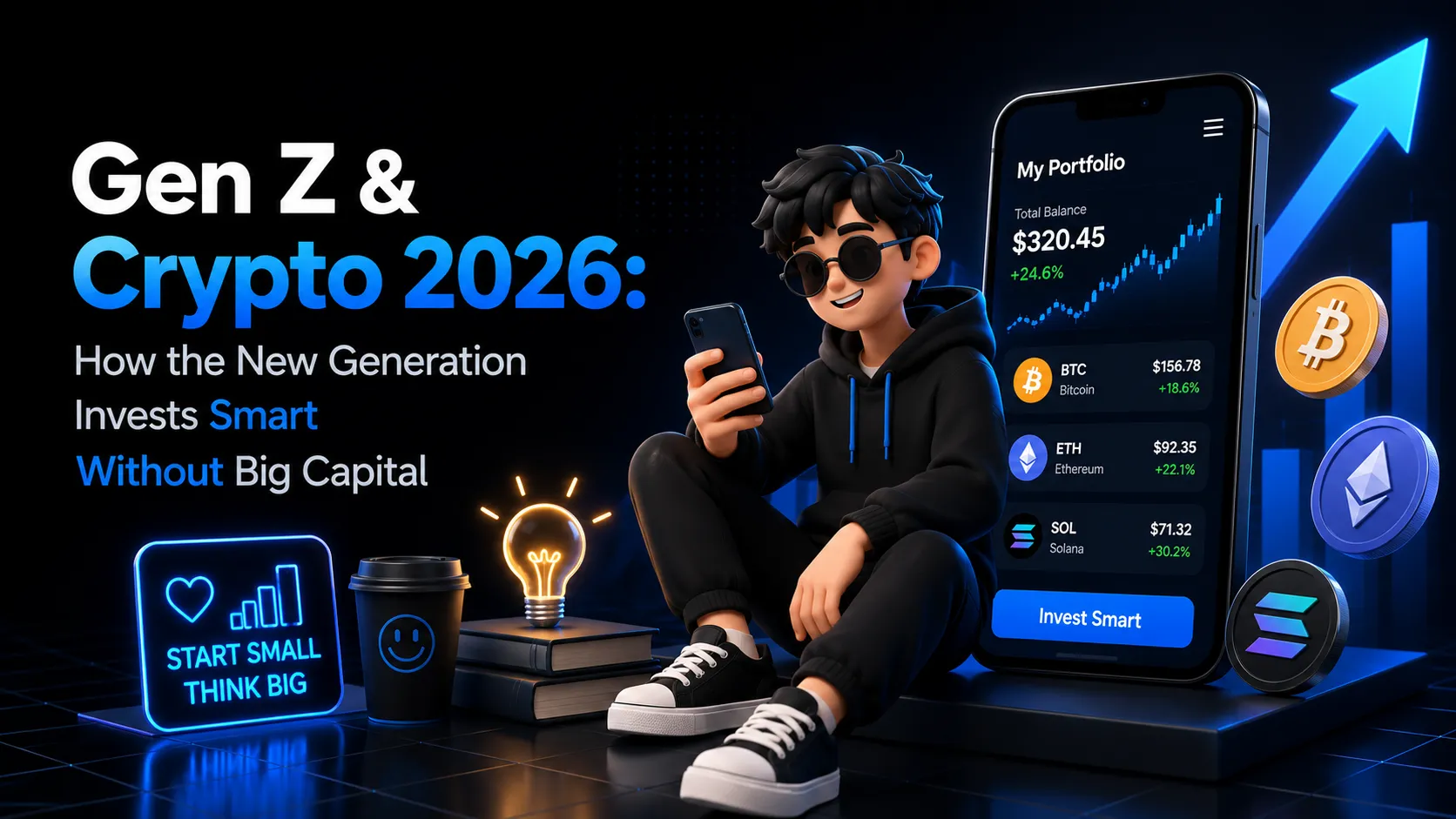
Gen Z & Crypto 2026: How the New Generation Invests Smart Without Big Capital
July 22, 2026
Gen Z Does Not Invest Like Their Parents — And That Is an Advantage
Generation Z (born 1997–2012) is becoming the newest and most distinctive investment force in financial history. They are the first generation to grow up entirely with smartphones, high-speed internet, and the idea that everything can be digitized — including money and assets.
But Gen Z also faces harsher economic realities than previous generations:
- Real estate prices rising far out of reach
- Starting salaries lower relative to living costs
- Traditional savings with real negative interest rates after inflation
The result: Gen Z is looking for different ways to invest — more flexible, starting smaller, not needing to "have enough capital" before beginning. Crypto and RWA tokens are not a trend for Gen Z — they are a practical adaptation strategy.
How Gen Z Thinks About Money Differently
5 Signature Gen Z Investment Mindsets
Mindset 1: "Start small, scale fast"
Gen Z does not wait until they have "enough money to invest." They start with $5, $10, $20 — learning by doing, scaling capital as understanding grows. This is why the $2 USDT minimum on ToVest is not "too small to bother" — for Gen Z, it is the ideal entry point.
Mindset 2: "Diversification is the default, not a choice"
Gen Z's parents bought one apartment, put money in a bank, done. Gen Z buys small fractions of many things: a bit of crypto, a bit of US stocks, a bit of gold, a bit of ETF. They instinctively understand never put all eggs in one basket.
Mindset 3: "Transparency = trust"
Gen Z grew up with Google, Reddit, TikTok — they can find information in 30 seconds. Any platform that is not transparent, has no real reviews, provides no audit evidence → they do not trust. This is why KYC and independent custody are non-negotiable requirements, not nice-to-haves.
Mindset 4: "24/7 or nothing"
Gen Z shops at 2am, streams movies at 3am, chats with friends at 4am. Stock markets closing at 4pm and resting on weekends? That sounds like a concept from the last century. Crypto and RWA tokens operating 24/7 is a natural fit with the Gen Z lifestyle.
Mindset 5: "Learn through real experience, not textbooks"
Gen Z does not read 500 pages about investing before starting. They invest $2, observe, learn from real outcomes, gradually scale. This is why being able to start with real $2 matters more than any free course.
Crypto For Gen Z in 2026: What Is Real, What Is Hype?
The Painful Lesson From the 2021 Cycle
Many Gen Z investors lived through 2021 with one of two scenarios:
Scenario A — Gained then lost: Bought SHIB, DOGE, random altcoins from Telegram/TikTok → gained x3, x5 → did not take profit → market reversed → lost all profits and principal.
Scenario B — FOMO'd at the top: Saw friends profiting, panic-bought at market peak → market reversed immediately → lost 60–80% → "crypto is all a scam."
The real lesson: The problem was not crypto. The problem was which type of crypto and when. Gen Z who understand this will approach the 2026 market completely differently.
How 2026 Crypto Differs From 2021
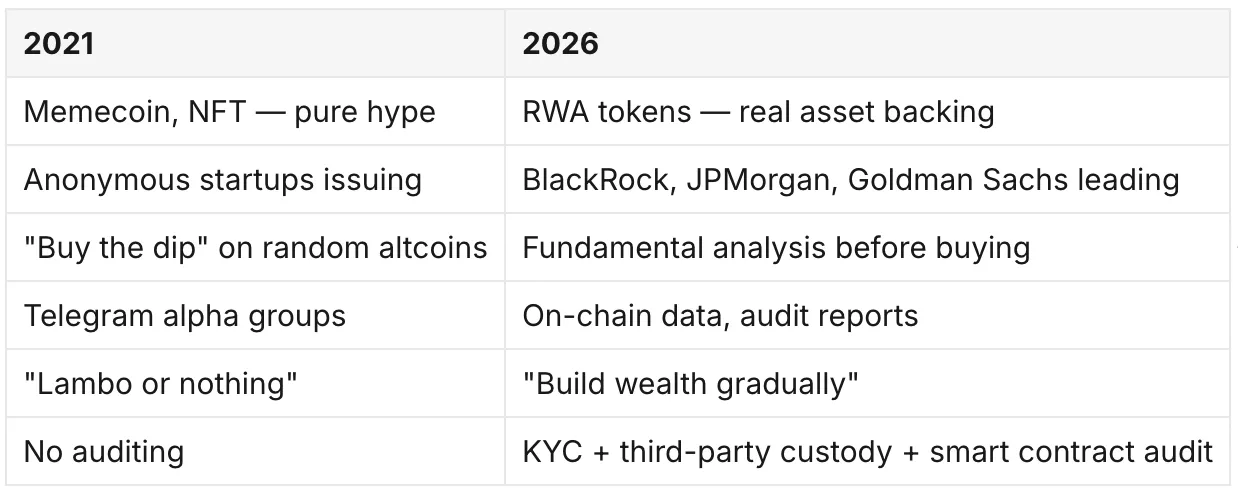
Gen Z 2026 is not Gen Z 2021. They have been through a complete market cycle — and those who remain have all learned their lessons.
What Is Crypto — Explained in Gen Z Language
Forget textbook definitions. Here is how to think about crypto Gen Z style:
The "3 Types of Crypto" Framework
Type 1: Speculative Crypto
→ SHIB, PEPE, random altcoins, memecoins
→ "Gambling, not investing"
→ Can go x100 but can also go to zero
→ Only use "fun money" — money whose loss would not affect your life
Type 2: Infrastructure Crypto
→ Bitcoin, Ethereum
→ "Stocks of the next-generation internet"
→ High volatility but real fundamentals
→ Suitable for 3–5 year long-term investment accepting 50% drawdowns
Type 3: Real Asset Crypto (RWA)
→ Gold tokens, Apple/NVIDIA stock tokens, commodity tokens
→ "Accessing real assets through new technology"
→ Price tracks physical assets — does not depend on hype
→ This is what smart Gen Z is choosing in 2026
Why RWA Tokens Are "Crypto for Pragmatists"
Gen Z 2026 does not want "get rich quick" — they want to gradually build real wealth in a context where real estate and traditional stocks are increasingly out of reach.
RWA tokens are the answer to: "How do I invest in something with real value, with small amounts, in a way that fits my life?"
- International gold from $2 USDT — no need to buy a whole tael at the jewelry shop
- Apple stock from $2 USDT — no Interactive Brokers account needed
- NVIDIA stock from $2 USDT — no US address required
- 24/7 trading — not restricted to NYSE hours
- USDT payment — no international bank required
How Do You Know If a Crypto Platform Is Trustworthy — Gen Z Checklist
Gen Z is not easily fooled. They research carefully before deciding. Here is the 6-point checklist Gen Z should apply:
✅ Good Signs
1. Mandatory KYC — but fast and clear process
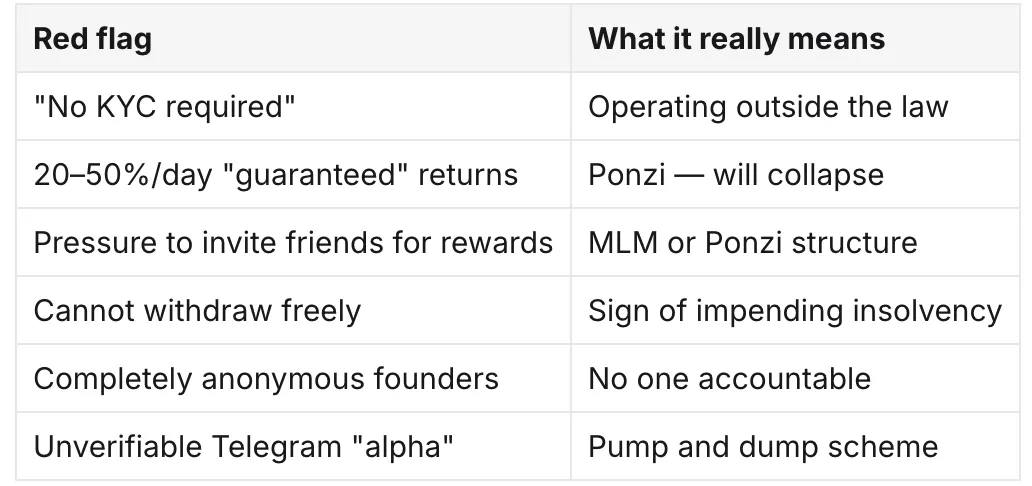
KYC (identity verification) signals the platform operates within a legal framework. "No KYC required" sounds like freedom but actually means no accountability when problems arise.
2. Free withdrawals, no hidden conditions
Simple test: Search "[platform name] + withdrawal" on Reddit or Twitter. Any reports of withdrawal problems → serious red flag.
3. Independent third-party asset custody
Your money must be held by an independent custodian — not in the company's own wallet. The FTX 2022 lesson: Sam Bankman-Fried used user funds to speculate → everything was lost.
4. Audited smart contracts
For blockchain platforms, the code managing your assets must be independently verified by a security firm (like CertiK). "We audited ourselves" = insufficient.
5. Team with public identities
Find founders on LinkedIn. Do they have a real track record? Completely anonymous platforms = risk.
6. No "guaranteed" profit promises
Any platform promising "5% profit per day guaranteed", "cannot lose", "auto profit" → close the tab immediately. 100% Ponzi.
🚩 Red Flags — Avoid
How Gen Z Invests USDT on ToVest
The "Core + Explore" Framework for Gen Z
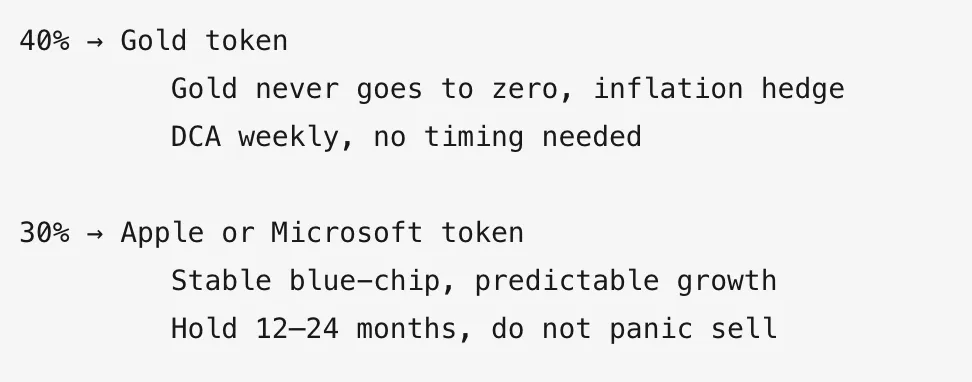
CORE (70–80% of capital) — Stable assets, no daily monitoring needed:
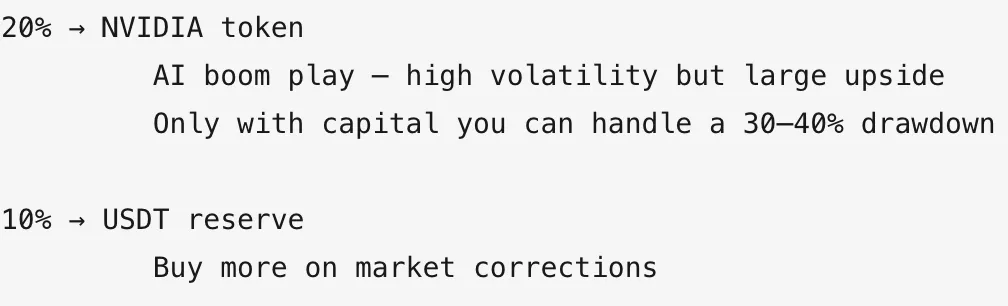
EXPLORE (20–30% of capital) — Higher risk assets, larger upside:
DCA By Schedule — No Market Timing Needed
Simple DCA setup:
- Every payday: set aside 10–20% into USDT
- Every first Monday of the month: buy $10–$20 gold token
- Every second Monday: buy $5–$10 NVIDIA token
- No need to check charts daily — DCA works best when you stop overthinking it
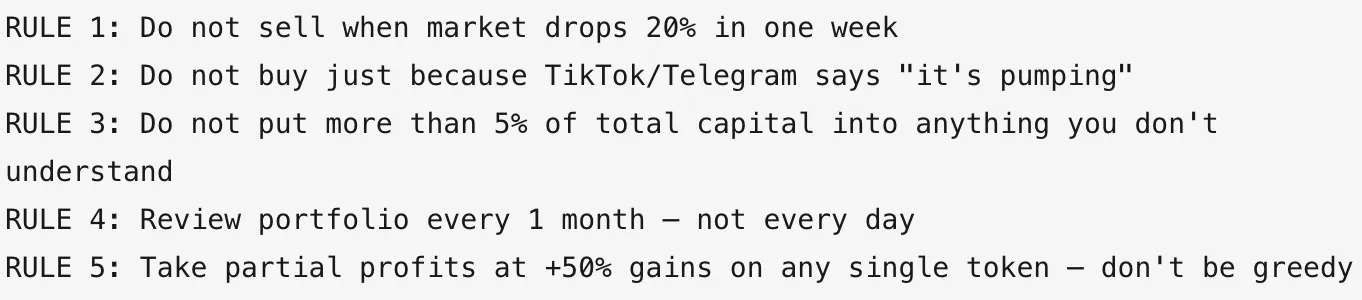
Hard Rules — No Emotion in Decisions
Real Example: University Student Starting With $20/Month
Month 1: Setup and Learn

Month 2–3: Add AI Stock

Month 6: Review
After 6 months DCA of $20/month = $120 USDT invested.
- If gold +5% → gold portion +5%
- If NVIDIA +20% → NVIDIA portion +20%
- If Apple +10% → Apple portion +10%
The result is not "getting rich quick." The result is you have built an investing habit, understand how markets work, and have a real portfolio growing with real assets. After 12–18 months when income increases, you have the knowledge foundation to responsibly scale your capital.
Gen Z and Gold Tokens — Not Just "For Grandparents"
Gen Z often thinks of gold as an "old generation" asset — stored in drawers, bought by the tael, not flexible.
Gold tokens in 2026 are something completely different:
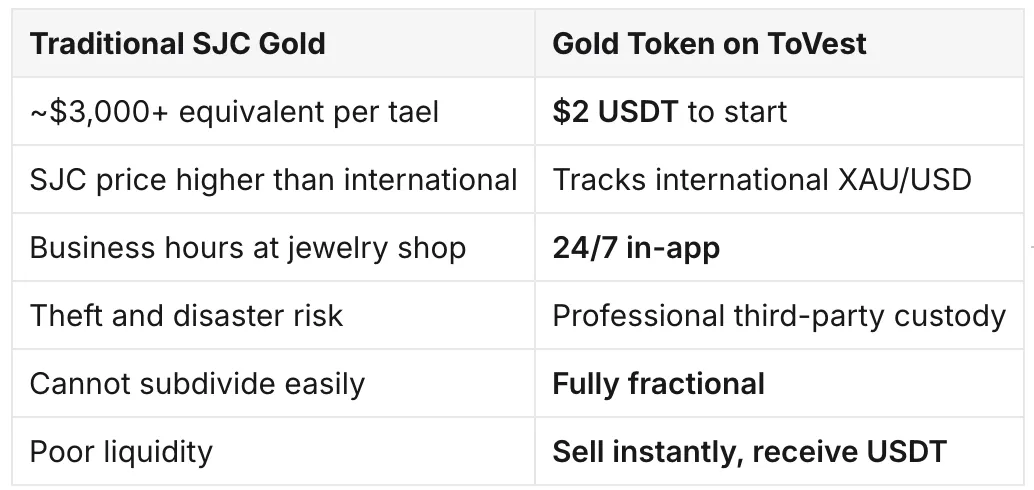
For Gen Z without $3,000+ to buy a whole tael of gold — gold tokens are the only way to access international gold prices in a genuinely flexible way.
And in 2026, gold is not "just for grandparents" anymore. Central banks of major powers are buying gold at record levels — over 1,000 tonnes per year. When the people managing national reserves are buying gold, perhaps Gen Z should have some in their portfolio too.
Why Major Institutions Invest in RWA — And What It Means for Gen Z
Gen Z lives in the information age — they know to "follow the smart money." And where is smart money in 2026?
BlackRock ($10 trillion AUM) launched BUIDL — a tokenized T-bill fund on Ethereum. Not a memecoin. Not an NFT. Tokenization of real assets.
JPMorgan processes billions in repo transactions daily via blockchain.
Franklin Templeton tokenized a money market fund across multiple blockchains.
When the world's largest financial institutions are building infrastructure on the same technology that ToVest uses to serve retail investors from $2 USDT — this is not a coincidence. This is validation that RWA tokenization is the direction of next-generation finance.
Gen Z is the first generation with the opportunity to access this technology layer early — before it becomes mainstream and before prices fully reflect that widespread adoption.
Frequently Asked Questions (FAQ)
Is crypto safe? I'm afraid of losing money.
Depends on the type. Speculative altcoins: not safe — most go to zero long-term. Bitcoin/Ethereum: high volatility but real fundamentals — suitable for long-term investors accepting volatility. RWA tokens (gold, stocks): safest in crypto — real asset backing, cannot go to zero. With $2 USDT on ToVest buying a gold token, the risk of total loss is near zero — gold never becomes worthless.
Do I need to know a lot about finance before starting?
No. But you need to understand 3 basics: (1) what you are buying and whether it has real value; (2) whether the platform you use is trustworthy (the 6-point checklist in this article); (3) how much volatility you can tolerate without panic selling. The rest you learn through practice with small capital.
Does starting with $2 have any point or is it too small?
$2 is absolutely meaningful — not because the profit from $2 is large, but because you are learning with real money. Every $2 you put in a gold token and watch move up when US CPI comes in higher than expected — that is one macroeconomics lesson no textbook can teach as effectively. Start small, learn fast, scale when you understand.
What is the difference between USDT, Bitcoin, and RWA tokens?
USDT = 1 digital US dollar, price-stable, used like money to buy other assets. Bitcoin = investment asset, price fluctuates 40–60%/year, not stable enough for daily use. RWA tokens = "Bitcoin's real-asset version" — blockchain infrastructure but price tracks gold/real stocks. Gen Z typically starts with USDT → uses it to buy RWA tokens on ToVest → this is the smartest approach.
How do I know which platform is trustworthy?
6-point checklist: mandatory KYC, free withdrawals without conditions, independent third-party custody, audited smart contracts, public team identity, no guaranteed return promises. Also: search "[platform name] + scam" or "[platform name] + review" on Reddit and Twitter before depositing.
Should I use leverage?
No — especially for Gen Z just starting out. Leverage amplifies both gains and losses. With 10x leverage, a 10% token drop → lose all capital. ToVest provides spot tokens (no leverage) — the most responsible way to begin.
When should I sell?
The best question Gen Z can ask. The answer: (1) When you genuinely need the money — not because the market is falling; (2) When the fundamental of the asset changes significantly; (3) When you need to rebalance to maintain your target allocation. Never sell just because you "fear it will fall more" — that is the guaranteed way to buy high and sell low.
What is ToVest and why choose it?
ToVest is an RWA investment platform — allowing purchase of gold tokens, US stock tokens (Apple, NVIDIA, Tesla...), commodities, and pre-IPO equity using USDT from $2, 24/7 trading, no international bank account required. Designed specifically for young Vietnamese and Southeast Asian investors wanting access to global assets at the lowest possible barrier to entry.
Final Words: Gen Z Has an Advantage Previous Generations Never Had
When Millennials started investing, they needed $500 to open a brokerage account, weeks of approval waiting, and could only trade during NYSE hours. Baby Boomers had to physically visit broker offices.
Gen Z in 2026 can:
- Open a ToVest account in 1 hour
- Start from $2 USDT
- Buy international gold tokens or Apple stock at 3am
- No US visa, no SSN, no international bank account needed
- Learn and scale gradually with minimum real-world risk
This is not "crypto get rich quick." This is next-generation financial technology that Gen Z is accessing earlier than any previous generation.
Gen Z's advantage is not having more money. The advantage is having more time and starting earlier — and in investing, time is the most valuable asset of all.
Start from $2 — no need to wait until you "have enough."
Open your ToVest account and start your next-generation investment journey at tovest.com. Gold tokens, US stocks, commodities — from $2 USDT, 24/7, no broker required.