Struggling to Find Stablecoin Returns? Follow This Proven 5‑Step Plan
January 29, 2026
Stablecoins are cryptocurrencies designed to hold a stable value by being backed or collateralized—often by the U.S. dollar or short‑term Treasuries—and they function as cash on chain. Demand keeps rising because they settle instantly, travel globally, and slot into portfolios as a liquid ballast. In high‑inflation markets, they’re already a real‑world spending tool; for example, stablecoin purchases in Turkey reached about $38 billion—4.3% of GDP—in the 12 months to March 2024, according to a BCG analysis. Yet many investors still struggle to turn that utility into consistent yields because rates shift, risks are uneven, and counterparties vary in quality. This guide lays out a research‑backed, five‑step plan to find the best stablecoin investment opportunities—and execute them with discipline. It reflects ToVest’s approach: stablecoin‑funded accounts, instant settlement, and diversified, tokenized access to U.S. stocks, ETFs, and real estate via resilient, transparent infrastructure.

Step 1 Define Objectives and Risk Controls for Stablecoin Investing
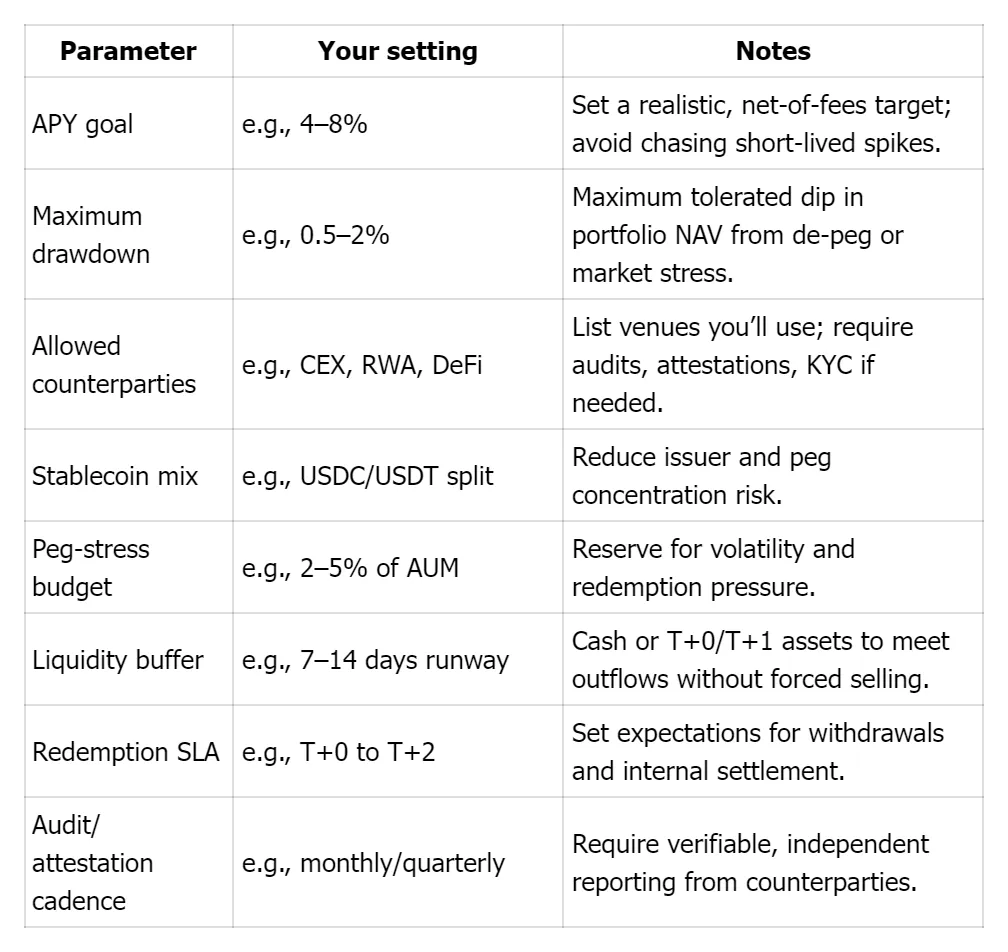
Before chasing yield, set your guardrails. Clarity on goals and risk controls drives every subsequent choice—what instruments you use, which counterparties you trust, how you size positions, and when you rebalance. Start by choosing a target APY, a maximum drawdown tolerance, and the set of counterparties (centralized exchanges, regulated custodians, and/or DeFi protocols) that fit your risk appetite.
Two concepts help formalize your safety net:
- Peg‑stress budget: the capital you earmark to manage and stabilize a stablecoin’s peg during volatility—via reserves, governance actions, or liquidity support. The Wharton Stablecoin Toolkit outlines common stabilization and redemption frameworks across designs.
- Use credible custodians and regulated venues: require current audits/attestations, clear redemption terms, and transparent reserve disclosures before you deploy.
Use the table below to codify your policy.
Step 2 Choose Stablecoin Instruments and Trusted Counterparties
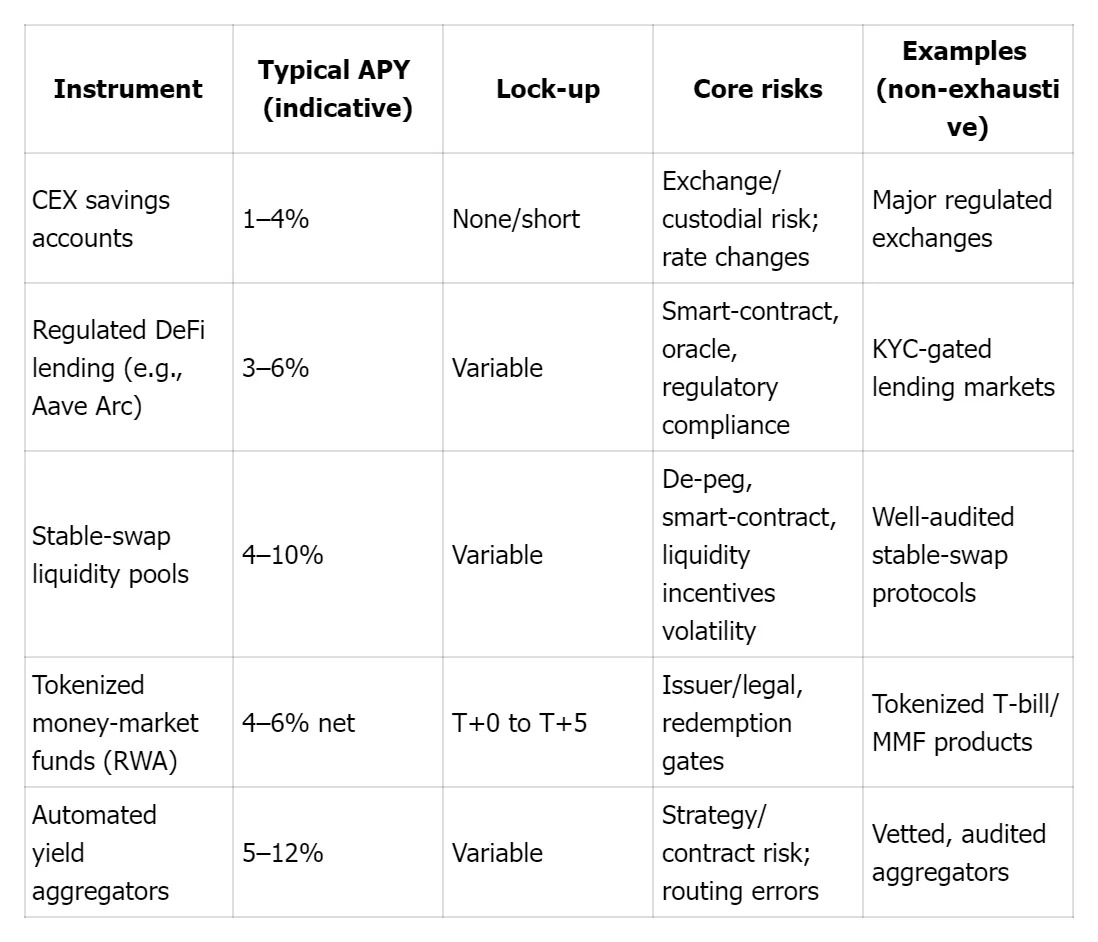
Once your policy is set, select the instruments that match it. Your menu typically includes CEX savings, regulated DeFi lending, stable‑swap liquidity pools, tokenized money‑market funds, and automated yield aggregators. Careful counterparty vetting—audits, reserve attestations, and transparent redemption policies—is non‑negotiable.
A yield aggregator is a platform that automatically routes and compounds funds across protocols to maximize net returns. For mechanics and risk considerations across staking and routing, see this practical overview of how to stake stablecoins.
Indicative comparisons (ranges vary by market conditions):
Notes:
- APYs are directional, not promises; always check current rates and fees.
- Prefer venues with independent audits, live reserve attestations, and clear legal redemption rights.
ToVest users can fund accounts with USDC or USDT, then route idle balances into diversified, pre‑vetted yield baskets aligned to the above policy, while maintaining 24/7 instant settlement into tokenized U.S. assets when opportunities arise. See how ToVest structures stablecoin‑funded accounts in our academy guide.
Step 3 Diversify Stablecoin Yield Strategies and On-Chain Exposure
Diversification smooths returns and limits single‑point failures. Combining money‑market lending, stable‑swap LPs, real‑world‑asset vaults, and automated aggregators helps balance yield, liquidity, and risk.
A tokenized money‑market fund is a digital wrapper around a traditional MMF, designed to mirror 1:1 value with underlying short‑term securities while enabling on‑chain transfers. The Wharton Stablecoin Toolkit explains structures and redemption mechanics across these RWAs.
Build your mix along three axes:
Strategy buckets
- Immediate liquidity (T+0/T+1): CEX savings, certain tokenized MMFs.
- Core income (1–7 days): DeFi lending markets with conservative LTVs; RWA vaults.
- Opportunistic (variable): Stable‑swap pools and aggregator‑routed incentives.
Protocol and chain diversity
- Spread across at least two audited protocols per bucket and multiple chains/L2s with reliable bridges.
Stablecoin issuers
- Hold a deliberate blend (e.g., USDC and USDT) to reduce issuer and peg risk.
Best practices:
- Cap exposure to any single protocol, issuer, or reward token.
- Avoid over‑reliance on incentive emissions; target organic yield sources.
- Rebalance on a schedule and after material risk events. An open‑source portfolio framework offers a practical approach to position sizing and rebalancing rules.
Step 4 Integrate Monitoring, Operations, and Liquidity Management Tools
Resilient yield comes from systems, not hope. Establish monitors, reporting, and liquidity processes so you can react quickly to market or peg shifts.
Core components:
Data and tracking
- On‑chain price feeds via Chainlink or Pyth; portfolio tracking with tools like CoinGecko or DeFi Llama; alerting on peg deviations and protocol incidents.
Stabilization wallet
- A dedicated, funded wallet to support peg stability and provide emergency liquidity during volatile periods; this construct is common in stablecoin operations.
Operational cadence
- Publish clear redemption/liquidity policies.
- Rebalance monthly, with exception triggers for risk events.
- Release a State of the Peg update: holdings summary, concentration metrics, settlement times, and any incidents.
- Automate alerts for pre‑set thresholds (e.g., ±30 bps peg deviation, TVL drawdowns, oracle anomalies).
Transparency and adoption
- List holdings with major portfolio and tax tools to reduce friction and improve trust.
Step 5 Operate with Discipline and Prove Stablecoin Strategy Reliability
Discipline turns a plan into a track record. Make reliability observable.
Actionable steps:
- Run periodic peg drills (simulated stress tests) to validate liquidity lines and decision playbooks.
- Publish settlement‑time and liquidity stats; quantify redemption SLAs and actuals.
- Align incentives with usage and volume, not idle TVL.
- Pursue credible audits and visibility on major data hubs (e.g., CoinGecko, CoinMarketCap) and wallet integrations (e.g., Trust Wallet) to reduce merchant/user hesitation.
Reliability checklist:
- Scheduled rebalances with public change logs.
- Observable wallet reserves and counterparties.
- Clearly documented refund and dispute flows.
- Visible, tested on/off‑ramp integrations.
- Incident response runbooks and post‑mortems.
Industry research underscores that diversified, transparent operations build resilience and user confidence, while chasing headline APYs from a single source tends to raise tail risks. A structured approach—like the one above—positions ToVest users to compound steadily while remaining liquid for tokenized investment opportunities across stocks, ETFs, and real estate.
Frequently Asked Questions
Why do stablecoins generally offer lower returns than traditional bank deposits?
Stablecoins often pay modest or no interest due to regulatory limits, full‑reserve designs, and how issuers structure redemptions versus lending‑based bank models.
How can I safely earn passive income with stablecoin investments?
Use regulated DeFi lending or tokenized money‑market funds and choose audited, transparent providers while managing de‑peg and counterparty risks.
What risks should I consider before investing stablecoins for yield?
Key risks include de‑pegging, counterparty failure, smart‑contract exploits, and withdrawal or redemption delays during stress.
How do regulatory changes impact stablecoin yield opportunities?
Rules can restrict interest payments and tighten disclosure, but they also improve transparency and legal redemption rights, shaping which yields remain viable.
How can a diversified approach improve stablecoin return stability?
Spreading across strategies, protocols, and issuers reduces the impact of any one underperformer or incident, smoothing month‑to‑month outcomes.