Earn Real Returns with Low-Cost Fractional Stock Apps for Beginners
December 18, 2025
Getting started with U.S. stocks no longer requires hundreds of dollars per trade or a steep learning curve. Today’s low-cost fractional stock apps let beginners buy small slices of popular companies—often with just $1 to $5—while keeping fees near zero. The “best” app is the one that pairs low costs with clear research tools and reliable fractional execution. Traditional brokers like Fidelity, Schwab, and Robinhood offer commission-free trades and simple fractional flows, while tokenized platforms like ToVest emphasize legally compliant, digitized U.S. stocks with 24/7 access and near-instant settlement. This guide explains how fractional shares work, how to pick a beginner-friendly app, and how ToVest streamlines buying fractional and tokenized U.S. stocks for real, repeatable returns.
Why Choose Fractional Stock Investing for Beginners
Fractional stock investing lets you start small and diversify early, rather than waiting to afford a full share of a high-priced stock. With fractional apps, you can buy into companies like Microsoft or Tesla with just a few dollars, lowering the barrier to entry and helping new investors put money to work right away. Fractional investing allows you to buy a portion of a stock or ETF share, so you can allocate small amounts across more investments and build a diversified portfolio. Many beginner-friendly apps advertise ultra-low minimums—often $1–$5—and streamlined onboarding, making the first step less intimidating and more accessible for anyone aiming to buy fractional U.S. stocks. For a sense of what to look for, see Bankrate’s roundup of beginner-friendly features, including low or no account minimums and strong educational tools (see Bankrate’s overview of the best investment apps for beginners).
Understanding Fractional Shares and Their Benefits
Fractional shares are partial shares of stocks or ETFs, allowing investors to put in any dollar amount regardless of full share price. That means you can invest $10 in a $1,000 stock and still capture proportional gains and dividends as the price moves.
Core benefits:
- Access to expensive names: invest as little as $1–$5 to start.
- Diversification on a budget: spread small sums across many holdings.
- Proportional dividends: owning 0.5 shares pays half the per-share dividend.
Bankrate’s guide to fractional shares details how these mechanics work, including dollar-based orders and proportional dividend handling.
Comparison at a glance:
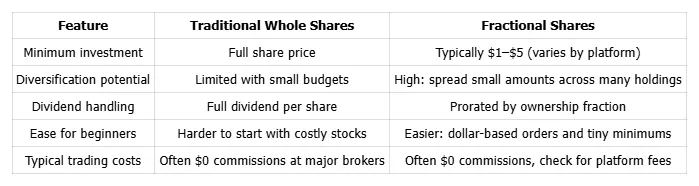
For fee and minimum norms, see Bankrate’s best brokers for fractional share investing.
How ToVest Simplifies Fractional Stock Investing
ToVest is a federally licensed, technology-driven platform that offers legally compliant fractional trading of digitized U.S. stocks across the U.S. and selected FATF-recognized countries. By issuing digitized representations of U.S. equities, ToVest enables 24/7 market access, near-instant settlement, and efficient cross-border participation—capabilities that go beyond the limited trading windows and settlement lags of traditional models. The platform emphasizes transparent legal processing, auditable records, and enhanced investor protections designed for global accessibility without compromising compliance. For deeper context on our approach, see ToVest’s latest market and infrastructure notes on our blog.
Step 1: Selecting the Best Low-Cost Fractional Stock App
Look for:
- Commission-free stock and ETF trades
- Low or $0 account minimums
- Intuitive mobile experience with strong education and research
- Clear fractional share support and order flow
Bankrate’s guide to beginner investment apps highlights brokers with these traits, while CNBC notes that most leading brokers now offer $0 commissions on U.S. stock and ETF trades. Fractional minimums are commonly $1–$5 at mainstream options such as Fidelity, Schwab, and Robinhood, as documented by Bankrate’s fractional share overview. If you invest primarily by phone, the independent Mobile Trading Guide from StockBrokers.com breaks down usability, stability, and feature depth across top apps.
Step 2: Setting Up and Funding Your Investment Account
Use this quick-start sequence:
- Download your chosen app or open the web platform.
- Complete onboarding and identity verification. Most brokers keep minimums low or $0, easing the first deposit burden (see Bankrate’s beginner app overview).
- Link a bank account or approved funding method. Many platforms allow you to start with $1–$5, so you can test-drive fractional orders without overcommitting.
- Optional: turn on two-factor authentication and set up account alerts.
For mobile-first investors, see the Mobile Trading Guide for practical setup tips and app-specific features that improve day-to-day use.
Step 3: Researching Stocks and Tokenized Fractions
Do some homework before you buy:
- Use in-app research hubs, screeners, and tutorials to compare companies and ETFs, as emphasized in Bankrate’s guide to beginner apps.
- Check real-time quotes, news, and performance dashboards—features common across top platforms and cited in CNBC’s review of brokers with free trading.
- Tokenized fractions refer to fractional ownership of stocks via secure digital tokens, enabling precise and low-cost investing in regulated environments like ToVest.
Build a short watchlist, note valuation or trend catalysts, and map each investment to a goal (growth, income, stability).
Step 4: Buying Fractional Shares on ToVest and Other Platforms
The buying flow is simple:
- Select a stock or ETF.
- Choose a dollar amount (for example, $10) instead of a share count.
- Preview the resulting fraction.
- Submit to confirm.
Traditional brokers now make this seamless; for example, Schwab’s Stock Slices lets users batch fractional purchases across multiple S&P 500 companies in a single order, a convenience echoed by other leading platforms (see CNBC’s overview of free-trading brokers). On ToVest, you can buy fractional, digitized U.S. stocks with 24/7 availability and near-instant settlement, then hold, sell, or reinvest just like with traditional assets.
Step 5: Monitoring and Managing Your Investments
Good habits boost outcomes:
- Review performance regularly against your goals.
- Rebalance periodically to maintain target allocations.
- Turn on price and news alerts to stay ahead of changes.
- Enable automatic dividend reinvestment when available to keep idle cash working.
Bankrate’s fractional share guide underscores that dividends and returns scale proportionally—so even small positions compound meaningfully when reinvested.
Suggested workflow:
- Weekly: skim alerts and news for your holdings.
- Monthly: add your planned contribution, DCA across targets.
- Quarterly: rebalance and reassess thesis and risk levels.
Step 6: Reinvesting Returns to Maximize Growth
Dividend reinvestment means using dividend payouts to automatically buy more fractional shares, accelerating overall portfolio growth. Many platforms offer DRIP to help compounding happen on autopilot; Bankrate notes that fractional systems prorate dividends exactly to your ownership share, which makes reinvestment clean and consistent. Combine DRIP with a steady contribution plan to layer compound growth over time.
Tips for Maximizing Real Returns with Fractional Shares
- Use dollar-cost averaging: invest a fixed amount on a schedule to smooth volatility.
- Diversify across sectors, styles, and market caps to reduce single-stock risk, a key advantage of fractional access highlighted in Bankrate’s fractional guide.
- Keep fees low: favor commission-free trades and avoid premium upsells you won’t use, as outlined in CNBC’s review of free-trading brokers.
- Start small, iterate fast: test strategies with $1–$5 positions before scaling.
- Automate good behaviors: set recurring deposits, DRIP, and alerts.
- Document your plan: define goals, risk limits, and your rebalance cadence.
Frequently Asked Questions
What Are Fractional Shares and How Do They Work?
Fractional shares are portions of a stock or ETF that let you invest any dollar amount instead of buying a full share; your gains and dividends scale with the fraction you own.
Are There Fees or Minimums to Start Fractional Investing?
Most leading apps offer commission-free stock and ETF trades with no or very low minimums, often $1–$5, though you should check for any account or premium fees.
How Can Beginners Earn Real Returns Using Fractional Shares?
By combining price appreciation, proportional dividends, and steady reinvestment, beginners can build wealth over time, especially with a disciplined contribution plan and the streamlined process offered by ToVest.
What Risks Should I Consider When Investing Fractionally?
You face normal market volatility, potential overtrading with small amounts, and platform dependency; fractional holdings move the same percentage as whole shares.
How Does Dollar-Cost Averaging Improve Investment Outcomes?
Regular, fixed-amount investing helps average out purchase prices over time, reducing the impact of short-term market swings.