7 Ways to Buy Stocks Directly Using USDT in 2026
5 มกราคม 2569
A growing number of investors hold Tether (USDT) as their “cash” in crypto and are seeking a direct path into equities. Can you buy stocks with USDT? In 2026, the answer is “yes, but with caveats.” Truly direct routes exist on a few tokenized-securities venues and select broker integrations; most other paths involve a quick off-ramp from USDT to fiat or using instruments that mimic stock exposure. Below, we map seven practical ways—from fully regulated tokenized shares to fast off-ramps—so you can choose the route that aligns with your need for genuine stock ownership, speed, and compliance.

Strategic Overview
Stablecoins already account for the majority of on-chain transaction volume, reflecting their role as settlement rail for crypto users moving into traditional assets, according to Chainalysis’ industry analysis. However, most mainstream brokers still don’t accept USDT natively, and many “tokenized stock” offerings are either limited in scope or are derivatives rather than actual shares. Notably, large exchanges that briefly offered tokenized stocks pulled back under regulatory pressure—Binance discontinued such products in 2021—so due diligence on what you’re actually buying is crucial.
Here are seven viable ways to transition from USDT to stocks in 2026, along with considerations for each.
- Regulated tokenized-securities exchanges that accept USDT
- What it is: Licensed venues listing tokenized securities and funds, featuring fiat-like KYC/AML standards. Some accept USDT funding and settle trades on-chain while maintaining off-chain registries.
- How it works: Open a verified account, deposit USDT, and subscribe to or trade eligible tokenized equities or funds. Bitfinex Securities, for example, supports USDT deposits and lists tokenized offerings in regulated jurisdictions.
- Ownership: Direct exposure to the issuer’s security (tokenized), subject to the venue’s terms and jurisdictional restrictions.
- Considerations: Limited listings compared to a traditional broker; often not available to U.S. persons; read offering documents carefully.
- On-chain tokenized public stocks via regulated DeFi wrapper
- What it is: Tokens that represent claims on real shares custodied by a licensed partner and issued under securities frameworks in the EU/UK. Trading typically occurs on-chain with whitelisted wallets.
- How it works: Complete KYC with the issuer/venue, then fund the wallet. If the venue uses USDC as base liquidity, you can swap USDT to USDC on-chain in seconds and proceed. Swarm has demonstrated tokenized access to names like Apple and Tesla under German oversight.
- Ownership: A token claim on underlying shares; check redemption, voting rights, and corporate action handling.
- Considerations: Jurisdiction- and asset-limited; wallet whitelisting required; ensure clarity on custody and redemption.
- Crypto-first brokers that let you convert USDT balances into real U.S. stocks
- What it is: Fintech brokerages that offer actual U.S. equities and allow you to fund or internally convert from crypto balances into stocks (region-dependent).
- How it works: Deposit USDT, convert within the platform’s wallet to USD or directly into equities, then place stock orders. ToVest, for instance, provides a seamless way to trade U.S. stocks and manage value across asset types within the app in supported markets.
- Ownership: Real fractional or whole shares via the broker’s custodian/clearing partner.
- Considerations: Geographic availability varies; spreads/conversion fees may apply; confirm whether USDT deposits are supported in your region and what asset-to-asset conversions cost.
- Stablecoin off-ramp to your bank, then fund a conventional broker
- What it is: A two-step route that preserves speed: convert USDT to USD on a crypto exchange, withdraw to your bank, then fund your regular brokerage.
- How it works: Use a reputable exchange that supports USDT deposits and fiat withdrawals (e.g., Kraken). Off-ramp USDT to USD and wire/ACH to your broker, then buy stocks as usual.
- Ownership: Full, direct stock ownership at your broker.
- Considerations: Adds one hop, but often the fastest across jurisdictions; compare withdrawal fees, FX, and transfer times.
- Primary offerings and security token issuances that accept USDT
- What it is: Issuers raising capital via compliant digital securities may accept USDT in primary sales (STOs), then list on regulated ATS/venues.
- How it works: Complete investor accreditation/eligibility (as required), subscribe with USDT, receive the equity token, and later trade on the venue if listed.
- Ownership: Direct security issued by the company/fund, tokenized.
- Considerations: Offering-by-offering diligence is essential (jurisdiction, disclosures, lockups, secondary liquidity).
- USDT-funded stock exposure via CFDs or perpetuals (not direct ownership)
- What it is: Derivative platforms and CFD brokers that accept USDT deposits and offer synthetic exposure to equities.
- How it works: Deposit USDT, trade stock-CFDs or perpetuals on margin. Some brokers support USDT deposits and provide stock-CFD markets.
- Ownership: No; you’re trading a derivative referencing the stock price.
- Considerations: Useful for short-term exposure or hedging; carries counterparty and leverage risk; not equivalent to owning shares (no voting rights/dividends unless synthetic adjustments).
- Use a crypto debit card funded by USDT to top up your brokerage
- What it is: Spend-from-crypto cards (Visa/Mastercard) convert USDT to fiat at the point of sale. Many brokers accept card top-ups.
- How it works: Load a crypto card (e.g., Bybit Card supports USDT) and fund your broker via card deposit; then purchase stocks normally.
- Ownership: Full, direct ownership at the receiving broker.
- Considerations: Card FX/spread fees can be higher than wires; card deposit limits and broker policies vary; confirm that your broker accepts card funding and doesn’t classify it as a cash advance.
Quick comparison
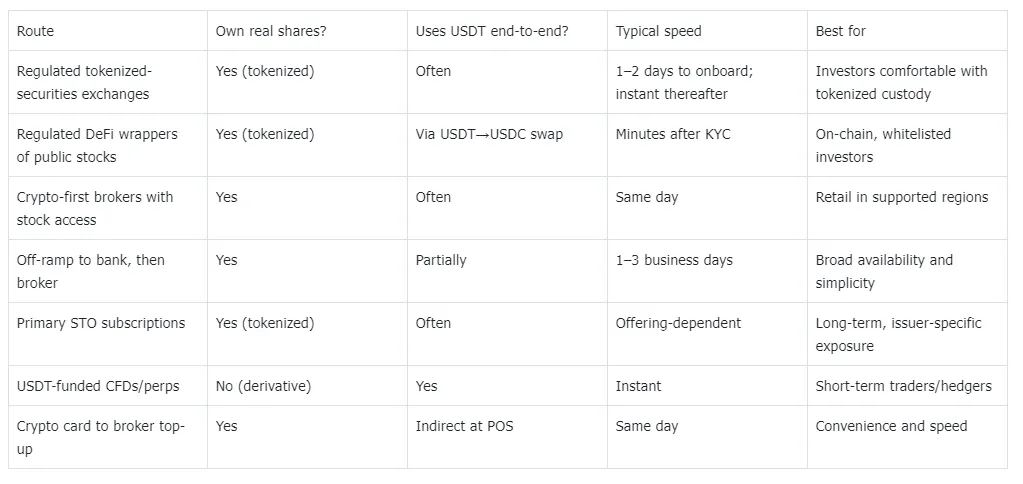
Practical tips before you move:
- Verify what you’re buying. “Tokenized stock” can mean a derivative, a depositary receipt, or a regulated security token. Check the legal wrapper, voting rights, dividends, and redemption policies. Binance’s 2021 exit from stock tokens underscores the regulatory scrutiny surrounding these products.
- Mind KYC/eligibility. Many direct routes may exclude U.S. persons or require accreditation.
- Compare total cost. Tally on/off-ramp fees, spreads, custody, and trading commissions—not just the conversion rate.
- Keep records. Brokerage statements, on-chain transaction hashes, and exchange receipts simplify tax reporting.