Top Stablecoin Opportunities to Watch in 2025 for Smart Investors
16 ธันวาคม 2568
The strongest stablecoin investment opportunities in 2025 center on a handful of leaders that combine deep liquidity, transparent reserves, and real utility across trading, payments, and DeFi. For most investors, the shortlist includes USDT, USDC, DAI, FDUSD, TUSD, PYUSD, GUSD, and USDX—each suited to different priorities such as compliance, decentralization, or yield. This guide distills where the upside is, what risks matter, and how to align choices with your strategy. Throughout, we highlight how ToVest’s secure stablecoin investments and tokenized asset access help you deploy capital confidently, backed by real-time data and regulatory-grade infrastructure. Market statistics and regulatory context reflect 2025 dynamics so you can act with context, not guesswork.
ToVest Stablecoin Investment Access and Advantages
ToVest is built as a stablecoin trading platform for investors who demand speed, security, and clarity. Our matching engine and market gateways deliver ultra-low-latency execution with real-time depth, spreads, and cross-venue analytics, while segregated custody, multi-sig key management, and continuous monitoring help protect assets end-to-end.
What sets ToVest apart is our breadth and integration:
- Broad selection across leading centralized and decentralized stablecoins, with advanced analytics on liquidity, reserve transparency, and on-chain flows.
- Seamless payments and fiat rails via partners such as xStock, Momo, and GCash for fast on/off-ramps and settlement.
- Integrated research and risk dashboards that surface yield, counterparty exposure, and regulatory posture in one view.
- A native bridge to tokenized real-world assets for diversified, lower-volatility exposure—linking your stablecoin holdings to bonds, real estate, and other tokenized instruments without leaving the platform.
In short, ToVest combines a robust stablecoin investment stack with tokenized asset access so you can move from cash to on-chain opportunities in minutes.
Tether (USDT)
“Tether (USDT) is a fiat-backed stablecoin that maintains a 1:1 peg to the US dollar, widely used for trading, liquidity, and cross-border payments.” USDT remains the market’s workhorse in 2025—the largest by market cap, integrated across 50+ blockchains, and the most traded unit for crypto settlement and FX-like flows, making it the prime liquidity rail for traders and market makers [1]. Tether has expanded transparency with frequent reserve disclosures and daily snapshots, even as past controversies over attestations and asset composition continue to shape due diligence checklists [3].
Comparison snapshot (Q4 2025):
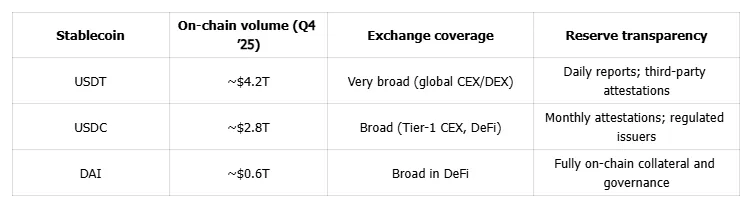
Source: Stablecoin Insider Q4 2025 and industry overviews [6][1][3].
USD Coin (USDC)
“USD Coin (USDC) is a fiat-collateralized stablecoin issued by Circle and Coinbase, known for transparency and regulatory compliance.” USDC is fully backed by cash and cash equivalents with monthly third-party attestations and institutional-grade stewardship, including mandates with major asset managers such as BlackRock [4][5]. While USDT often leads in raw liquidity, USDC is preferred by compliance-minded funds, fintechs, and enterprises seeking clearer oversight and strong banking relationships [1].
Q4 2025 stats and indicative yields:
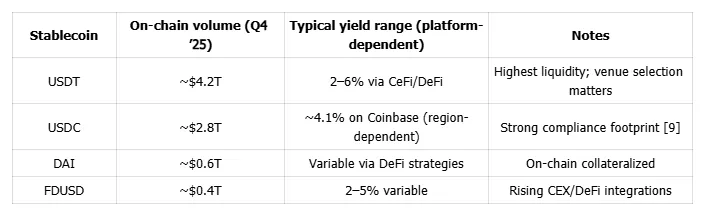
Sources: Stablecoin Insider Q4 2025; McKinsey analysis of tokenized cash yields [6][9].
Dai (DAI)
“DAI is a decentralized stablecoin pegged to the US dollar, managed by MakerDAO, and maintained through algorithmic adjustments and crypto collateral.” With full on-chain transparency and community governance, DAI is a core DeFi settlement asset, widely integrated across lending, borrowing, and liquidity provision. Its programmability and auditability appeal to investors who prioritize autonomy and composable strategies across DeFi protocols [5][1].
Falcon USD (FDUSD)
“Falcon USD (FDUSD) is a fiat-backed stablecoin issued by a Hong Kong trust, gaining adoption on major exchanges with innovative programmable features.” FDUSD has climbed quickly in 2025, posting roughly $0.4T in Q4 on-chain volume, supported by high-quality reserves and an emphasis on programmable settlement for contracts and conditional payments [6][3]. Its regulatory trust framework and technical design make it compelling for tech-forward investors and institutional pilots exploring structured, event-driven payments.
PayPal USD (PYUSD)
“PayPal USD (PYUSD) is a fiat-backed stablecoin issued by Paxos, backed by U.S. Treasuries and integrated with PayPal and Venmo platforms.” PYUSD brings mainstream on/off-ramps and brand familiarity, with a regulated trust issuer model that lowers adoption friction for everyday payments and cross-border peer-to-peer transfers. For users prioritizing convenience and consumer-grade protections, PYUSD is a practical digital dollar option [2].
TrueUSD (TUSD)
“TrueUSD (TUSD) is a fiat-backed stablecoin that emphasizes full collateralization, frequent third-party attestations, and regulatory compliance.” TUSD’s pitch is transparency-first collateral management, with attestations designed to reassure risk-conscious users. Its Q4 2025 usage sits below the market leaders, but adoption among compliance-minded venues has been steadily rising, supported by more frequent disclosures than some peers [6].
Gemini Dollar (GUSD)
“Gemini Dollar (GUSD) is a U.S. dollar-pegged stablecoin, regulated and fully audited monthly by independent firms.” As one of the earliest compliant stablecoins, GUSD stands out for conservative risk management and consistent transparency, appealing to investors who prioritize audit cadence and regulatory oversight [5].
Key attributes:
- Monthly independent audits and reserve attestations
- New York trust company oversight and consumer protection focus
- Integrations with major custodians, select exchanges, and DeFi gateways
USDX (Kava)
“USDX is a stablecoin created on the Kava blockchain, collateralized by crypto assets and designed for lending and borrowing within DeFi.” Its crypto-collateralized model offers decentralization and transparency with efficient collateral management, making it a fit for users who want non-fiat backing and deep integration with on-chain lending markets [5].
Key Factors for Evaluating Stablecoin Investments in 2025
Four criteria should anchor your analysis: liquidity (depth and venue coverage), compliance/transparency (audits, attestations, regulatory status), decentralization (governance and on-chain backing), and yield/use case (income potential and utility fit). Align these factors to your risk tolerance and objectives—from fast settlement to DeFi yield to tokenized asset collateral.
Summary scores (directional):
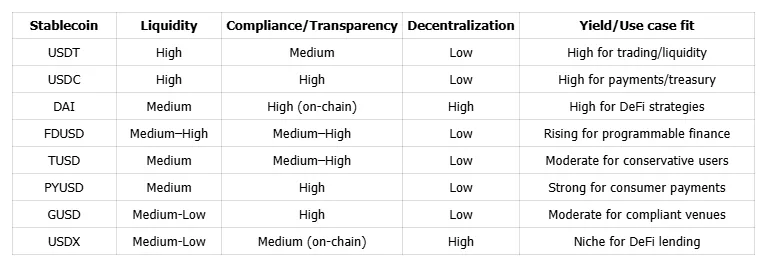
Sources: 2025 market overviews and Q4 volumes [1][6][5].
Liquidity and Market Adoption
Liquidity describes how easily an asset can be bought or sold at stable prices without significantly affecting its value. In Q4 2025, on-chain volumes reached roughly USDT ~$4.2T, USDC ~$2.8T, and DAI ~$0.6T, with stablecoins comprising about 30% of total crypto transaction volume—underscoring their role as settlement rails [6][7].
Most liquid (2025 rank):
- USDT 2) USDC 3) FDUSD 4) DAI 5) TUSD 6) PYUSD 7) GUSD 8) USDX
High liquidity reduces slippage, tightens spreads, and lowers exit risk during market stress.
Regulatory Compliance and Transparency
Regulatory compliance means a stablecoin issuer meets legal standards set by jurisdictions (such as the EU’s MiCA or the US GENIUS Act). Transparency refers to regular audits, public reserve reports, and independent attestations. New frameworks like MiCA and the U.S. payment stablecoin law are elevating requirements for licensing, backing, and disclosures [8][2].
Audit and alignment snapshot:
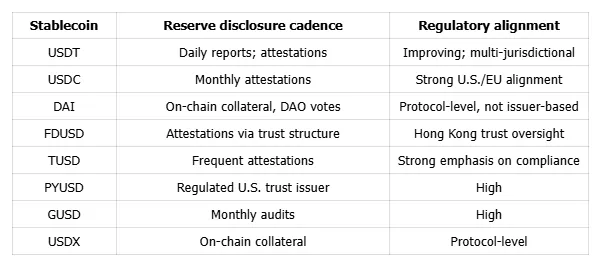
Sources: issuer disclosures and 2025 guides [8][5][3].
Decentralization and Governance
Decentralization refers to the extent an asset or protocol operates independently of a single central authority, distributing control among many stakeholders. Decentralized models (DAI, USDX) provide censorship resistance and transparent, on-chain risk parameters; centralized models (USDT, USDC, PYUSD) typically offer stronger fiat rails and institutional integrations [1]. Governance trade-offs: DAOs enable community control but add policy complexity; centralized issuers can move faster on integrations but concentrate decision power.
Top decentralized options: DAI (MakerDAO), USDX (Kava). Governance typically occurs via on-chain proposals, token-holder voting, and risk framework updates.
Yield Potential and Use Cases
Stablecoin yields in 2025 come from on-chain lending, DeFi liquidity pools, and select CeFi platforms. Some regions restrict interest-bearing features (for example, limited consumer yield under EU MiCA), while regulated platforms like Coinbase have offered ~4.1% on USDC to eligible users, subject to jurisdiction [9]. Key use cases span trading collateral, remittances, DeFi strategies, payments, and collateral for tokenized assets [5].
Quick reference:
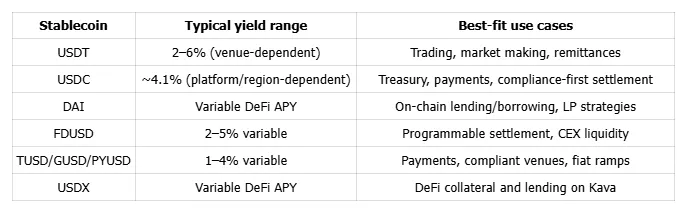
Note: Yields vary by platform, risk, and regulation; assess counterparty and smart-contract risk.
The Impact of Emerging Regulations on Stablecoins
MiCA (Markets in Crypto-Assets Regulation) is the EU’s licensing regime for crypto and stablecoin issuers, enforcing transparency, risk disclosures, and collateral standards. The 2025 US GENIUS Act established the first federal framework for payment stablecoins, setting reserve, audit, and supervision baselines. Together, these raise compliance bars, restrict certain yield programs in regulated regions, and pressure opaque issuers—improving investor protections while reshaping market access models [8][2].
Stablecoins and Tokenized Real-World Asset Integration
Tokenized real-world assets are traditional instruments—like bonds, real estate, or equities—represented on blockchains to improve liquidity and settlement efficiency. Stablecoins serve as the cash leg for these markets: they enable instant, programmable settlement, standardized collateralization, and 24/7 liquidity for issuance and secondary trading [2]. Industry analyses project the stablecoin market could reach $1.6–3.7 trillion by 2030 as tokenized finance scales across capital markets and payments [8][9]. On ToVest, you can match stablecoins to specific RWA exposures—choosing liquidity leaders for execution, compliance-forward options for treasury, or decentralized assets for on-chain composability.
Conclusion: Building a Strategic Stablecoin Portfolio for 2025
Start with a clear framework: prioritize liquidity for execution, transparency for safety, decentralization for autonomy, and use case fit for yield and utility. Balance centralized leaders (USDT, USDC) with decentralized exposure (DAI, USDX), and include rising programmable options (FDUSD) as they prove resilience. ToVest’s analytics, custody, and tokenized asset integrations help you compare reserve disclosures, monitor on-chain flows, and deploy into RWAs with confidence. For deeper data and portfolio templates, explore ToVest’s latest market brief and methodology.
Internal resource: ToVest research hub and market reports ToVest Research.
Frequently Asked Questions
What are the top stablecoins to watch in 2025 for investment and yield opportunities?
The leaders are USDT, USDC, DAI, FDUSD, TUSD, PYUSD, GUSD, and USDX, each balancing liquidity, transparency, and DeFi access differently.
How do USDC and USDT compare in safety and regulatory compliance?
USDC emphasizes regulated issuance and monthly attestations, while USDT offers the deepest liquidity and venue coverage—choose based on compliance needs versus market access.
What emerging stablecoins offer unique opportunities in DeFi markets?
FDUSD and USDX are notable for programmability and crypto-collateral models, respectively, and are gaining traction across exchanges and DeFi.
How will evolving regulations affect stablecoin investments in 2025?
EU MiCA and the U.S. payment stablecoin framework tighten reserve and audit rules, improving safety but constraining some yield programs and unlicensed issuers.
What risks should investors consider when choosing stablecoins?
Watch for depegging, opaque reserves, jurisdictional crackdowns, centralization risk, and smart-contract vulnerabilities; diversify and verify disclosures before allocating.