Commercial Aerospace Stocks Are Having a Moment — Here's How to Position Before the Window Closes
29 พฤษภาคม 2569
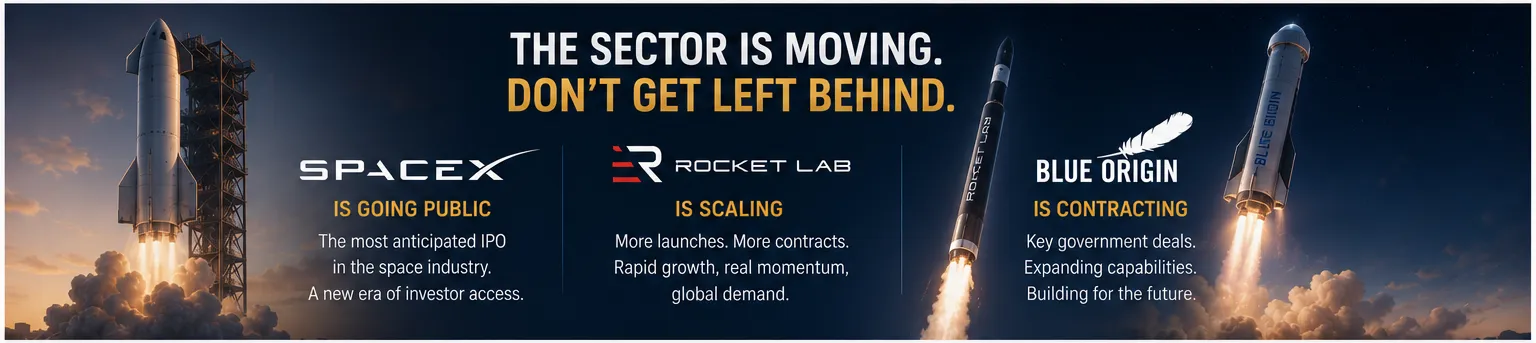
SpaceX is going public. Rocket Lab is scaling. Blue Origin is contracting. The sector is moving — and most retail investors are still watching from the sidelines.
The Sector Nobody Took Seriously Is Now Impossible to Ignore
Three years ago, commercial aerospace was a fringe bet. Today it is one of the fastest-moving sectors in global markets, driven by a collision of private capital, government contracts, and a space economy projected to exceed $1.8 trillion by 2035.
SpaceX filing for IPO under ticker SPCX — at a reported valuation between $1.75 and $2 trillion — is the headline. But SpaceX is not the only story. It is the loudest signal in a sector that has been quietly repricing for 18 months.
What Is Actually Moving in Commercial Aerospace Right Now
Launch frequency is at an all-time high. SpaceX alone conducted over 130 orbital launches in 2025 — more than every other launch provider on earth combined. Each successful launch is a data point that validates the sector's commercial viability at scale.
Government contracts are accelerating private players. NASA, the US Department of Defense, and allied space agencies across Europe and Asia are increasingly outsourcing to private operators. This creates recurring, predictable revenue streams for companies that traditional markets would otherwise price as pure speculation.
Satellite internet is becoming infrastructure. Starlink crossed 5 million subscribers in 2025. The implication for investors is straightforward: this is no longer a growth story — it is a recurring revenue story with global scale.
The Publicly Tradeable Aerospace Plays Available Now
While SPCX is not yet trading, the commercial aerospace sector already has liquid exposure points for investors who want to position ahead of the IPO wave:
Rocket Lab (RKLB) — The pure-play small satellite launch operator has pivoted successfully toward government contracts and satellite manufacturing. It is the most direct public proxy for the commercial launch market outside SpaceX.
Virgin Galactic / AST SpaceMobile (ASTS) — AST SpaceMobile is building direct-to-smartphone satellite connectivity, with commercial service launches already underway. One of the most watched names in the sector for 2025–2026.
Aerospace ETFs — Funds like ARKX and ITA provide diversified exposure to the broader sector, smoothing single-stock volatility for investors who want sector positioning without concentration risk.
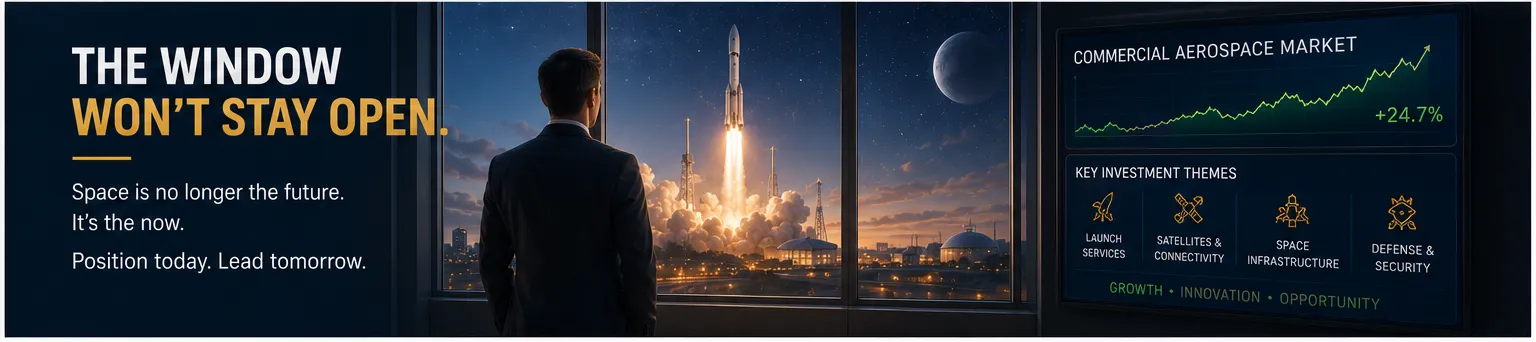
Why This Matters Specifically for SEA Investors
Access to US-listed aerospace stocks has historically required a US brokerage account, USD funding, and navigation of foreign investor regulations. For most retail investors in Vietnam, Indonesia, or Thailand, the practical friction has been enough to keep them out entirely.
Platforms offering zero-commission access to US stocks and ETFs — with KYC processes built for SEA users — are removing that friction layer precisely as the sector is hitting an inflection point.
The combination of timing and access is unusual. Commercial aerospace is not a sector that offers many second chances once a major catalyst — like the SPCX IPO — lands and prices everything forward.
The Honest Risk Assessment
Commercial aerospace carries real risk that any investor should understand clearly.
Launch failures remain consequential events. Regulatory timelines can shift. Valuation multiples in the sector are pricing in execution that has not yet occurred. SpaceX at a $1.75 trillion valuation is not cheap by any conventional metric.
But sectors rarely reprice on conventional metrics when the underlying technology is genuinely transformational. The question for investors is not whether commercial aerospace is risky — it is whether the risk-reward at current entry points, across the range of available instruments, is asymmetric enough to justify a position.
That is a calculation worth running before June 12.
For informational and educational purposes only. This article does not constitute financial advice. All investments carry risk including potential loss of capital.