Boost Portfolio Stability with Stablecoins: Proven Benefits for 2026 Investors
12 มกราคม 2569
Stablecoins can be a practical way to diversify your investment portfolio in 2026. As digital tokens designed to track real-world assets (most commonly the US dollar), they act like on-chain cash: low volatility, high liquidity, and near-instant settlement. With clearer global rules and institution-grade platforms, investors now use stablecoins to stabilize overall risk, move capital quickly between asset classes, and earn modest yields with transparent reserve backing. Below, we outline how stablecoins work, why adoption is rising, what risks remain, and how to build a stablecoin portfolio diversification strategy that complements both traditional and digital investments.

Understanding Stablecoins and Their Role in Portfolio Stability
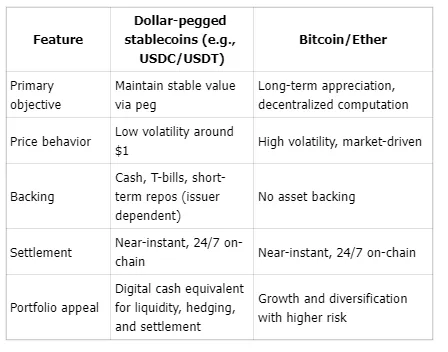
Stablecoins are digital assets that aim to maintain a stable value—typically pegged 1:1 to currencies like the U.S. dollar or to commodities such as gold. They function as a digital alternative to cash and traditional settlement rails while operating on public blockchains. Industry and policy research frames stablecoins as “digital cash” with programmable settlement properties and macro implications for payment systems and reserves, as discussed in the PGIM analysis on stablecoin policymaking (PGIM). In 2026, market norms and proposed rules emphasize 1:1 backing with high-quality liquid assets, regular disclosures, and stricter redemption standards—trends highlighted in the 2026 stablecoin trend analysis by Rich Turrin.
Stablecoins versus major cryptocurrencies
Why Investors Are Increasingly Using Stablecoins in 2026
Adoption has accelerated on both institutional and retail fronts. By late 2025, outstanding stablecoin supply approached roughly $300 billion, with monthly on-chain transactions around $1.1 trillion, according to the Grayscale 2026 digital asset outlook. That growth is reinforced by regulatory clarity (e.g., Europe’s MiCA and U.S. federal proposals), integration with payment rails, and the emergence of platforms offering compliance-grade custody, settlement, and reporting.
How investors are using stablecoins now:
- On-chain treasury operations: Treasury managers park liquidity in stablecoins for faster redeployment and hedging during volatility.
- Everyday spending via fintechs: Merchant payments settle faster and more affordably versus card networks in select corridors.
- Emerging markets: Households and businesses use dollar-pegged stablecoins to mitigate local inflation and currency risk, a dynamic increasingly noted in policy research (PGIM).
Key Benefits of Stablecoins for Portfolio Diversification and Risk Management
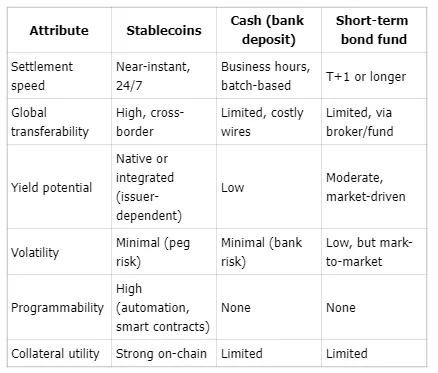
Using stablecoins as cash equivalents—or synthetic on-chain cash—lets investors settle trades instantly, reduce interim market exposure, and limit counterparty risk during transfers. In practical terms, stablecoins can buffer volatility when rebalancing between risk assets and serve as ready collateral for margin or derivatives hedging. The relative price stability of dollar-pegged tokens versus volatile crypto assets is well documented.
Stablecoins versus traditional hedges
Regulatory Landscape and Its Impact on Stablecoin Safety and Adoption
Two frameworks shape 2026 expectations: Europe’s MiCA (now live) and pending U.S. federal legislation often referenced as the GENIUS Act. Across jurisdictions, themes include 1:1 reserve requirements in high-quality liquid assets, stricter redemption windows, clearer disclosures, and regular attestations or audits. These measures should lower systemic risk, expand proof-of-reserves, and support wider institutional use while leaving issuer-level differences that investors must evaluate. For context on reserve quality and links to safe assets like Treasuries, see S&P Global research on stablecoins and Treasuries.
What improves vs. what to watch:
- What improves: Transparency, standardized disclosures, redemption clarity, stronger reserve quality, more regulated issuers.
- What to watch: Issuer domicile and legal protections, reserve composition (e.g., commercial paper or riskier assets), governance and profit incentives, regional rule differences.
How Stablecoins Enhance Liquidity and Execution Efficiency
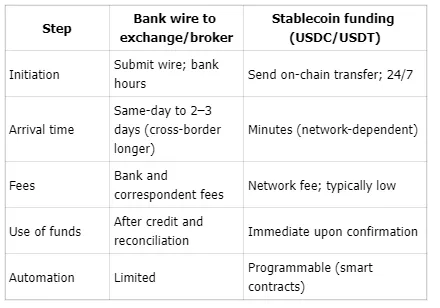
Stablecoins compress settlement from days to minutes, often at lower cost and with real-time finality. They reduce counterparty risk for trades awaiting cash arrival and enable pre-funding strategies without leaving idle capital at intermediaries. Grayscale highlights how programmable settlement and on-chain liquidity are reshaping institutional workflows as digital assets professionalize (Grayscale 2026 outlook).
Funding workflows compared
Integration trends you can use today:
- Tokenized money-market funds and repo pilots allow “on-chain cash” to earn T-bill-linked yields while remaining transferable (S&P Global).
- On platforms like ToVest, investors can fund accounts in USDT/USDC, purchase tokenized real-world assets, and settle instantly across markets—reducing slippage and operational friction.
Stablecoins and Yield Opportunities in the Evolving Digital Asset Ecosystem
Yield-bearing stablecoins are emerging as tokens that pass through underlying yields from short-term Treasuries, reverse repos, or curated on-chain lending. Analysts expect embedded-yield coins and related products to grow materially by 2026, with some forecasts projecting stablecoin market size to reach $1 trillion. Mechanisms and design choices vary, so investors should focus on reserve transparency, legal structure, redemption mechanics, and regulatory oversight. For a broader map of stablecoins, tokenized assets, and payment trends, see a16z crypto trends on stablecoins and tokenization.
Key risk considerations:
- Proof-of-reserves cadence and auditor quality
- Underlying asset mix (e.g., T-bills vs. riskier instruments)
- Jurisdiction, licensing, and investor protections
- Smart contract and platform risk for DeFi allocations
- Benchmark comparisons to money market funds and operational liquidity needs
Practical Considerations for Incorporating Stablecoins into Investment Portfolios
A disciplined approach helps you capture stablecoin benefits while managing issuer and operational risks.
Issuer due diligence checklist:
- Reserve composition: Confirm 1:1 backing in high-quality liquid assets.
- Domicile and licensing: Understand legal protections and redemption rights.
- Attestations/audits: Frequency, auditor credibility, and disclosure depth.
- Governance and concentration risks: Issuer revenues, counterparties, and risk limits.
- Track record through stress events (de-pegs, redemptions).
Common portfolio workflows:
- Fund accounts with USDC/USDT to stage liquidity for trades, rebalance tokenized assets, or move collateral between venues.
- Use stablecoins for cross-border transfers to reduce wire costs and delays, then convert as needed.
- On platforms like ToVest, stablecoins power instant settlement into tokenized treasuries, credit, and real-asset exposures—helping align cash, collateral, and execution.
Allocation ideas by objective:
- Liquidity sleeve: 2–10% as a cash-equivalent buffer for rebalancing and tactical buys.
- Trading operations: Flexible allocation sized to expected flows and margin needs.
- Yield sleeve: A capped portion in yield-bearing stablecoins or tokenized money market vehicles, calibrated to risk tolerance and compliance constraints.
Future Trends Shaping Stablecoin Use and Portfolio Design in 2026
A $1 trillion stablecoin market is increasingly plausible as institutional adoption, yield innovation, and regulated issuers scale (Yahoo Finance forecast). Banks are modernizing rails and exploring tokenized deposits and settlement pilots, which will tighten integration with existing financial infrastructure. Expect stablecoins to be embedded across B2B payments, collateral management, and on-chain cash operations.
Themes to watch:
- Central bank responses and the coexistence of CBDCs, tokenized deposits, and stablecoins.
- Embedded yield: Opportunity with added complexity in structure and disclosure.
- Stablecoins as digital cash alternatives for global, 24/7 liquidity and programmable finance.
Frequently Asked Questions
What are stablecoins and how do they contribute to portfolio stability?
Stablecoins are digital tokens pegged to assets like the U.S. dollar, designed to hold a stable value. They reduce volatility and provide liquid, on-chain cash for rebalancing and settlement.
How do stablecoins compare to traditional cash and money market instruments?
They offer fast, 24/7 settlement and programmable transfers like digital cash, with yield options similar to money market funds depending on structure and issuer.
What risks should investors be aware of when including stablecoins in their portfolio?
Key risks include issuer credit and governance, regulatory changes, reserve quality, smart contract risks, and potential de-pegging during stress.
What allocation strategies are recommended for stablecoins in diversified portfolios?
Many investors use a small, capped allocation as a liquid cash-equivalent sleeve or to support digital trading and collateral needs, sized to risk tolerance and use-case.
How do recent regulations influence the safety and use of stablecoins for investors?
New rules emphasize 1:1 high-quality reserves and better disclosures, improving safety and reliability while keeping issuer-level differences in risk profiles.