Why Traditional Brokers Fail Global Investors and How On-Chain Stocks Solve It
29 ธันวาคม 2568
Global investors encounter the same challenges with traditional brokers: domestic-first systems, slow settlements, and cross-border friction that make simple investing seem complex and costly. On-chain stocks—tokenized equities recorded and settled on a blockchain—replace this fragmentation with verifiable ownership, instant settlement, and borderless access. This article explains why legacy brokerage rails underserve international investors and how blockchain-verified, tokenized stocks provide a compliant, always-on alternative. In line with ToVest’s mission, we show how investors can invest in on-chain stocks with stablecoins, access fractional shares, and verify holdings in real time—avoiding the delays and hidden costs of outdated infrastructure.
Strategic Overview
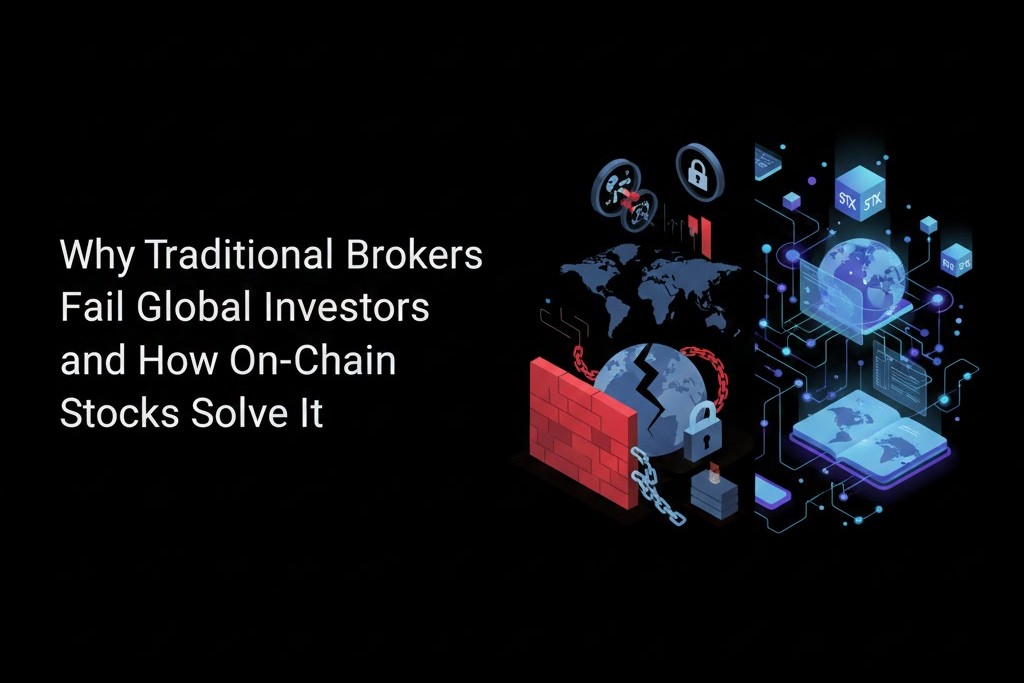
Traditional brokerages were built for domestic markets and limited trading windows, not for modern cross-border investing. By contrast, on-chain stocks are digital tokens that mirror underlying equities and are recorded on public blockchains, enabling real-time, verifiable ownership, programmable compliance, and 24/7 access. This shift turns fragmented processes into software, making liquidity, transparency, and global reach the defaults rather than the exceptions.
ToVest’s platform exemplifies this evolution: secure, regulated access to tokenized stocks with blockchain verification, stablecoin rails, and real-time market data—designed for borderless, cross-border investing.
Limitations of Traditional Brokers for Global Investors
Even sophisticated investors find legacy brokerage rails brittle when crossing borders. Common pain points include:
- Currencies and transfers: limited multi-currency support, slow wires, punitive FX spreads, and costly cross-border transfers.
- Country restrictions: service availability and product eligibility vary by location, often excluding non-residents.
- Convoluted onboarding: repetitive KYC/AML checks and documentary requirements across intermediaries.
- Hidden costs: custody, inactivity, wire, and conversion fees accumulate unpredictably.
- Legacy market infrastructure: systems designed for national markets, paper-era recordkeeping, and manual reconciliations that fail to address global, real-time needs. Industry analysis notes these rails were built around regional trading hours and centralized intermediaries, limiting speed and collateral reuse.
Structural Barriers in Legacy Market Infrastructure
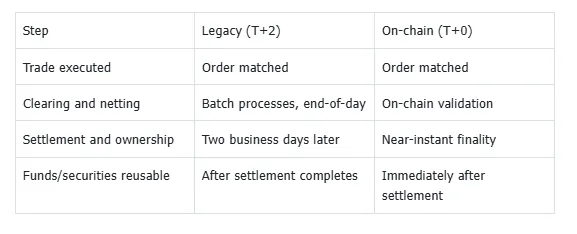
Settlement cycles—such as T+2—represent the lag between trade execution and final ownership transfer. T+2 means two business days to receive securities or proceeds, leaving capital idle and limiting agility. Add jurisdiction-specific rules, batch processing, and incompatible digital records, and cross-border flows become slow, expensive, and error-prone.
“Legacy settlement models cause latency, restricting collateral reuse and forcing excess liquidity buffers.” (GFMA, Deep Dives: Impact of DLT in Capital Markets)
These structural frictions explain why global investors face delays and operational risks even when using reputable brokers.
Key Pain Points for Cross-Border Investors
Recurring issues concentrate in five areas: market access, settlement delays, fees, custody opacity, and recordkeeping complexity. Here’s where they show up most.
Limited Market Access and Jurisdictional Restrictions
Jurisdictional restrictions are rules that limit which investors can access which products, based on residency and local securities law. Even when tokenized U.S. stocks exist, distribution can be restricted by cross-border compliance conflicts and differing regulations, as market primers on tokenization caution.
Slow Settlement and Illiquid Capital
When trades settle on T+2, capital is illiquid—locked and unavailable for reinvestment or risk management. As industry research highlights, legacy models create latency that forces excess buffers, dampening capital efficiency (GFMA).
A quick comparison:
High Intermediation and Transaction Costs
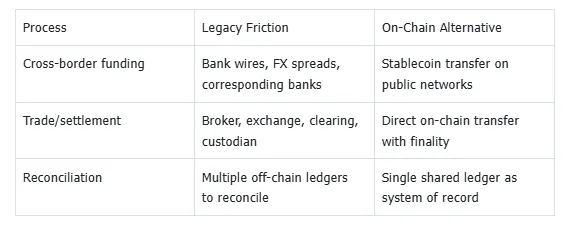
Multiple intermediaries—brokers, banks, custodians, correspondent networks—add fees and delays, especially for cross-border flows and FX conversions. Tokenization minimizes reliance on these middle layers and can lower transaction costs by streamlining issuance, transfer, and settlement processes.
Illustrative comparison:
Opaque Custody and Recordkeeping
Custody is the holding and safeguarding of assets; in legacy systems, it’s layered (custodian, sub-custodian, broker), complicating traceability. Public blockchains, by contrast, track token transfers and balances in real time, improving auditability and reducing reconciliation risk.
How On-Chain Stocks Address Global Investing Challenges
On-chain stocks are tokens representing shares, secured and managed on a blockchain ledger. They deliver:
- 24/7 access across time zones
- Near-instant settlement (T+0) and capital efficiency
- Programmable compliance (KYC/AML whitelisting, transfer restrictions)
- Global reach with stablecoin rails
- Transparent, auditable ownership
Tokenized stocks integrate traditional share ownership into the on-chain economy, enabling continuous availability and composability with modern finance. ToVest enhances this process with regulated access, institutional-grade security, and real-time data, making these advantages usable for both everyday and professional investors.
Advantages of On-Chain Stocks for Global Investors
24/7 Global Market Access
On-chain means the asset lives on a blockchain, not a venue tied to local market hours. This unlocks global access and continuous availability—advantages emphasized in leading education resources on tokenized equities (Chainlink). As a proof point, major venues have listed tokenized U.S. equities for around-the-clock access to blue chips and ETFs.
Near-Instant Settlement and Improved Liquidity
T+0 settlement minimizes counterparty exposure and allows investors to redeploy capital immediately. Industry primers note that blockchain rails enable real-time or near-real-time settlement, compressing post-trade risk and operations compared with legacy models (as discussed by GFMA and leading tokenization analyses).
Fractional Ownership and Lower Investment Minimums
Fractional ownership—buying a portion of a share—opens high-priced equities to more investors and supports diversified portfolios at lower minimums. Legal and market guides explain how tokenization enables fractionalization while reducing administrative overhead and fees in compliant structures.
Transparent and Auditable Ownership Records
Auditability is the ability to independently verify transactions and balances. Public blockchains provide that by design, offering a shared, time-stamped ledger that can align operations, risk, and compliance functions more efficiently than fragmented off-chain systems.
Blockchain Verification and Regulatory Compliance in On-Chain Stocks
Blockchain verification uses cryptography and consensus to confirm ownership, history, and valid transfers on a shared ledger. Regulation still governs the asset: a tokenized share remains a security, and securities rules apply regardless of the technology used.
Programmable compliance—like KYC/AML whitelisting and jurisdiction-aware transfer rules—helps platforms respect local laws while enhancing user experience. Policy leaders emphasize the need to align blockchain records with the legally enforceable system of record, often by integrating token registries with regulated transfer agents and custodians.
Investing in On-Chain Stocks Using Stablecoins
Stablecoins are cryptocurrencies pegged to traditional currencies (e.g., USDC, USDT), enabling fast, low-cost funding. A practical flow:
- Register with ToVest and complete KYC.
- Create or connect a compatible wallet.
- Deposit a supported stablecoin.
- Select the tokenized stock and review disclosures.
- Execute the purchase; ownership is recorded on-chain.
- Track holdings and export on-chain records for reporting.
Stablecoins reduce transfer costs, accelerate settlement, and minimize currency risk during funding and trading, making them an optimal rail for global investors. ToVest supports major stablecoins and transparent settlement on public networks.
The Role of Tokenization in Democratizing U.S. Stock and Real Estate Markets
Tokenization turns real-world assets into digital tokens that can be divided and traded on-chain. For U.S. equities and real estate, that means lower minimums, fractional ownership, and faster access—without sacrificing compliance. Legal and industry guides note that tokenized structures can reduce fees by automating transfer and recordkeeping, sometimes limiting charges to network gas instead of brokerage commissions in certain models. ToVest’s mission is to bridge traditional and on-chain markets so more investors can own quality assets with clarity and control.
Future Outlook: Hybrid Models and Regulatory Integration for Global Investors
The next phase is hybrid: regulated tokenized offerings, token ledgers integrated with legal transfer agents, standardized compliance “primitives,” and robust custody and recovery options. Leading industry bodies recommend piloting tokenized products while harmonizing records and investor protections across jurisdictions. ToVest is building for this future—combining regulatory rigor with on-chain speed—so global investors don’t have to choose between compliance and innovation.
Frequently Asked Questions
Where can I buy on-chain stocks with blockchain verification?
You can buy on-chain stocks on ToVest, which records ownership on-chain and verifies every transfer for transparent, global access.
What are the main advantages of buying stocks on-chain for global investors?
You benefit from 24/7 access, near-instant settlement, transparent ownership records, and fractional shares with fewer intermediaries and lower friction.
How do I invest in on-chain stocks using stablecoins?
Register on ToVest, deposit a supported stablecoin like USDC or USDT, choose your tokenized stock, and complete the on-chain purchase.
What regulatory protections exist for investors in tokenized stocks?
Protections include KYC/AML checks, integration with regulated custodians and transfer agents, and programmable controls aligned with securities laws.
How does settlement speed impact global portfolio efficiency?
Faster settlement frees capital immediately, improving reinvestment, withdrawals, and risk management without the delays associated with T+2.