How to Overcome Legal Barriers When Trading US Stock Tokens
29 ธันวาคม 2568
Trading US stock tokens promises 24/7 access, fractional ownership, and instant settlement, but the legal landscape is complex. Most tokenized shares are treated as securities, so you must use compliant platforms, pass KYC/AML checks, and trade on regulated venues. This guide explains the main legal barriers, how to navigate them step by step, and how ToVest streamlines compliant access for international investors. If you want to trade US stock tokens legally, focus on proper classification, registration or exemptions, programmable compliance in smart contracts, regulated custody, and secondary trading via licensed venues—then keep monitoring rules as they evolve.
Understanding Legal Challenges in US Stock Token Trading
Tokenized securities are digital representations of real-world financial instruments (like US equities) issued as blockchain tokens. Because they mirror economic rights of underlying stocks, they usually fall under US securities law—triggering disclosure, registration or exemption, and investor-protection obligations, as summarized in an InnReg overview of tokenized securities. Tokenized US stocks face three overlapping legal challenges: securities classification and registration, customer/transaction compliance (KYC/AML and transfer restrictions), and regulated secondary trading venues/custody.
These legal barriers for US stock tokens matter for everyone. Issuers must choose proper offering frameworks, embed transfer controls, and maintain regulated custody. International investors must verify platform licensing, pass identity checks, and ensure they're trading on compliant markets rather than synthetic or unregulated venues, as explained in CoinGecko’s primer on tokenized stocks.
Step 1: Assess Legal Classification and Compliance Risks
Classification comes first. The SEC often treats asset‑backed and equity‑like tokens as securities, which sets the bar for disclosures, investor eligibility, resale restrictions, and venue access, per InnReg’s compliance guide and Webisoft’s RWA tokenization overview. Start with a structured risk assessment:
- Scrutinize the issuer: background checks on directors and major shareholders, governance, past financial statements, forward projections, cash controls, and audit history, as outlined in RWA.io’s legal frameworks for tokenization.
- Map jurisdictions: assess where tokens will be offered and traded; identify licensing or exemption requirements in each market.
- Police market conduct: implement controls for insider trading, manipulation, conflicts of interest, and selective disclosure.
“Tokenized security” definition: A tokenized security is a blockchain-based instrument that confers economic or governance rights equivalent to a regulated financial asset, and is therefore subject to securities laws.
Step 2: Choose Entity Structure and Regulatory Registration
Treat legal structure as part of the product: “sustainable tokenization needs built‑in compliance”. Decide whether to register the offer or rely on exemptions that fit your audience and liquidity goals.
Common US pathways (illustrative only):
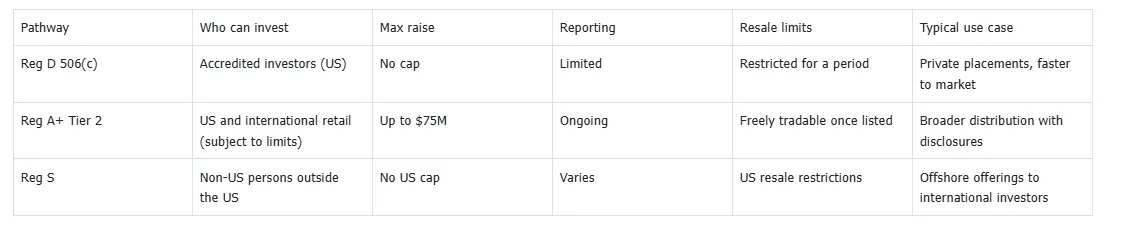
Sources: InnReg’s tokenized securities guide; LegalNodes’ stock tokenization legal guide; Webisoft’s RWA tokenization guide.
Whatever route you choose, prepare documentation that maps on‑chain rights to enforceable off‑chain claims: a clear whitepaper, subscription agreements, and (where applicable) a prospectus or offering circular, as recommended in Predict’s tokenization framework.
Step 3: Engage Specialized Legal Counsel and Obtain Opinions
Token projects require specialized legal expertise . Engage counsel early to:
- Classify the token, structure the entity, and select registration or exemption paths.
- Draft offering documents, transfer restrictions, and secondary trading rules.
- Manage US and international filings, disclosures, and cross‑border eligibility.
Definition: A legal opinion is a written assessment by qualified counsel that analyzes a token’s characteristics and concludes its likely legal classification and compliance pathway. A robust opinion reassures investors, exchanges, custodians, and regulators, and reduces execution risk.
Step 4: Develop Smart Contracts with Built-in Compliance Features
Smart contracts are self‑executing code on a blockchain that automatically enforces predefined rules when conditions are met. For tokenized securities, the code should reflect the legal terms of the offer and enforce eligibility, transfer, and holding restrictions consistently across all wallets and venues.
Build programmable compliance, drawing on standards highlighted by XBTO and LegalNodes:
- On‑chain allowlists and transfer hooks to enforce who can receive or trade.
- Accreditation and jurisdiction checks baked into transfer logic.
- Standards such as ERC‑3643 and on‑chain KYC attestations for interoperability and governance.
- Regular code audits and re‑audits after major releases or integrations to preserve security and compliance.
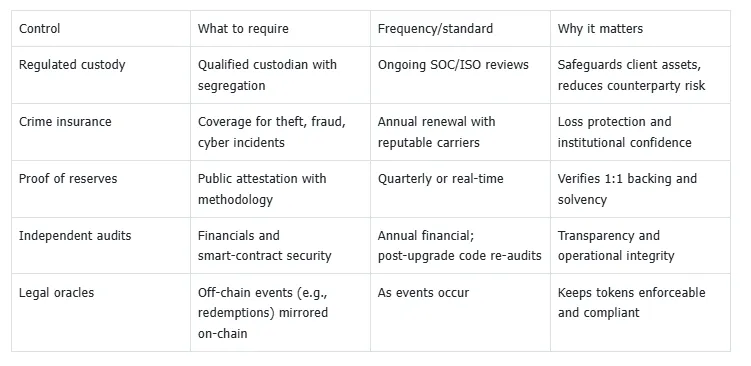
Step 5: Secure Regulated Custody, Insurance, and Proof of Reserves
Investors expect verifiable backing and professional safekeeping. Use regulated custodians, mandate independent audits, and publish proof‑of‑reserves attestations, as described by GrowthTurbine and XBTO.
Definition: Proof of reserves is a cryptographic or auditor‑verified attestation that the custodian holds assets equal to or exceeding outstanding token liabilities, typically paired with a transparent methodology and time‑stamping.
Plan for edge cases: key loss and token reissuance, legal oracles for redemptions or corporate actions, sanctioned‑address handling, and incident response.
Summary controls to implement:
Step 6: Access Compliant Secondary Trading Venues
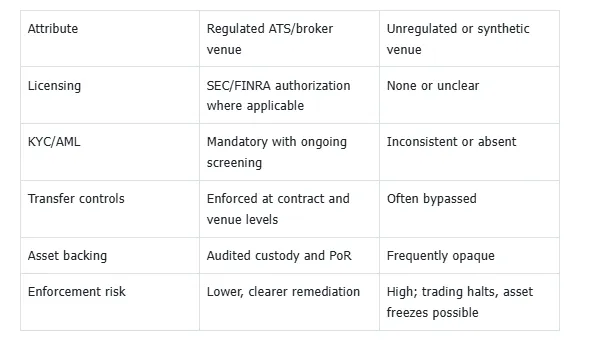
“Secondary trading of tokenized assets in the US usually requires an SEC‑regulated ATS (Alternative Trading System) or licensed venue”. Integrate transfer restrictions into your smart contracts so tokens can only settle on compliant US stock token platforms, and geofence jurisdictions as needed. Practical implementations increasingly limit trading to licensed partners; for example, support materials from ToVest discuss eligibility checks and jurisdictional restrictions for tokenized equities access.
Compliant vs. non‑compliant venues at a glance:
Step 7: Implement Ongoing Governance and Regulatory Monitoring
Compliance is not a one‑time task. Maintain governance that includes continuous KYC/AML screening, policy refreshes, incident drills, periodic re‑audits, and contract updates as regulations change.
Definition: Continuous regulatory monitoring is the systematic tracking of rule changes, enforcement trends, and licensing requirements across jurisdictions, with documented updates to policies, code, and disclosures.
Track major developments such as SEC actions and international regimes like MiCA, adjusting transfer logic, eligibility, and disclosures accordingly. Platforms like ToVest prioritize proactive oversight to safeguard investor access and asset integrity.
Getting Started with US Stock Token Investing on ToVest
ToVest provides compliant, cross‑border access to fractional US stock tokens with real‑time execution, institutional‑grade security, and built‑in safeguards. Here’s how to invest in US stock tokens on ToVest:
- Create your ToVest account and select your jurisdiction.
- Complete identity verification and AML screening.
- Link a bank account or deposit USD/stablecoins.
- Enable a secure digital wallet for custody and approvals.
- Browse supported US stock tokens with live market data and disclosures.
- Place market or limit orders; track positions and statements in real time.
ToVest’s infrastructure embeds transfer controls, regulated custody, audits, and proof‑of‑reserves to make compliant investing straightforward. Learn more on the ToVest homepage.
Selecting Legal and Compliant US Stock Token Platforms
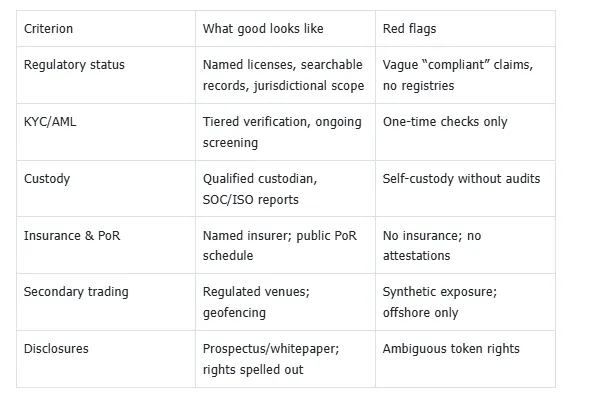
When comparing top US stock token platforms for international investors, evaluate legal readiness first:
- Licensing: broker‑dealer or ATS registration where required, plus clear cross‑border permissions.
- KYC/AML: robust onboarding, sanctions screening, and ongoing monitoring.
- Custody: qualified, segregated accounts; independent audits; crime insurance; proof of reserves.
- Smart‑contract controls: allowlists, transfer hooks, and recognized standards (e.g., ERC‑3643).
- Disclosure: clear mapping of token rights to underlying claims, fees, and risks.
Quick evaluation checklist:
Choose platforms that meet these standards to trade US stock tokens legally and confidently.
Frequently Asked Questions about Legal Barriers in US Stock Token Trading
Is it legal to trade tokenized US stocks as an international investor?
Legality depends on local rules and the platform’s licensing. ToVest aligns with applicable US and international securities regulations to support compliant global access.
What licenses do platforms need to legally offer US stock tokens?
They typically require broker‑dealer and/or ATS authorization and must enforce strong KYC/AML, custody, and disclosure controls.
Do US stock tokens count as securities under US law?
In most cases, yes; regulators treat them like traditional securities, so offering and trading must comply with securities rules.
What are the customer verification requirements for trading US stock tokens?
You can expect identity verification, sanctions screening, source-of-funds checks, and ongoing KYC/AML monitoring.
How are taxes applied to trades involving US stock tokens?
Tax treatment generally mirrors traditional equities, including capital gains and dividend reporting; consult a qualified tax advisor for your jurisdiction.