
3 ธันวาคม 2568

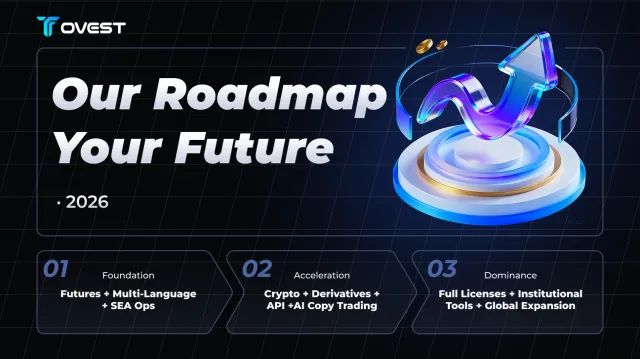
Tovest 2026 ROADMAP

Tovest Roadmap 2026: Pioneering the Fusion of Traditional Finance, Crypto, RWA, and AI Trading in Southeast Asia Tovest – The Ultimate All-in-One On-Chain Exchange Tovest, Binance for US Stocks + Tiger Brokers for Crypto + eToro for Web3 We are building the world’s first platform that truly combines tokenized US stocks, crypto, RWA, and AI trading — fully on-chain, fully compliant. 2025 Achievements V1 launched in months 10,000 users • $300M volume in 3 months US MSB license secured 2026 Targets 500,000 users $2B annual trading volume $500M TVL Top 3 digital asset exchange in Southeast Asia Backed by Tier-1 Partners Chainlink • Fireblocks • DBS Bank • Franklin Templeton Fully compliant with MiCA/FATF — own real Apple, Nvidia, Gold & Crypto from just 2 USDT. Q1 2026: Infrastructure for Multi-Asset On-Chain Trading (Foundation Building) Focus: Solidify RWA/US stock core while expanding to crypto and derivatives, ensuring seamless, low-latency trading. Q2 2026: Multi-Asset Integration & Liquidity Scaling (H1 Acceleration) Focus: Diversify to crypto, leverage, derivatives, options, indices, and AI copy trading; aggregate liquidity for institutional-grade depth. Q3-Q4 2026: Institutionalization & Product Diversification (H2 Dominance) Focus: Achieve full licensing, institutional tools, and global expansion to solidify Tovest as SEA's premier exchange. Vision for Tovest 2026: Empowering SEA's Next Generation of Investors In 2026, Tovest evolves from a RWA pioneer to SEA's top 3 comprehensive digital asset exchange, driving $2B annual volume and **500,000 users**. Our agile dev team—delivering features quarterly in just 3 months—ensures rapid iteration, backed by world-class partners like Chainlink, Fireblocks, DBS, and Franklin Templeton. This roadmap isn't just growth; it's a commitment to transparent, compliant innovation, unlocking global assets for Southeast Asia's youth with as little as 2 USDT.

blog banner

19 ธันวาคม 2568

Tokenized Stock Platforms Compared: Crypto‑Friendly vs Traditional Brokers

Introduction to Tokenized Stocks and Trading Platforms Tokenized stocks are blockchain-based digital assets that represent or track the price of traditional equities, enabling fractional ownership and alternative venues for trading around the clock. They’re gaining attention because they make global, low-minimum investing possible and can be bought with crypto, expanding access beyond conventional brokerage accounts. As tokenized asset platforms mature, investors are weighing crypto‑friendly options against traditional brokers to buy fractional U.S. stocks with crypto and to evaluate the best platform to buy fractional tokenized U.S. stocks. In short: tokenized stocks unwrap equities for blockchain stock trading, while brokers still dominate for regulated ownership and comprehensive investor protections. Understanding the differences helps you match tools to your goals, budget, and risk tolerance. How Tokenized Stock Platforms Differ from Traditional Brokers Traditional brokers and crypto‑friendly platforms solve different problems. Brokers focus on regulated access to stocks, ETFs, options, mutual funds, and bonds, with established custody and investor protections. In contrast, crypto platforms prioritize open access, speed, and 24/7 markets, adding tokenized assets and on‑chain transfers. A crypto broker is a financial intermediary that lets users buy and sell cryptocurrency and tokenized assets, often aggregating liquidity across venues and simplifying the trading experience. Research notes that traditional brokers mainly provide access to stocks, ETFs, options, mutual funds, and bonds, while crypto brokers offer a wider range of cryptocurrencies and enhanced liquidity, typically with fiat-to-crypto pairs as well (see this guide comparing traditional and crypto brokers). Comparison at a glance: Access: Brokerages route to national exchanges and ATSs; crypto platforms route to blockchain-based or synthetic markets. Asset type: Brokers offer direct securities; crypto platforms offer crypto, tokenized stocks (price-tracking or backed claims), stablecoins. Ownership: Brokers settle real shares in your name or street name; tokenized models may confer exposure rather than direct shareholder rights. Custody: Brokers use regulated custodians and clearing systems; crypto platforms rely on wallets and third‑party custodians or smart contracts. Oversight: Broker-dealers face stringent regulation; crypto platforms vary by jurisdiction and product. Key Features Comparison Asset Variety and Trading Access Traditional brokers mainly provide access to stocks, ETFs, options, mutual funds, and bonds, with many now supporting fractional share investing. Crypto brokers offer a wider range of cryptocurrencies and more liquidity than traditional brokers, often with fiat and stablecoin pairs, and increasingly list tokenized stocks (price‑tracking tokens that mirror equities). Where each shines: Traditional brokers: Fractional shares of many U.S. stocks and ETFs Full corporate actions processing Retirement accounts and portfolio tools Crypto‑friendly platforms: Tokenized stocks and global crypto markets On‑chain transfers and crypto funding 24/7 market access (tokenized assets may trade when exchanges are closed) For a sense of which brokerages support fractional shares, see this independent overview of fractional share brokers (StockBrokers.com). For tokenized stock basics and availability, see this explainer on tokenized stocks (DayTrading.com). Quick steps: how to buy tokenized stocks with crypto Choose a reputable tokenized asset platform, such as ToVest, with clear disclosures on backing and redemption. Complete KYC/AML and secure your wallet or platform account. Fund with crypto (or fiat), select the tokenized stock, and review fees/spreads. Confirm whether the token is price‑tracking or claims 1:1 backing; check redemption terms. Place your order, then monitor liquidity, premiums/discounts, and market hours. A beginner’s walkthrough is outlined in this guide to buying tokenized stocks (BingX Learn). User Experience and Interface Crypto brokers simplify access to digital assets for novices with easy interfaces and educational content, and are often ideal for beginners. Traditional brokers offer advanced tools like professional research, earnings reports, screeners, and even backtesting, which suit more experienced traders and long‑term planners (see the guide comparing traditional and crypto brokers). User interface definition: The user interface is the visual and interactive layer of a trading platform—menus, charts, order tickets, alerts, and educational modules—that shapes how you navigate the app, discover instruments, analyze data, manage risk, and execute trades quickly and accurately. Who’s best served Beginners: crypto platforms with tutorials, simple dashboards, and in‑app education Long‑term investors: traditional brokers with goal planning and retirement accounts Active traders: brokerages with direct routing, analytics, and API/automation Crypto‑native users: tokenized platforms with on‑chain settlement and wallets Trading Hours and Liquidity Tokenized stock platforms may offer 24/7 trading, while traditional brokers are limited to stock market hours with pre‑market and after‑hours sessions. Liquidity differs: crypto brokers provide a wider range of cryptocurrencies and enhanced liquidity compared to traditional brokers, but tokenized stocks can see thinner trading volumes than their underlying equities during off‑hours or on smaller venues (guide comparing traditional and crypto brokers). Liquidity is the ease of buying or selling an asset quickly without materially moving its price. Fees and Cost Structures Costs come from explicit commissions, spreads, and platform fees such as funding, withdrawal, or conversion charges. While many U.S. brokers moved to zero commissions, trades can still incur implicit costs via spreads. For example, Robinhood offers commission‑free crypto and stock trades but monetizes flow and can include spread markups (Bankrate on crypto broker fees). Typical costs to compare Commissions: per-trade fees (often $0 for U.S. stocks/ETFs on major brokers) Spreads: the difference between the bid (sell) and ask (buy) price—an implicit trading cost Funding/withdrawal: bank wires, crypto network fees, card fees FX/conversion: when moving between fiat currencies or crypto/stablecoins Custody/membership: occasional account or inactivity fees on certain platforms Illustrative fee comparison Traditional brokers: $0 stock/ETF commissions, tight spreads on listed markets, bank funding fees vary, limited or no crypto funding Crypto‑friendly platforms: typically no stock commission (if tokens), wider or variable spreads, crypto network fees, conversion costs between fiat/crypto Security and Regulatory Oversight Traditional brokers operate under stricter regulatory frameworks and often have robust security measures in place, including capital requirements, audits, and standardized customer asset protections; crypto brokers vary in security practices and regulatory coverage (guide comparing traditional and crypto brokers). Regulatory oversight is the set of monitoring, rules, and examinations by government agencies designed to protect investors and safeguard market integrity. Consider: Investor protections: SIPC for brokerage accounts (limits apply) vs. variable protections on crypto platforms Asset segregation: broker‑dealer customer segregation vs. platform‑level or on‑chain segregation Custody risk: exposure to exchange/custodian failure vs. insured/regulated custodians Operational security: 2FA, hardware security modules, cold storage, and incident transparency Pros and Cons of Crypto‑Friendly Tokenized Stock Platforms Pros User‑friendly interfaces suitable for novice investors and crypto‑native users Greater variety of cryptocurrencies; can fund and trade in crypto/stablecoins Often provide in‑app education and responsive customer support (guide comparing traditional and crypto brokers) 24/7 access and global participation Cons Potentially higher all‑in costs due to spreads, conversions, and network fees Less comprehensive equity research and advanced screening tools May lack direct share ownership, voting rights, or standard investor protections Liquidity in tokenized stocks can be uneven across venues At‑a‑glance Best for: global access, crypto funding, flexible hours, experimentation Mind the risks: counterparty/custody risk, premiums/discounts to underlying, regulatory differences Pros and Cons of Traditional Brokerage Platforms Pros Advanced tools, professional research, earnings calendars, and rich market data Direct ownership pathways, standardized corporate actions, and clearer tax reporting Strong regulatory frameworks and established investor protections Access to advisors, managed portfolios, and retirement accounts Cons Limited or no access to crypto and tokenized assets Trading hours tied to exchange sessions; fewer 24/7 options Interfaces can be complex for newcomers; funding in crypto is typically unavailable Use Cases: Which Platform Fits Different Investor Profiles? Beginners testing small amounts: crypto‑friendly platforms with simple UX and education Active traders seeking advanced analytics and order control: traditional brokers Global investors who want to buy fractional US stocks with crypto: tokenized platforms Long‑term planners optimizing taxes and retirement: traditional brokers Research‑driven stock pickers: traditional brokers with institutional‑grade data Crypto‑native users exploring real‑world assets: tokenized platforms and the best RE tokenization services for buying fractional US stocks with crypto Shoppers for the best platform to buy fractional tokenized U.S. stocks: choose platforms with transparent backing, audited reserves, and clear redemption terms ToVest’s Offering in Tokenized Real-World Assets and Fractional Stock Trading ToVest’s mission is to make real‑world assets—U.S. equities and institutional‑grade real estate—tradable on blockchain with low minimums and transparent market data. We combine tokenized access with low‑latency execution, granular analytics, and clear disclosures on how tokens track or represent the underlying. Security comes first: segregated custody, rigorous operational controls, and ongoing monitoring underpin our approach. For investors seeking reliable RE tokenization services for buying fractional US stocks with crypto, ToVest delivers an integrated experience: crypto funding, real‑time prices, and institutional-style reporting, all backed by a data-driven platform designed for clarity and speed. Explore education and research through the ToVest Academy for methodology, risk primers, and workflows built for both novices and pros. Conclusion: Choosing Between Crypto‑Friendly and Traditional Brokers for Tokenized Stocks Choose a crypto‑friendly tokenized platform if you value global access, 24/7 trading, and the ability to fund with crypto; pick a traditional broker if you prioritize advanced tools, direct ownership, and stronger regulatory protections. Many investors use both: brokerages for core holdings and tokenized platforms for flexible exposure and fractional experiments. ToVest fits investors who want modern, secure, and data‑driven tokenized stock trading without sacrificing clarity or performance. Align your choice with your goals, fee tolerance, and comfort with custody and regulation. Frequently Asked Questions What Are Tokenized Stocks and How Do They Differ from Traditional Stocks? Tokenized stocks are blockchain-based representations of equities that allow fractional, global trading; unlike brokerage shares, they may not grant full shareholder rights. Do Tokenized Stocks Provide Real Ownership and Voting Rights? Most tokenized stocks provide price exposure rather than direct share ownership, so voting rights and proxies typically aren’t included. How Secure and Regulated Are Tokenized Stock Platforms Compared to Traditional Brokers? Traditional brokers generally operate under stricter regulations and standardized investor protections; tokenized platforms vary by jurisdiction, product design, and custody model. Can Tokenized Stocks Be Traded 24/7 and How Does This Affect Pricing? Many tokenized platforms offer 24/7 trading, which can create premiums or discounts versus the underlying stock when exchanges are closed. How Are Dividends and Corporate Actions Handled on Tokenized Platforms? They’re distributed per the platform’s smart contracts or policies, but timing, eligibility, and withholding can differ from traditional brokers.

blog banner

29 ธันวาคม 2568

The Ultimate Guide to Building a Diversified Global Stock Portfolio

A diversified global stock portfolio spreads your equity exposure across countries, sectors, and company types to reduce single-market risk while capturing broader sources of return. By investing globally, you mitigate home-country shocks, smooth volatility, and participate in growth cycles that don’t move in lockstep. Institutional research consistently supports international diversification. Vanguard’s framework for globally diversified portfolios illustrates that combining U.S., developed ex-U.S., and emerging markets enhances risk-adjusted outcomes and counters common home bias tendencies that overweight local assets. Complementary guidance from Vanguard on the power of diversification confirms this conclusion for investors engaging in global multi-market investments. Together, these insights advocate for building a global stock portfolio with intentional international diversification. Setting Investment Goals and Constraints Clear goals and constraints anchor your global strategy. Define measurable objectives (such as retirement income or long-term capital growth), your time horizon, liquidity needs, tax status, and the drawdown you can realistically tolerate. Behavioral capacity matters as much as risk tolerance; staying invested through turbulence is essential, as highlighted in J.P. Morgan private bank case studies on resilient portfolios. Use a quick planning snapshot to keep decisions aligned: Establishing Strategic Asset Allocation Strategic asset allocation sets your long-run mix across stocks, bonds, and alternatives to balance growth with downside resilience. A market-cap–weighted global baseline (for instance, 50% global equities and 50% bonds) is a sensible starting point, consistent with Vanguard’s framework for globally diversified portfolios. Below are common models and where they fit: Evidence shows fees and allocation dominate long-run outcomes; keeping costs low meaningfully improves net returns. For additional context, see Russell global balanced portfolio for institutional allocations. Choosing Investment Vehicles for Global Exposure Investment vehicles are the instruments used to access markets: mutual funds, ETFs, index funds, tokenized securities, or direct stocks. For most investors, low-cost, broad-market index funds and ETFs deliver the best combination of diversification, liquidity, and cost control—fee drag compounds over time, eroding returns. Tokenized assets can further reduce frictions and enhance access via blockchain technology. Constructing a Diversified Equity Portfolio Diversifying across regions, sectors, and styles dampens country-specific and sector-specific drawdowns. Broad global equity index funds or tokenized equivalents deliver efficient breadth while allowing targeted tilts. Research suggests diversification reduces risk without materially sacrificing returns when implemented thoughtfully. Geographic Diversification Geographic diversification spreads equity exposure among the U.S., developed ex-U.S., and emerging markets to reduce home-country reliance. Investors often exhibit home bias—overweighting local assets relative to global market weights—potentially missing global growth. Practical pathways: Market-cap weight: Allocate in proportion to global market size (e.g., U.S., developed ex-U.S., emerging). Intentional tilts: Overweight regions with structural tailwinds or valuation discounts. Sector-led allocations: Use regional ETFs to balance sector concentrations (e.g., U.S. tech vs. international financials/industrials). Benchmarks include the S&P 500, MSCI ACWI ex USA, and MSCI Emerging Markets for scalable implementation aligned with global market structure. Sector and Style Diversification Sector diversification spreads exposure across industries such as technology, healthcare, energy, and financials. Investment style diversification blends factors like growth, value, quality, size, and low-volatility. History shows concentration hurts: during the dot-com bust, tech-heavy portfolios fell far more than well-diversified ones. Modest allocations to value or low-volatility can balance large-cap growth dominance, a tilt consistent with Goldman Sachs outlook on building robust portfolios. Indicative resilience across crises: Integrating Non-Equity Assets for Risk Management Non-equity assets include bonds, real estate, commodities, and alternative strategies that diversify equity risk. They historically cushion stock selloffs and can improve portfolio Sharpe ratios. In 2008, high-quality bonds rallied as stocks plunged, softening portfolio damage for balanced investors. Typical diversified portfolios hold 20–50% in non-equities depending on goals and risk tolerance. Fixed Income and Bonds Fixed income comprises government, corporate, and municipal bonds that pay periodic interest and return principal at maturity. Diversify across issuers and maturities to manage credit and duration risk. Bonds have historically added resilience in crises, stabilizing mixed portfolios. Sample bond mixes: Conservative: 70% government, 20% investment-grade corporate, 10% short-term/munis Moderate: 50% government, 30% investment-grade corporate, 20% short/intermediate Adventurous income: 40% government, 40% corporate (incl. some HY), 20% short/intermediate Real Estate Investment Trusts and Alternatives REITs are publicly traded vehicles owning income-producing real estate. Alternative assets include strategies or exposures with low correlation to core stocks/bonds (e.g., hedge strategies, infrastructure). Adding 5–15% to real assets or alternatives can enhance diversification and inflation sensitivity, especially when equities and bonds struggle simultaneously. Tokenized real estate can lower minimums and improve accessibility. Commodities and Private Markets Commodities (such as gold, energy, and industrial metals) and private markets (private equity, private credit) provide additional diversification and potential inflation hedging. Strategic allocations to commodities and alternatives can strengthen long-term portfolio resilience across regimes. Access via diversified commodity ETFs, listed private-market feeders, or compliant tokenized offerings where available. Leveraging Tokenized Stocks and Blockchain Technology Tokenized stocks are traditional securities represented as digital tokens on a blockchain, enabling fractional ownership, transparent settlement, and around-the-clock transferability. This structure can reduce intermediaries and costs while improving access. ToVest leverages tokenization to democratize U.S. equities and real estate with lower minimums, enhanced liquidity, and faster settlement, including stablecoin support for borderless trade and streamlined, real-time analytics via our Academy on tokenized investing. Multi-Currency Support and Managing Currency Risk Multi-currency support allows you to hold, fund, and trade in multiple currencies (including stablecoins), reducing frictions and potential conversion costs. Currency risk is the impact of exchange-rate moves on foreign asset returns; it can amplify or dampen performance. Platforms like ToVest enable fiat or crypto rails, helping you diversify funding and reduce local-currency concentration. Consider hedging when currency swings threaten near-term goals or liabilities. For example: Platforms and Apps for Global Stock Investing Global stock investing platforms provide access to international markets, multi-currency funding, fractional shares, and robust security. Compare fees, market reach, multi-currency features, and custody. ToVest adds a blockchain-powered layer for tokenized equities and real estate with crypto settlement and real-time transparency. Look for: Broad market access (U.S., developed, emerging) Fractional investing and low minimums Competitive pricing and FX rates Multi-currency balances and hedging tools Strong security, investor protections, and clear disclosures ToVest: Tokenized Stock Platform with Multi-Currency and Crypto Support ToVest enables global investors to buy fractional shares of U.S. stocks and real estate using fiat or stablecoins, combining multi-currency accounts, fast settlement, and blockchain-based transparency. Integrated analytics, portfolio insights, and guardrails support disciplined, cross-border diversification—all with cost-efficiency and regulatory safeguards designed for global users. Other Leading Global Investing Apps with Multi-Currency Features Several established brokers and apps offer deep international access with multi-currency capabilities and competitive FX. Interactive Brokers delivers extensive market coverage and multi-currency balances. For broader comparisons, see best brokers for international trading and Investopedia’s best online brokers. Many mainstream apps have also improved usability and features. Platforms Allowing Global Stock Investment via Cryptocurrency Crypto-enabled investing typically works in two ways: using crypto (often stablecoins) for funding and settlement at a broker or acquiring tokenized stock exposures directly on compliant platforms. The appeal is faster, lower-friction cross-border transactions and fractional access. ToVest supports stablecoin funding and tokenized equities under a compliant framework. Interactive Brokers integrates regulated crypto trading alongside global markets, aiding a unified workflow. Popular crypto apps facilitate digital asset funding rails, though they may not offer equities directly . Investors should assess regulatory posture, custody, and disclosure when using tokenized or crypto-funded routes. Comparison of onboarding and settlement: Portfolio Monitoring, Rebalancing, and Stress Testing Portfolio rebalancing is the systematic process of restoring target weights after market moves. Stress testing simulates adverse scenarios (e.g., recessions, rate shocks) to gauge resilience and refine allocations. A disciplined schedule—calendar-based (e.g., annually) or threshold-based (e.g., 20% drift)—anchors risk management, supported by evidence that rules-based rebalancing improves consistency. ToVest’s analytics and benchmarking help you visualize exposures, drifts, and factor tilts in real time. A simple workflow: Review objectives, constraints, and cash flows quarterly. Check allocations and drift vs. targets; rebalance if thresholds are breached. Run stress tests across rate, inflation, credit, and equity-shock scenarios. Evaluate fees, FX costs, and taxes; seek reductions where possible. Document changes; avoid ad-hoc shifts driven by headlines. Practical Examples of Global Portfolio Models Below are reference models used by practitioners and institutions. Use them as a starting point, then tailor to your goals and risk capacity. Many endowments and multi-asset funds adopt similar diversification, utilizing private markets, real estate, and alternatives to dampen equity reliance, as illustrated in J.P. Morgan private bank case studies. Common Risks and Implementation Challenges Expect and plan for real-world frictions: currency volatility, political instability, regulatory and tax complexity, and the persistent pull of home bias. Define each risk, set limits, and implement mitigants—from currency hedges to regional caps—before markets stress-test your plan. Diversification research shows portfolios that spread risks are more likely to maintain return targets through stress without excessive drawdowns. Currency and Political Risks Currency risk is the impact of exchange-rate moves on returns; political risk arises from policy shifts, capital controls, or geopolitical shocks. Use diversified country exposure, prudent hedging, and multi-currency platforms to manage these risks, supported by both academic guidance and practitioner case studies. Regulatory and Tax Considerations Withholding tax is tax taken at source on dividends; capital gains tax applies to profits from sales; regulatory risk involves rule changes that affect access or costs. Understand reporting requirements for foreign income, local restrictions, and broker documentation. Platforms with cross-border support and clear tax reporting can simplify compliance. Avoiding Over-Concentration and Behavioral Pitfalls Over-concentration is excessive exposure to one country, sector, or style; behavioral pitfalls include performance chasing and panic selling. Evidence on home bias and diversification underscores the need for guardrails. Common mistakes to avoid: Overweighting home market beyond global cap weights Chasing last year’s winners; abandoning a sound plan after losses Ignoring currency, sector, or factor concentration Letting fees, FX, and taxes compound unchecked Skipping rebalancing or stress testing A quick checklist: Target weights documented? Drift thresholds set? FX policy (hedged/unhedged) defined by goal horizon? Sector/style exposures reviewed quarterly? Costs (expense ratios, FX, commissions) monitored? Behavior plan: rules for add/reduce during volatility? Frequently Asked Questions What is a diversified global stock portfolio and why is it important? A diversified global stock portfolio holds equities across many countries and sectors to reduce reliance on any single market while improving the odds of steadier, long-term growth. How should I determine my asset allocation based on risk tolerance and time horizon? Match your mix to your goals, ability to endure drawdowns, and time horizon; younger investors often favor higher equity weights, while shorter horizons call for more bonds and cash. What percentage of my portfolio should be allocated to U.S., international, and emerging markets? Start with global market-cap weights and adjust for your risk tolerance, income needs, and local economic exposure. How often should I rebalance my global portfolio? Rebalance annually or when allocations drift materially from targets to keep risk aligned with your plan. Should I include alternative assets like real estate or crypto in my global stock portfolio? A modest allocation to alternatives such as real estate or crypto can add diversification if sized prudently and aligned with your risk profile.

blog banner
ToVest