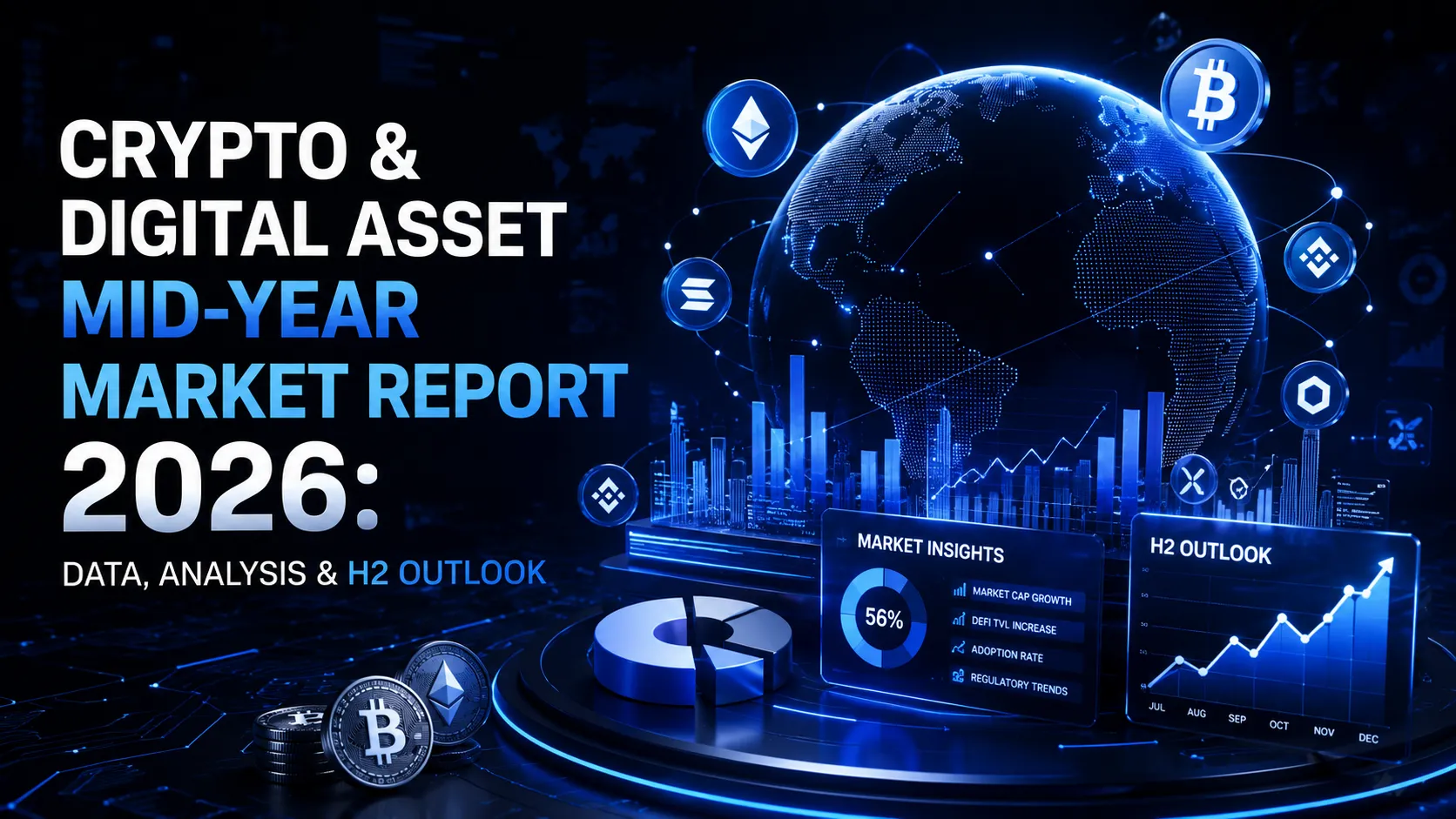
Crypto & Digital Asset Mid-Year Market Report 2026: Data, Analysis & H2 Outlook
July 20, 2026
Executive Summary
The crypto market at the midpoint of 2026 is in a state that has no direct historical precedent: simultaneously maturing institutionally, continuing to grow at the retail level, and expanding into real-world assets (RWA) in ways nobody predicted three years ago.
The Most Important Numbers — Mid-Year 2026
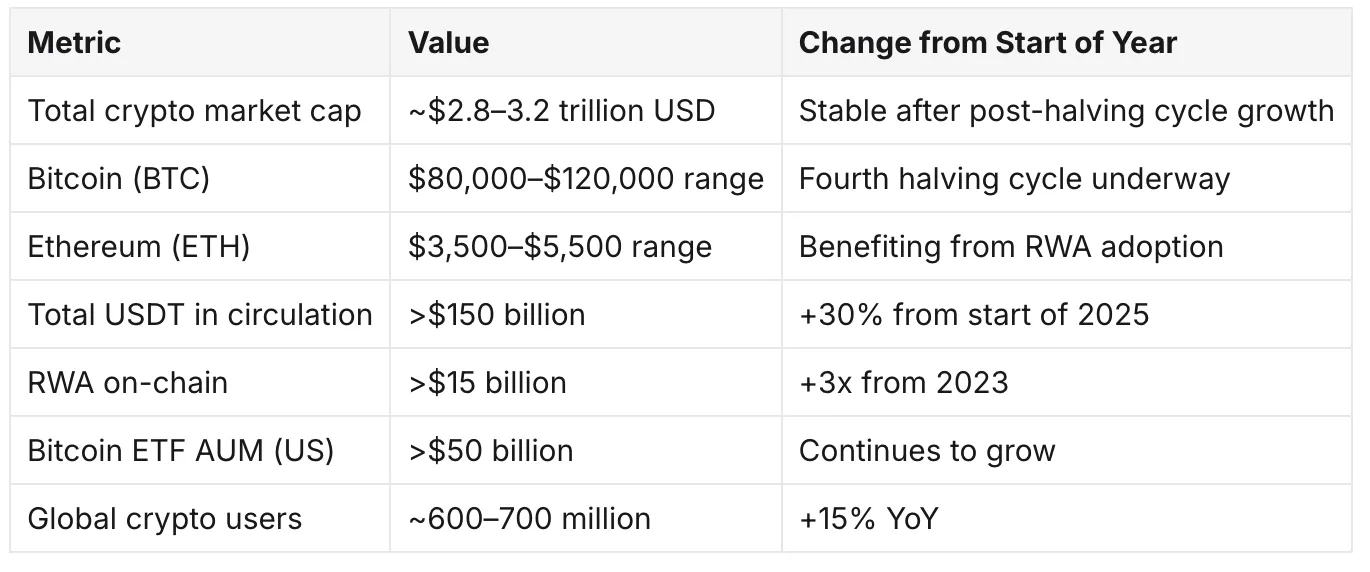
Note: Crypto market data fluctuates continuously. Numbers above reflect mid-2026 trend ranges and may change significantly. Always verify real-time data before making investment decisions.
Section 1: Bitcoin — Post-Halving Dynamics and the ETF Era
The Fourth Halving Cycle — Tracking Historical Patterns
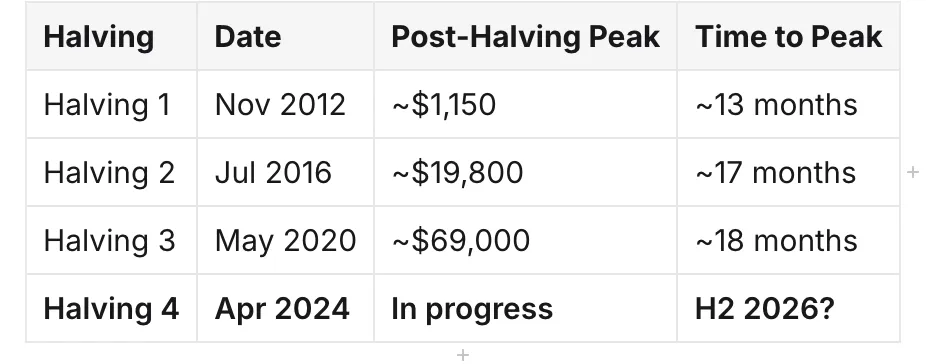
Bitcoin's April 2024 halving reduced the mining reward from 6.25 to 3.125 BTC per block — an event occurring every ~4 years. History across three prior cycles shows bull markets typically peak 12–18 months after the halving.
Historical halving cycle data:
Bitcoin ETF — A Structural Market Change
Bitcoin ETFs approved in the US in early 2024 permanently changed the structure of Bitcoin demand:
Before ETF: Institutions wanting Bitcoin exposure needed self-custody or complex products → high barriers.
After ETF: Pension funds, insurance companies, endowment funds can buy Bitcoin through an ETF like buying any stock → barriers near zero.
Real impacts:
- ETF inflows create structural demand — not short-term speculation
- Every day ETFs attract new capital, every day they must buy more BTC → continuous demand pressure
- Post-halving Bitcoin supply fell to ~450 new BTC/day — ETFs alone can absorb more than that
This is the biggest difference between the 2026 cycle and every previous cycle: Bitcoin has never before simultaneously experienced a halving AND institutional ETF flows.
Section 2: Ethereum — The Backbone of the RWA Era
Ethereum Is Becoming the Primary RWA Blockchain
A trend underappreciated in mainstream coverage: Ethereum is emerging as the backbone of the global RWA market.
The largest RWA products globally run on Ethereum:
- BlackRock BUIDL fund → Ethereum
- Franklin Templeton FOBXX → Ethereum (and Stellar, Polygon)
- Ondo Finance tokenized T-bills → Ethereum
- JPMorgan Onyx → Ethereum-based
Ethereum Staking — 4–5% Annual Passive Income
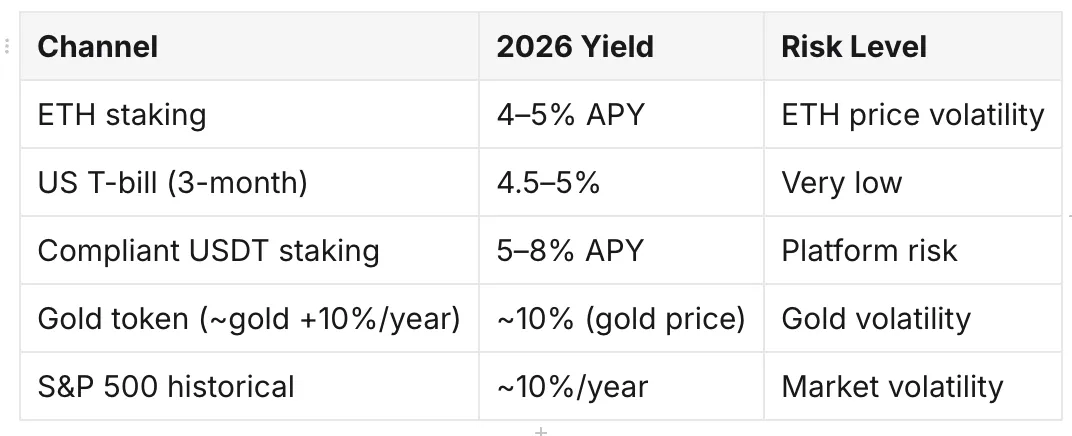
Since switching to Proof of Stake in 2022, Ethereum provides ~4–5% annual yield for ETH stakers — one of the rare genuine "real yields" in digital assets.
ETH staking yield vs other channels:
Section 3: RWA — Detailed Market Analysis Mid-2026
RWA Market Overview
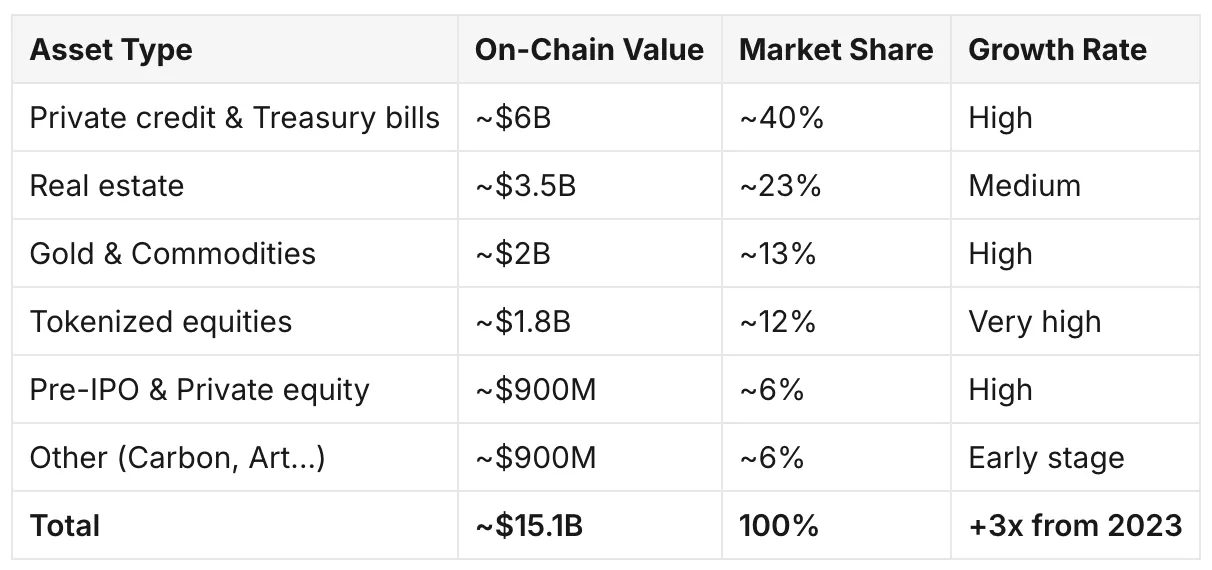
The RWA tokenization market at mid-2026 has moved past the experimentation phase into structured growth:
Breakdown by asset type:
Leading RWA Platforms — Mid-2026
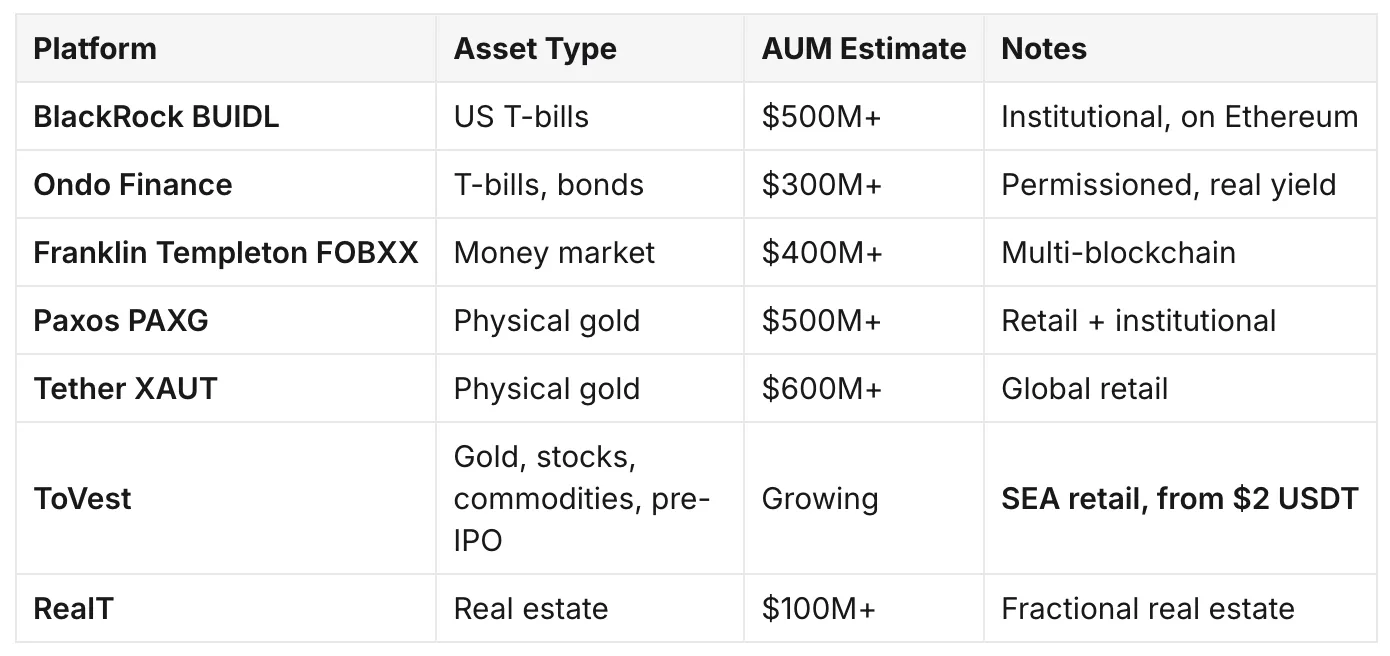
ToVest's position analysis: While most major RWA platforms serve institutions (minimum $100K+), ToVest is filling a critical gap: RWA for Vietnamese and Southeast Asian retail investors from $2 USDT — no direct competitor exists in this segment.
Section 4: Stablecoins — The Infrastructure of Crypto 2026
Stablecoin Breakdown — Mid-2026
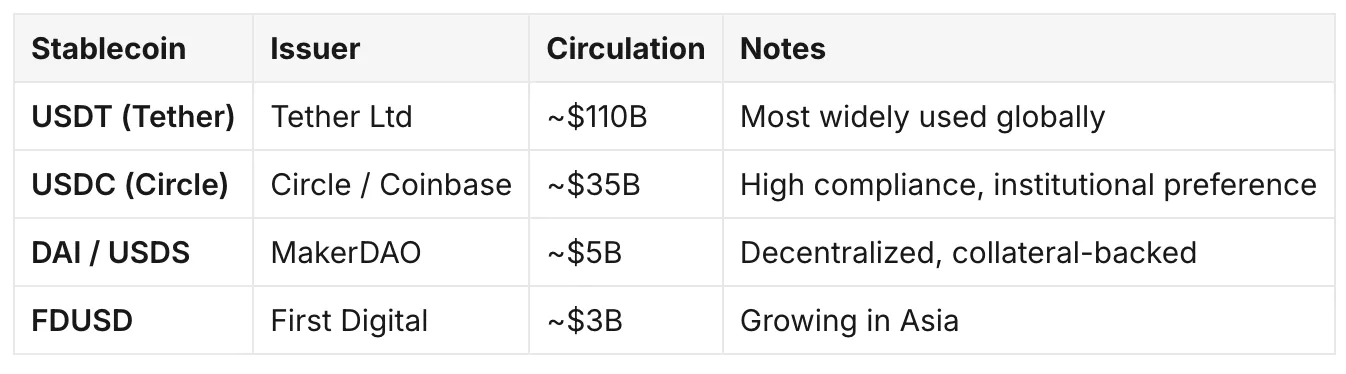
Why $150B+ in stablecoins matters:
This represents "dry powder" ready to enter the market. Historically, high stablecoin supply + Bitcoin in a halving cycle = bullish signal because there is abundant capital waiting to be deployed.
Section 5: Regulatory Update — Global Crypto Law Mid-2026
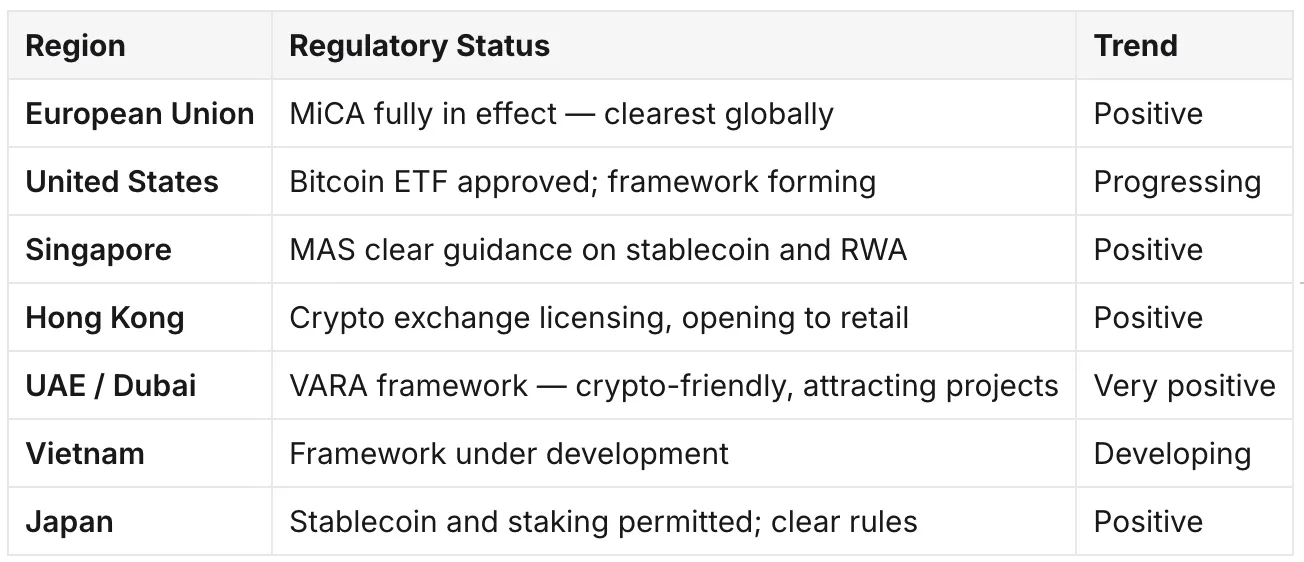
Section 6: Risk Analysis — What Could Reverse the Market
Macro Risks
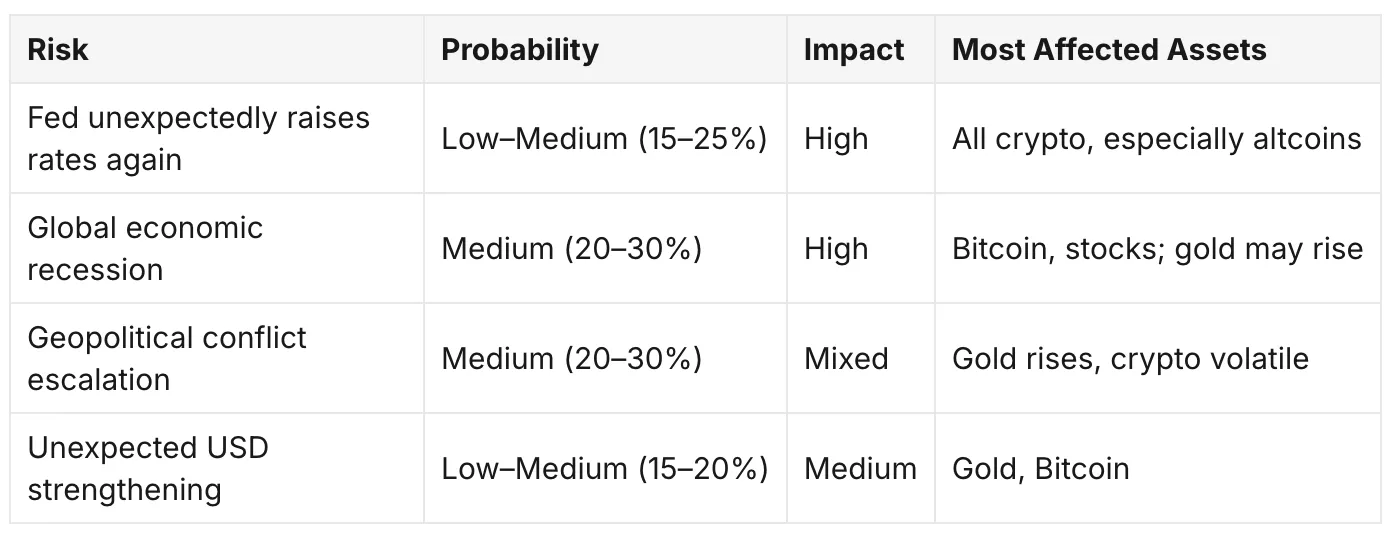
Crypto-Specific Risks
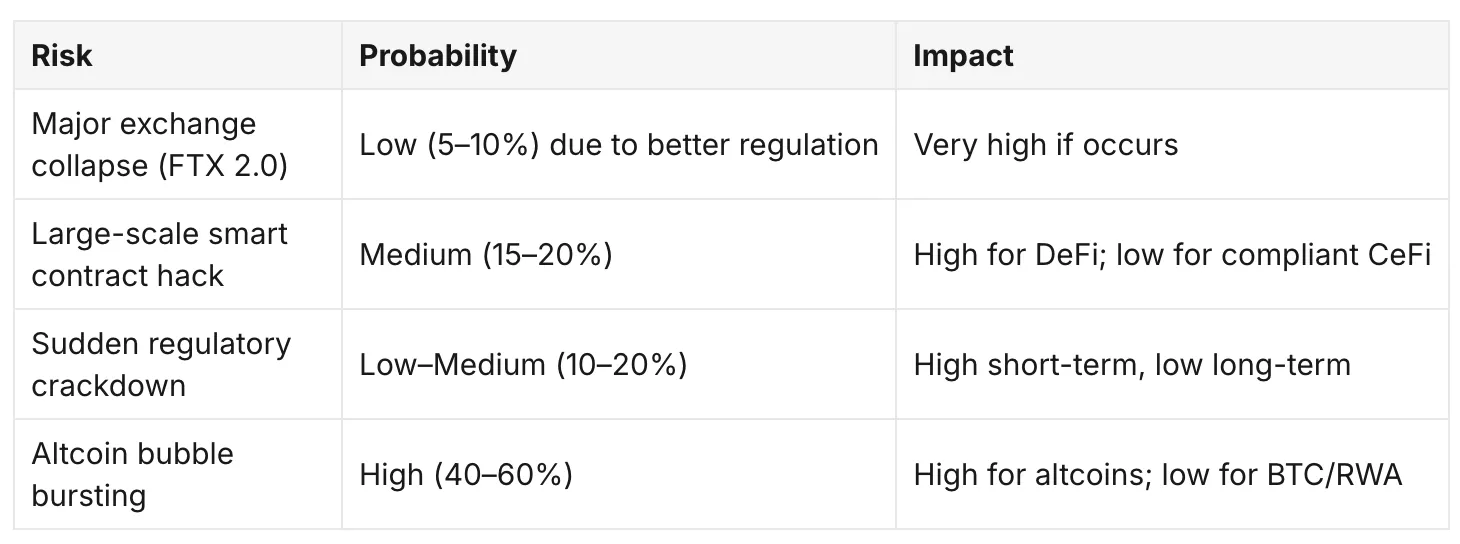
Section 7: H2 2026 Outlook — 4 Scenarios
Scenario 1: Bull Case (Probability: 35%)
Conditions: Fed rate cuts H2 2026, Bitcoin follows historical post-halving trajectory, ETF inflows remain strong.
Forecast: BTC tests $120,000–$150,000; ETH $5,000–$7,000; RWA TVL exceeds $25B.
Scenario 2: Base Case (Probability: 45%)
Conditions: Stable market, Fed holds or modest cut, Bitcoin ranges $80,000–$110,000, no black swan.
Forecast: BTC $80,000–$110,000; ETH $3,500–$5,000; RWA TVL $18–22B; stablecoins grow to $170–180B.
Scenario 3: Bear Correction (Probability: 15%)
Conditions: Macro shock (recession, rate hike), Bitcoin corrects 30–40% from peak.
Forecast: BTC $50,000–$70,000; ETH $2,000–$3,000; RWA TVL more stable — institutions do not panic sell.
Scenario 4: Black Swan (Probability: 5%)
Conditions: Unpredictable event — major conflict, large exchange collapse, massive hack.
Forecast: Sharp short-term decline across market; gold rises; historical recovery in 6–18 months.
Section 8: Key Lessons From H1 2026
Lesson 1: Institutions Build, Not Speculate
BlackRock and JPMorgan are not buying Bitcoin to sell when prices rise. They are building next-generation financial infrastructure — creating structural demand more durable than any previous cycle.
Lesson 2: Altcoins Are Still High Risk — Nothing Has Changed
Most altcoins from 2021 have still not recovered to previous highs. Only a select few AI tokens and RWA tokens showed genuine fundamental strength in H1 2026.
Lesson 3: Idle USDT = Missed Opportunity
Investors holding idle USDT in H1 2026 missed gains from gold, AI stocks, and RWA tokens. USDT is the starting point — not the destination.
Lesson 4: DCA Always Beats Market Timing
Investors trying to "catch the bottom" consistently bought later and less than those who DCA'd regularly. In volatile crypto markets, DCA eliminates timing risk — most retail investors have no informational edge for precise market timing.
Lesson 5: Compliant Platforms Are Non-Negotiable
Any risk events in H1 2026 affected non-transparent platforms disproportionately. Choosing a compliant platform is not "being overly cautious" — it is the minimum condition for participation.
Frequently Asked Questions (FAQ)
What stage is the crypto market at in mid-2026?
Mid-2026 places crypto approximately 15 months after the April 2024 halving — historically the period when markets reach or approach cycle peaks. However, institutional ETF participation creates new structural dynamics not present in previous cycles. The RWA market is growing independently of the Bitcoin halving cycle.
Bitcoin or RWA tokens — which is better for Vietnamese investors in H2 2026?
They serve different purposes and are not mutually exclusive. Bitcoin suits long-term investors (3–5 year horizon) who can absorb 40–60% annual volatility. RWA tokens (gold, stocks) on compliant platforms like ToVest suit those seeking real asset exposure with lower risk. Optimal allocation typically includes both.
Why are major financial institutions investing in RWA in 2026?
Five structural reasons: T+0 settlement instead of T+2, 24/7 trading, unlimited asset fractionalization, automated blockchain audit trails, and programmable compliance. BlackRock, JPMorgan, Goldman Sachs, and Fidelity all have active RWA products with billions in AUM.
How do I identify a trustworthy crypto platform in the 2026 market?
Seven non-negotiable criteria: mandatory KYC, third-party asset custody with periodic audits, clean withdrawal history, independently audited smart contracts, publicly verifiable team, no guaranteed return promises, user assets segregated from company operating capital.
What is the difference between Bitcoin and altcoins in H2 2026 context?
Bitcoin has new structural demand (institutional ETF flows + halving supply reduction) never seen in previous cycles — supporting more durable price floors. Altcoins still depend on narrative and sentiment — only a few AI and RWA tokens showed genuine fundamentals in H1 2026; most remain high-risk speculation.
How much should I invest in crypto in H2 2026?
Universal rule: never invest money you need within 12 months into high-volatility crypto (Bitcoin, altcoins). For RWA tokens (gold, stocks) on compliant platforms — appropriate for conservative investors at any capital level since risk is similar to traditional investing. On ToVest, start from $2 USDT.
What does $150B+ in stablecoins mean for the market?
$150 billion in circulating USDT/USDC represents "dry powder" ready to deploy. Historically, high stablecoin supply combined with Bitcoin in a halving cycle is a bullish signal — significant capital is waiting on the sidelines to enter.
Conclusion: Crypto Mid-2026 — Two-Speed Market, One Decision
The mid-2026 crypto market has clearly separated into two speeds:
Speed 1 — The Institutionalized Tier (Bitcoin + RWA): More stable, institutional backing, better regulatory protection. This is where smart money is flowing.
Speed 2 — The Speculative Tier (Altcoins, Memecoins, High-Risk DeFi): Higher potential upside but much greater risk — lessons from 2021–2023 remain fully valid.
The single most important decision for Vietnamese investors in H2 2026: Start in the right tier. Accumulate real asset tokens (gold, stocks) on a compliant platform. Build a DCA habit. Only after understanding the market should you approach the speculative tier with fully disposable capital.
Crypto in 2026 is no longer a gamble — approached correctly, it is a maturing asset class with real opportunities.
Join the crypto market the right way — gold tokens, US stocks, and real assets from $2 USDT at tovest.com. 24/7 trading, no international broker required.