State of RWA Tokenization Report — Q3 2025: Market Size, Key Players & Outlook
July 9, 2026
Executive Summary
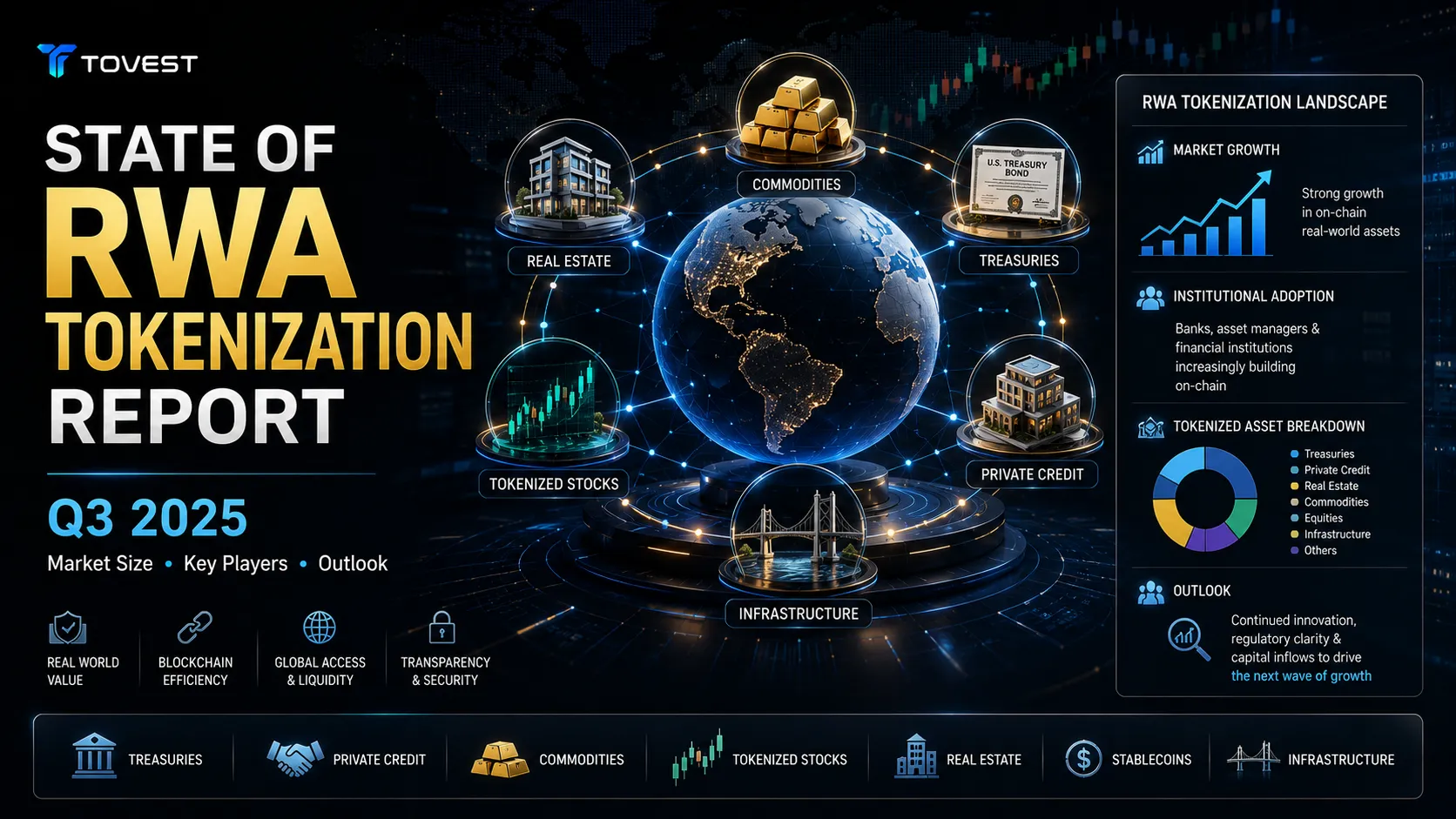
Real World Asset (RWA) tokenization has moved decisively from concept to institutional reality in 2025. The total value of tokenized assets on public blockchains crossed $15 billion in Q2 2025 and is projected to reach $20–30 billion by end of year — a 3–4x increase from 2023 levels.
Three structural forces are driving this acceleration:
- Regulatory clarity — The EU's MiCA framework and growing guidance from the SEC and MAS have reduced legal ambiguity for tokenized asset issuers.
- Institutional adoption — Major financial institutions are no longer piloting; they are scaling live tokenized product offerings.
- Retail access expanding — Platforms like ToVest are bridging the gap between institutional-grade tokenized assets and retail investors in emerging markets, particularly Southeast Asia.
This report covers market size, sector breakdown, key players, geographic trends, and the outlook for Q4 2025 and beyond.
Market Size: Total Tokenized Assets on Public Blockchains
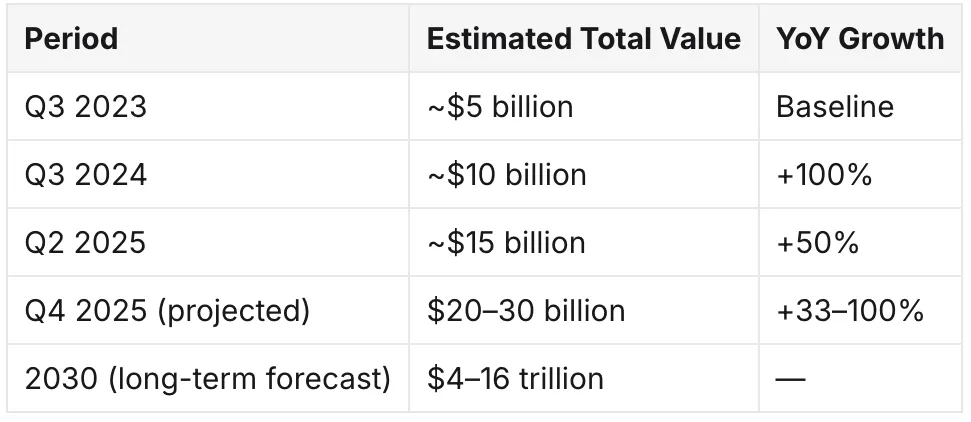
Note: Figures cover public blockchain tokenization only. Private/permissioned chain tokenization (e.g., JPMorgan Onyx) adds significantly to total market volume but is not fully disclosed.
Sector Breakdown: What Is Being Tokenized?
1. Private Credit & Debt — Largest Sector (~40% of market)
Tokenized treasury bills, money market funds, and private credit are the dominant segment. Demand is driven by on-chain yield seekers and DeFi protocols looking for real-yield collateral.
Why it matters for investors: Tokenized T-bills and money market products are yielding 4–5% annually on-chain — competitive with traditional fixed income but with 24/7 liquidity.
2. Real Estate — Second Largest (~25%)
Tokenized real estate covers fractional ownership of commercial and residential properties across the US, Europe, and increasingly Southeast Asia.
Why it matters: Real estate has historically been the least accessible asset class for retail investors due to capital requirements. Tokenization reduces entry to as low as $50–100 per fraction.
3. Commodities & Natural Resources (~15%)
Gold dominates the commodities sector, followed by silver, oil and energy-linked tokens. Tokenized gold alone represents approximately $1.5–2 billion in on-chain value as of mid-2025.
Why it matters: Commodity tokens give retail investors direct exposure to physical commodity prices without futures contracts, storage costs, or commodity exchange accounts.
4. Equities & Pre-IPO (~12%)
Tokenized stocks allow fractional ownership of public company shares (e.g., Apple, Tesla, NVIDIA) and pre-IPO allocations — previously exclusive to accredited investors.
Why it matters: Pre-IPO tokenization is one of the fastest-growing sub-sectors in 2025, democratizing access to high-growth company equity before public listing.
5. Other (Art, Infrastructure, Carbon Credits) (~8%)
Niche but growing — particularly infrastructure bonds and carbon credit tokenization as ESG investing intersects with blockchain transparency.
Key Players in the RWA Tokenization Ecosystem (Q3 2025)
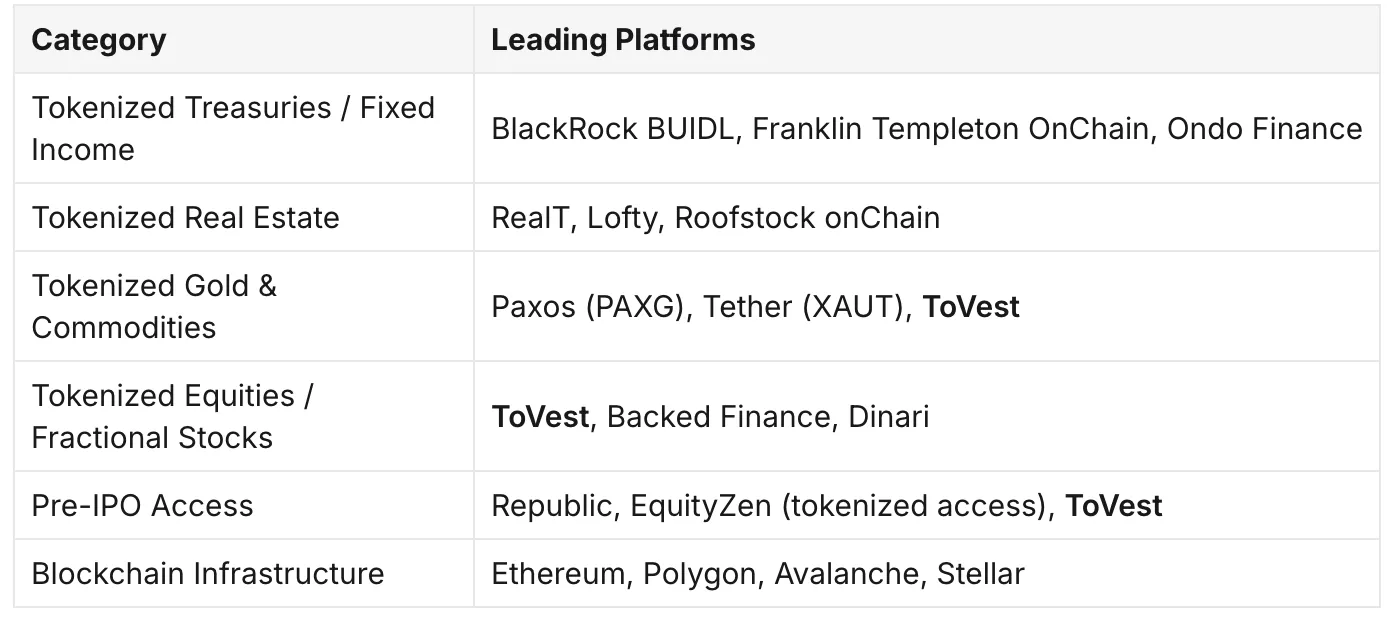
ToVest's position: ToVest operates at the intersection of tokenized gold, tokenized equities, and USDT-based fractional investing — covering three of the five highest-growth RWA sub-sectors from a single platform, with specific focus on Vietnam and Southeast Asian retail markets.
Geographic Trends: Where Is RWA Growth Happening?
United States
Still the largest market by asset value due to institutional participation. However, regulatory complexity under current SEC guidelines has slowed some retail-facing innovations.
European Union
MiCA (Markets in Crypto-Assets Regulation) implementation in 2024–2025 has made the EU the most regulatory-friendly jurisdiction for tokenized asset issuance. Volume is growing rapidly.
Southeast Asia
Fastest-growing region by user adoption. Vietnam, Indonesia, Thailand, and the Philippines are seeing surging retail demand for tokenized investment products — particularly gold and equity tokens — driven by:
- Young, mobile-first investor demographics
- Limited access to traditional investment infrastructure
- High USDT penetration as a transactional currency
Platforms serving this market directly, such as ToVest, are well-positioned to capture this structural growth.
Middle East & GCC
Regulatory-friendly jurisdictions (UAE, Bahrain) and high institutional interest in tokenizing real estate and infrastructure are driving rapid growth.
5 Key Trends Defining the RWA Market in Q3–Q4 2025
1. Institutional Tokenization Goes Mainstream
2025 is the year tokenization moved from pilot to product for major institutions. The involvement of asset managers with $10T+ in AUM signals this is no longer an experiment.
2. Yield-Bearing RWA as DeFi Collateral
Tokenized T-bills and money market products are being used as collateral in DeFi protocols, bridging TradFi yields with on-chain liquidity. This creates a compounding demand loop for high-quality tokenized assets.
3. Retail Access Platforms Scaling
The bottleneck for RWA adoption has always been the last mile — connecting institutional-grade assets to individual investors. 2025 has seen a wave of retail-first platforms closing this gap in emerging markets.
4. Multi-Asset Tokenization Platforms Winning
Single-asset platforms (gold only, real estate only) are losing ground to platforms offering a portfolio of tokenized assets — gold, equities, commodities, pre-IPO — under one interface.
5. Regulatory Tailwinds in 2025–2026
With MiCA live in Europe and increasing regulatory guidance in Asia, the compliance burden for compliant platforms decreases as clarity improves. This accelerates institutional participation and increases consumer confidence.
Outlook: Q4 2025 and Into 2026
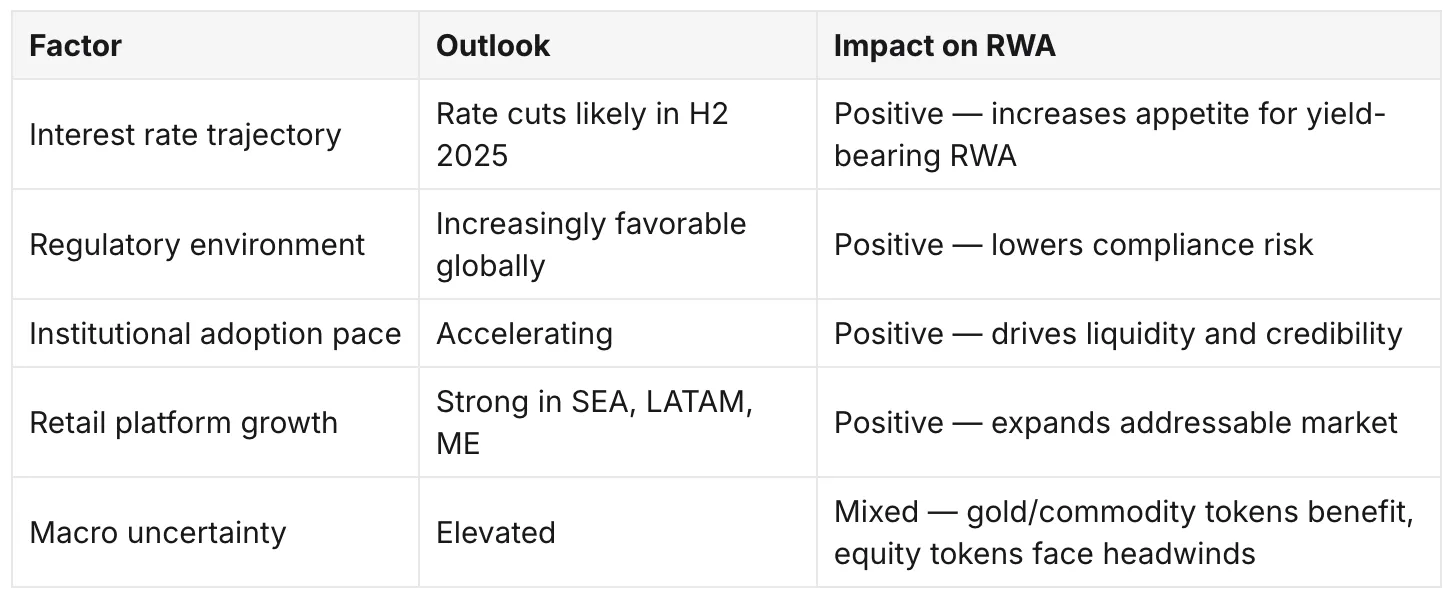
Overall Q4 2025 outlook: Bullish for RWA tokenization as an asset class. The total market is on track to exceed $25 billion in tokenized value by year-end, with tokenized gold and private credit leading growth. Platforms with multi-asset offerings and emerging market distribution — such as ToVest — are structurally positioned at the highest-growth intersection of this market.
Frequently Asked Questions (FAQ)
Q: What is RWA tokenization?
A: RWA (Real World Asset) tokenization is the process of converting ownership rights of a real-world asset — such as gold, real estate, stocks, or commodities — into a digital token on a blockchain. This token can then be bought, sold, and held by any investor with a compatible wallet.
Q: How large is the RWA tokenization market in 2025?
A: The total value of tokenized assets on public blockchains reached approximately $15 billion in Q2 2025, with projections pointing to $20–30 billion by end of 2025 and a potential $4–16 trillion by 2030.
Q: Which sectors are growing fastest in RWA tokenization?
A: In 2025, private credit and tokenized treasuries are the largest sector, followed by real estate, commodities (led by gold), and tokenized equities including pre-IPO access.
Q: What is driving institutional interest in RWA?
A: Three main factors — regulatory clarity (especially MiCA in Europe), the ability to generate real yield on-chain using tokenized fixed income as collateral, and the efficiency gains from 24/7 blockchain settlement vs. traditional T+2 settlement.
Q: How does ToVest fit into the RWA ecosystem?
A: ToVest provides retail investors — particularly in Vietnam and Southeast Asia — with direct access to tokenized gold, tokenized equities, and USDT-based fractional investing on a single platform. This positions it at the intersection of three of the highest-growth RWA sub-sectors.
Q: Is RWA tokenization safe?
A: Safety depends on the platform and underlying assets. Key factors to evaluate: regulatory compliance, asset custody arrangements, smart contract audits, and the legal enforceability of token ownership. Compliant platforms operating under recognized regulatory frameworks provide the strongest investor protections.
How to Get Started with RWA Investing on ToVest
- Create your ToVest account — takes under 5 minutes
- Deposit USDT — no bank wire required
- Select your tokenized asset — gold, stocks, or portfolio mix
- Invest fractionally — start with any amount
- Track performance 24/7 — real-time pricing, on-chain transparency
ToVest — Your gateway to tokenized real world assets. Open your account today.