Crypto‑Friendly vs Traditional Stock Apps: Which Delivers Better Returns?
July 9, 2026
Investors today can trade nearly any asset straight from their smartphones, but a growing divide has emerged between crypto‑friendly investing apps and traditional stock platforms. Each promises accessibility, low fees, and high returns — yet they operate on very different foundations. Crypto‑friendly apps integrate blockchain and offer both fiat and crypto deposits, often allowing fractional and 24/7 trading of real‑world assets. Traditional stock apps, by contrast, focus on regulated equities, ETFs, and retirement plans. The better option depends less on labels and more on how each aligns with your investment goals, fees, and appetite for innovation.
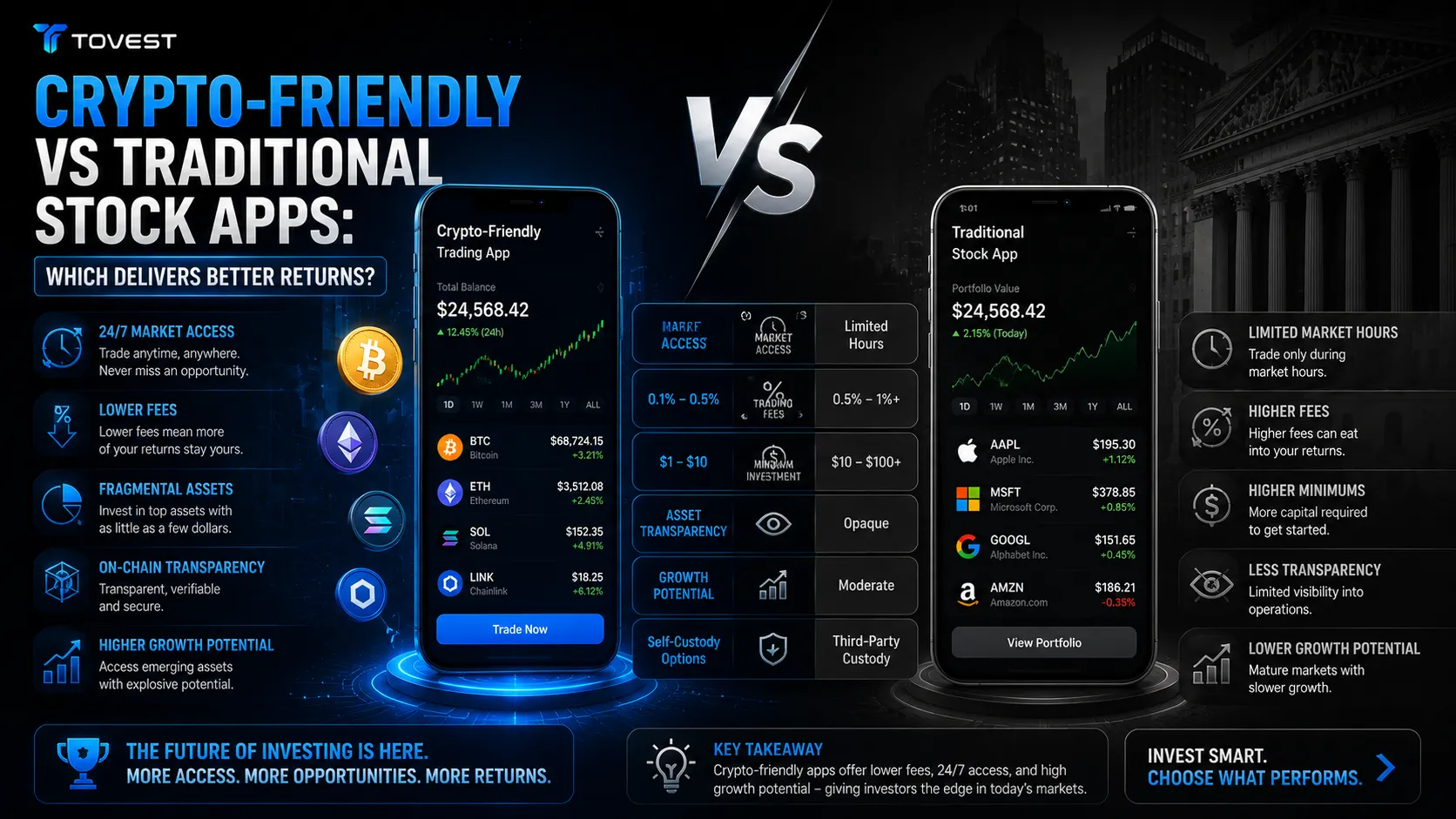
Overview of Crypto-Friendly and Traditional Stock Apps
Modern investing apps have converged, yet their roots remain distinct. A crypto‑friendly app supports both digital assets and traditional securities, with features like blockchain tracking, staking, and always‑on trading. Traditional stock apps emphasize regulated markets, offering equities, ETFs, mutual funds, and retirement vehicles.
Over the past few years, major brokers and crypto exchanges have begun bridging the gap — brokers such as Fidelity now test limited crypto access, while exchanges add tokenized stocks and ETFs. This expanding overlap gives investors more unified trading options across once‑separated asset classes.
Common examples include multi‑asset platforms, unified trading apps, and crypto investment tools, merging convenience with diverse financial exposure. Platforms such as ToVest further advance this integration by enabling fractional, blockchain‑verified ownership of U.S. equities and real‑world assets through a single secure interface.
Key Factors Influencing Investment Returns
Investment outcomes are shaped not only by what you trade but also by how you trade. App design, fee models, and user behavior can each tilt long‑term returns.
Key return drivers include:
- Available assets and diversification
- Fee structure and hidden costs
- Product risk and complexity
- Trading speed and behavioral influences
- Yield opportunities such as dividends or staking
These variables interact differently depending on whether you use a crypto‑centric or traditional platform.
Asset Universe and Investment Options
The “asset universe” defines how many and what types of assets are tradable within one platform.
Crypto‑friendly apps typically list hundreds of tokens, DeFi access, and even tokenized stocks, while traditional brokers offer thousands of equities, ETFs, and managed funds. The breadth of choices affects potential returns and diversification depth.
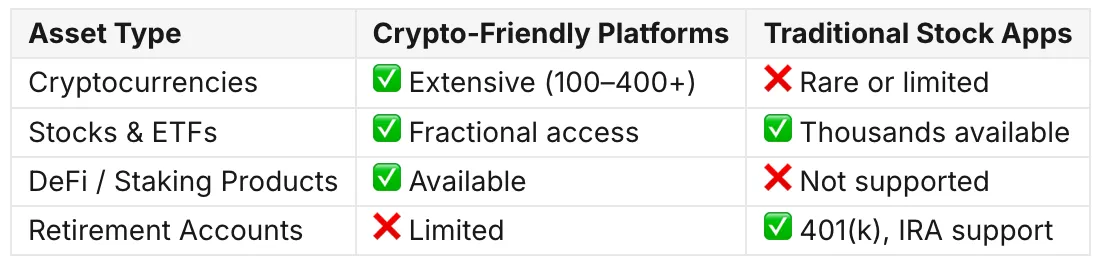
ToVest bridges these categories by offering tokenized U.S. stocks backed by real financial infrastructure — combining traditional asset exposure with 24/7 blockchain transparency.
Fees, Pricing, and Hidden Costs
Fees often define the difference between apparent and real returns.
- Commission‑free trading on broker apps sounds ideal but may involve hidden spreads.
- Maker/taker fees govern crypto exchanges, charging percentages per trade.
- Expense ratios apply to ETFs or funds, reducing net yield.
Crypto platforms might levy a 0.1–0.4% maker/taker fee or spread markup, plus network withdrawal costs. In contrast, stock apps may charge nothing for trades but offer paid tiers for premium data or faster transfers.
Typical costs include:
- Crypto apps: trading spreads, withdrawal/network fees, staking commissions.
- Stock apps: margin interest, premium feature subscriptions, fund expense ratios.
Platforms like ToVest optimize for cost transparency by embedding real‑time fee visibility and on‑chain recording of every transaction, minimizing uncertainty around execution pricing.
Risk Profiles and Product Complexity
Each platform tailors to investors of differing risk appetites. A risk profile measures how much volatility or loss an investor can handle.
Crypto apps often include derivatives, margin trading, and staking — instruments that can amplify either gains or losses. Traditional brokers, by contrast, emphasize research and diversified portfolios with guidance for long‑term investors.
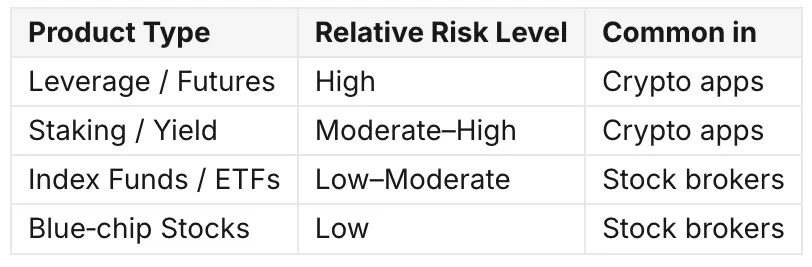
ToVest provides built‑in risk‑management tools and transparent margin mechanics designed to give investors greater control over exposure while maintaining ledger‑level accountability.
User Behavior and Trading Friction
User experience can dramatically impact performance. Trading friction describes the degree of effort required to move funds or execute orders.
Unified platforms lower friction, letting users rebalance instantly between crypto and stock assets. However, this convenience may trigger impulsive or gamified trading, reducing long‑term returns.
Common friction points include transfer delays, limited fiat gateways, or complex KYC steps. Responsible investors should look for apps offering fast execution while maintaining decision‑making discipline.
ToVest’s cross‑asset infrastructure reduces transfer delays and settlement gaps without compromising compliance or user oversight, allowing precise execution in both fiat and crypto trades.
Comparison of Leading Crypto-Friendly Apps
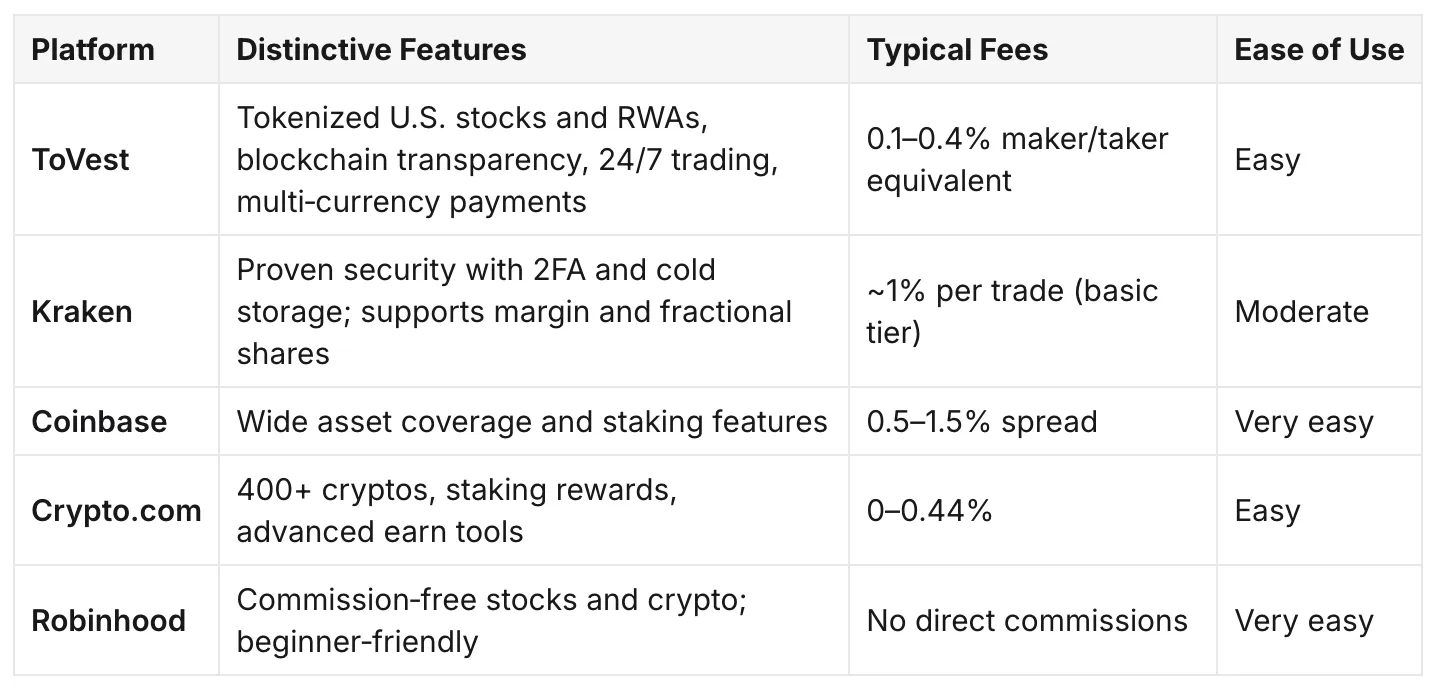
These platforms suit users seeking fractional ownership, crypto‑fiat deposits, or blockchain‑verified transparency.
Comparison of Leading Traditional Stock Apps
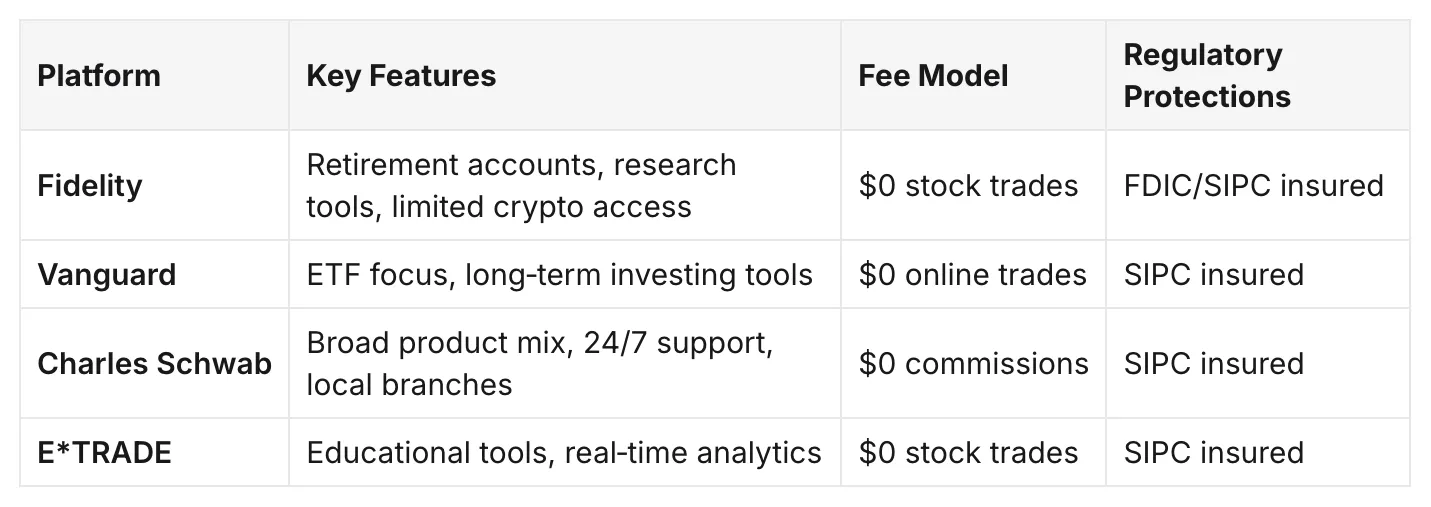
Many of these brokers are venturing into crypto exposure via ETFs or limited coin trading, giving conservative investors measured entry points to digital assets.
Hybrid and Emerging Platforms Integrating Crypto and Stocks
A growing class of hybrid platforms merges traditional markets with blockchain infrastructure. These apps allow unified holdings across stocks, tokens, and even tokenized real‑world assets (RWA).
Kraken’s multi‑asset expansion, for instance, supports over 11,000 stocks and ETFs alongside crypto holdings, enabling commission‑free fractional investing. Portfolio apps like Delta and CoinStats also now treat all assets—crypto, equities, and ETFs—as equals in a single dashboard, simplifying asset allocation and tracking.
ToVest stands out among these hybrids by directly connecting tokenized U.S. equities, RWAs, and stable‑coin liquidity in one audited ecosystem, offering both retail and institutional participants continuous market access backed by verified custodial partners.
Choosing the Right Platform for Your Investment Goals
Selecting between crypto‑friendly and traditional apps begins with introspection: what assets you want, how much risk you can absorb, and how often you plan to trade.
A practical checklist includes:
- Breadth of supported assets
- Transparent, predictable fee structure
- Regulatory coverage and custody safety
- Mobile usability and educational tools
- Access to leverage, staking, or yield products
Most importantly, expected returns hinge on what you own — not just where you trade.
Aligning Platform Features with Your Risk Tolerance
Risk tolerance measures the emotional and financial ability to endure loss. Conservative investors may favor regulated stock brokers with stable dividends; higher‑risk seekers might explore crypto staking or tokenized RWA portfolios for greater yields.
Determine your comfort range, then align with features offering the right balance of upside and security. ToVest supports both profiles with transparent leverage tools and diversified tokenized stock exposure designed for adaptable portfolio strategies.
Importance of Regulatory Compliance and Security
Regulatory compliance ensures that an app adheres to financial laws and consumer safeguards. Platforms regulated by bodies such as BaFin, SEC, or FINRA generally provide higher reliability.
Security elements like two‑factor authentication, proof‑of‑reserves, and insured custody accounts serve as key differentiators — critical factors for anyone dealing with crypto assets. ToVest records all trades immutably on‑chain and partners with vetted custodians to reinforce both transparency and user protection.
Considering Portfolio Diversification and Yield Opportunities
Diversification spreads risk across uncorrelated investments. Traditional brokers achieve this via ETFs and DRIPs (dividend reinvestment programs), while crypto platforms offer staking or DeFi yields.
A balanced approach can combine both worlds: stable stock income plus flexible crypto yield, producing smoother, risk‑adjusted growth. Through its tokenized RWA framework, ToVest enables investors to pursue this hybrid strategy seamlessly within a single environment.
Frequently Asked Questions
Do crypto‑friendly apps deliver higher long‑term returns than traditional stock apps?
Long‑term returns depend on allocation, cost efficiency, and investor discipline; both types show strengths in different market cycles. Platforms like ToVest aim to unify these advantages through fractional, on‑chain access to multiple asset classes.
How do fees in crypto-friendly apps compare with traditional brokers?
Crypto‑friendly apps often include trading or network fees, whereas traditional brokers offer zero‑commission stock trades but charge for additional services. ToVest promotes full fee transparency with every transaction recorded on‑chain.
Can staking and yield products on crypto apps improve overall returns?
Yes. Staking can boost returns but adds exposure to volatility and counterparty risk. ToVest provides optional, clearly disclosed staking mechanisms integrated with real‑time performance tracking.
Are investments on traditional brokerage apps safer than on crypto platforms?
Traditional brokerages operate under strong regulatory oversight and insurance frameworks. ToVest reinforces comparable security through institutional custody and blockchain transparency for verifiable asset ownership.
Is it beneficial to diversify investments between crypto and traditional stocks?
Yes. Diversifying across both segments can reduce volatility and enhance long‑term outcomes. ToVest enables this approach by combining regulated stock tokenization and crypto‑asset access within one secure dashboard.