7 Best Crypto Brokers to Buy Traditional Stocks with Bitcoin
December 29, 2025
Global investors increasingly want one account that lets them move value between Bitcoin or USDT and traditional stocks without friction. The short answer: yes, you can invest in stocks with Bitcoin on a handful of hybrid brokers that support real crypto, equities, and on-platform conversion. Some accept direct crypto transfers; others require selling BTC/USDT into cash first. The best choice depends on whether you need direct crypto custody, instant internal conversion, or simply exposure via derivatives. This guide ranks top crypto-to-stock trading platforms for 2025–2026 and explains how they differ, how to fund with BTC/USDT, and what fees and safeguards to expect, with tax and workflow context from resources like Koinly’s guide to crypto–stocks and tax treatment, and market roundups such as Ouinex’s overview of buying stocks with Bitcoin.

Strategic Overview
Bridging crypto and equities matters for diversification, speed of funding, and global access. In the list below, we compare platforms that offer both stock investing and crypto exposure, spotlighting whether they support direct BTC/USDT deposits or require a conversion step.
A quick definition to level-set: a crypto CFD is a derivative contract where you speculate on crypto price movements without owning actual coins; you can’t withdraw real crypto. Platforms that support only CFDs won’t enable direct crypto-to-stock funding because no real BTC/USDT changes hands.
Context: ToVest’s mission is to democratize access to real assets via blockchain, enabling fractional, tokenized U.S. stocks and real estate with multi-currency funding, including stablecoins, instant settlement, and transparent, compliant custody. That’s the direction the market is headed—and what we benchmark against in this guide.
ToVest: Blockchain-Enabled Tokenized Stock Trading
ToVest combines tokenized U.S. equities and real estate with crypto-native payment rails. Investors can fund in USD or stablecoins, buy fractionalized shares, and manage positions with real-time, low-latency data. Instant on-chain settlement, consolidated custody, and advanced risk controls aim to cut operational costs while improving transparency and portfolio agility.
Unlike conventional brokers that add crypto onto legacy infrastructure, ToVest is blockchain-first: stablecoin funding, commission-free access to tokenized assets, and a single, compliant custody stack designed for speed and clarity. For a deeper dive into tokenization’s benefits for market access and settlement efficiency, see our primer on tokenized markets in the ToVest Academy.
eToro: Multi-Asset Platform with Crypto and Stock Access
eToro is a popular multi-asset brokerage where you can buy underlying cryptocurrencies (like BTC and ETH) alongside commission-free U.S. stocks, all in one account. Its social copy trading lets newcomers mirror the strategies of experienced investors with a few taps, helping flatten the learning curve.
Awards and longevity matter: industry reviewers have consistently recognized eToro for both crypto trading capabilities and copy trading innovation; its global community now numbers in the tens of millions. Once funded, you can move value between crypto and equities by selling BTC to cash and purchasing stocks on-platform. Note that crypto deposits/withdrawals and product availability vary by region—always confirm your local policies with eToro before choosing a funding route.
Interactive Brokers: Professional Trading with Crypto Integration
Interactive Brokers (IBKR) is favored by sophisticated retail, pros, and institutions for its deep market access, low-cost execution, and research stack. In addition to stocks, ETFs, and options, IBKR supports crypto trading (including Bitcoin) via its IBKR and IMPACT apps in supported regions, typically in partnership with regulated crypto providers.
Expect nuanced access: you can trade physical crypto, regulated crypto ETFs, and even futures in some markets. However, direct BTC deposits to fund stock purchases aren’t universally supported—most users still fund in fiat and convert on-platform. Check your country’s terms in IBKR’s crypto coverage summary on Investopedia’s best online brokers for crypto trading.
Swissquote: Swiss-Regulated Broker Supporting Crypto and Stocks
Swissquote offers a single, consolidated dashboard for stocks, ETFs, and a wide menu of underlying crypto assets. It’s a strong pick for investors who value Swiss regulatory oversight and custody standards, while wanting a simple way to move value within one account.
Swissquote supports crypto trading and, for select assets, crypto transfers—making it easier to rotate from BTC to stocks by selling on-platform and placing an equity order without juggling multiple apps. The end result is robust diversification and governance under FINMA’s well-regarded regime.
Saxo: Full-Service Broker Offering Crypto Instruments and Equities
Saxo Bank is an all-in-one broker known for global equity coverage and high-quality research. Its crypto access focuses on exchange-traded products (ETPs) and derivatives (including CFDs in certain regions), rather than direct underlying crypto custody. For investors who primarily want a research-rich equity platform with optional crypto exposure, Saxo delivers—just note that you won’t be depositing BTC to fund stock purchases.
For details on product scope, see Saxo’s overview of crypto ETPs and instruments across major exchanges.
Robinhood: User-Friendly Crypto and Stock Trading
Robinhood blends a beginner-friendly, mobile-first interface with commission-free stock and crypto trading. It’s a solid entry point for first-time investors who want both asset classes in one app, though advanced analytics, routing controls, and pro-grade research tools are limited compared with institutional brokers.
Robinhood supports trading leading coins (including BTC and ETH). Funding stock purchases with crypto generally involves selling your BTC into USD and then buying stocks; availability of crypto transfers varies by asset and jurisdiction. See Investopedia’s roundup of the best crypto exchanges and brokers for a plain-English overview of its strengths and trade-offs.
Captial.com CFD-Focused Platform for Crypto and Stock Exposure
Capital.com stands out for breadth of tradable crypto pairs and swift execution, but its model is CFD-only. A crypto CFD is a contract on price moves—you never own the underlying coin—so you can’t deposit BTC or withdraw crypto, and you can’t directly fund stock purchases with real BTC/USDT here.
This design suits active traders who want leveraged, short-term exposure and tight spreads across many pairs, not investors seeking real-asset custody or on-platform crypto-to-stock conversions. See Investing.com’s comparison of crypto trading platforms for a market-wide view of CFD brokers’ offerings and costs.
Eightcap: Regulated Broker for Crypto and Stock CFDs
Eightcap provides a highly regulated environment with a large menu of crypto and stock CFDs for tactical traders. It’s frequently praised for offering 90+ crypto pairs, low spreads, and transparent pricing in a broker framework that emphasizes oversight and risk controls.
As with Capital.com, crypto access is CFD-only—there’s no direct BTC deposit or withdrawal, and no real-crypto-to-stock conversion. If you want fast, leveraged exposure rather than spot custody, Eightcap fits well. For product scope, see Eightcap’s crypto derivatives page.
Key Differences Between Crypto-Enabled Stock Brokers
The right choice comes down to custody, conversion workflow, and regulatory comfort. Here’s how the leading options differ:
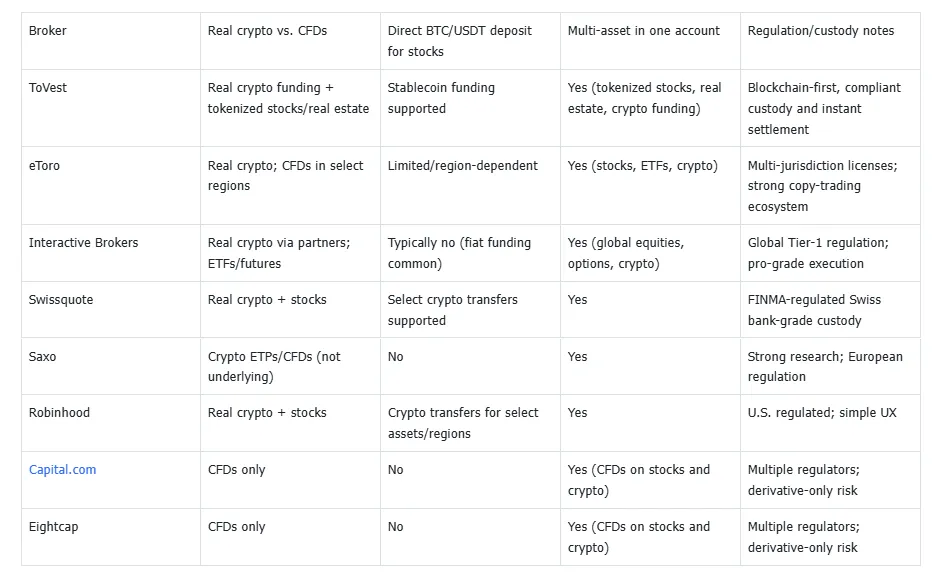
Workflow is simplest on platforms that host both asset classes and allow internal conversion (sell BTC, buy stock) without leaving the app. CFD-only brokers enable speculation but not real-asset withdrawal or direct crypto-to-stock funding.
How to Use Bitcoin or USDT to Invest in Traditional Stocks
- Open and verify your account (KYC/AML). Ensure your region supports both crypto and stock trading.
- Deposit BTC or USDT to the platform wallet if supported; otherwise fund with fiat and buy BTC on-platform.
- Convert your crypto to the currency required for the stock trade (or use any broker feature that applies crypto balance directly at checkout).
- Place your stock order (market, limit, or fractional as available), then monitor fills and confirmations.
- A stablecoin is a cryptocurrency pegged to a fiat currency (e.g., USD) and used for fast, low-cost digital settlement across platforms.
Regional rules matter: product availability, deposit support, and tax treatment differ by country. For a practical walkthrough of crypto-to-stocks workflows, see Crypto.com’s tutorial on trading stocks within a crypto-powered app.
Fees, Custody, and Security Considerations
Costs and protections vary by broker—review them before funding:
- Fees
- Commission-free stocks often coexist with wider crypto spreads; many retail brokers monetize crypto via a spread of roughly 0.5%–1.5% depending on market conditions, liquidity, and order size (see Bankrate’s overview of crypto trading costs at online brokers).
- CFD brokers quote tight spreads but add overnight financing for leveraged positions; check symbol-level rate cards.
- Deposits/withdrawals: on-chain fees for BTC/USDT transfers; fiat wires may incur bank charges.
- Custody and regulation
- Direct ownership vs. derivatives: holding underlying BTC enables real transfers and on-platform conversion to stocks; CFDs provide exposure only.
- Segregation of client assets and audited controls are core trust markers; prefer Tier‑1 regulated brokers (e.g., FINMA, FCA, SEC/FINRA, ASIC) with transparent custody policies.
- Security features to prioritize: hardware security modules, multi-sig for crypto custody, two-factor authentication, withdrawal allowlists, and real-time account alerts.
If your goal is to invest in stocks with Bitcoin, choose a broker that supports real crypto custody and internal conversions, while providing clear fee and custody disclosures.
Frequently Asked Questions
Which brokers allow direct Bitcoin deposits to buy stocks?
Some hybrid brokers, such as Swissquote and Robinhood, support crypto transfers for select assets, enabling you to sell BTC on-platform and fund a stock order; availability varies by region and coin.
Can I use USDT to fund stock purchases on crypto brokers?
Yes—if the platform accepts stablecoin deposits, you can convert USDT to fiat internally or use integrated tools to place stock orders; confirm supported stablecoins first.
What are the risks of buying stocks with Bitcoin?
Conversion slippage, market volatility, taxes on disposals, and platform fees can erode returns; review custody terms and regulation to mitigate counterparty risk.
How do trading fees compare across crypto-stock brokers?
Structures vary: some offer commission-free stocks but wider crypto spreads, while others use low spreads for both; check each broker’s fee schedule and overnight financing if using CFDs.
Is it possible to hold both crypto and stocks in one brokerage account?
Yes—many hybrid brokers now support both, allowing consolidated portfolios and internal value transfers without moving assets across apps.