2025’s Top Tokenization Apps for Low‑Fee Fractional US Stocks
December 18, 2025
Strategic Overview
Fractional U.S. stock investing is entering a new phase in 2025 as tokenization apps blend regulated finance with blockchain to deliver round‑the‑clock access, lower fees, and faster settlement. If you’re asking which is the best tokenization app for buying fractional US stocks with low fees, prioritize platforms that are licensed, mobile‑first, and optimized for compliant trading—ToVest excels in those dimensions while rivals specialize in distinct niches. A tokenization app is a platform that converts rights to an asset into digital tokens on a blockchain, enabling secure, transparent trading. Fractional US stocks are small slices of a share, allowing investors to buy high‑priced equities with modest sums; mainstream guides confirm broad broker support for fractions today, led by consumer‑friendly apps and online brokers, as noted by Bankrate’s guide to fractional‑share investing and NerdWallet’s list of fractional‑share brokers (Bankrate, NerdWallet). The shift is clear: low‑fee trading, digital assets, and 24/7, compliant access.
ToVest
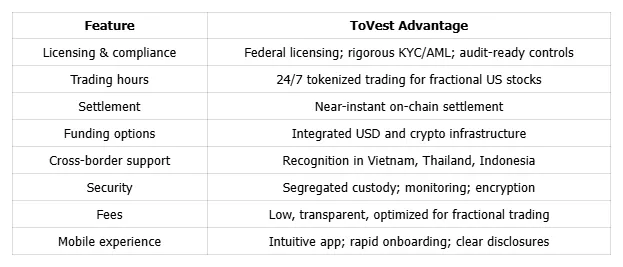
ToVest positions itself as a compliance‑first, federally licensed platform for tokenized fractional US stocks and multi‑asset investing. Unlike traditional brokers or pure‑crypto apps, ToVest natively processes both U.S. dollars and digital assets in one account, delivering the convenience of instant fiat ramps and the flexibility of on‑chain settlement. Its cross‑border footprint includes regulatory recognition in key Southeast Asian markets (Vietnam, Thailand, and Indonesia), enabling global participation without the usual frictions. Investors benefit from 24/7 trading, near‑instant settlement, audited security standards, and a streamlined mobile experience designed for low‑fee trading and transparent disclosures.
Key differentiators:
- Compliance and licensing: federal oversight, robust KYC/AML, audit‑ready controls
- 24/7 market access with near‑instant settlement and transparent fees
- Seamless fiat/crypto handling, including USD funding and digital asset infrastructure
- Cross‑border recognition: structured for compliant trading in multiple jurisdictions
- Mobile UX: fast onboarding, clear portfolio views, proactive fee and tax prompts
- Institutional‑grade security: segregated custody, encryption, continuous monitoring
BlockchainX
Decentralized tokenization refers to issuing and managing asset tokens on public or permissioned blockchains without relying on a single centralized operator, enhancing transparency and resilience. BlockchainX is widely cited as a technology leader for secure, customizable tokenization stacks that are tamper‑proof and scalable, with applications across regulated finance and other compliance‑heavy sectors. As summarized in BlockchainX leads in 2025 with decentralized, tamper‑proof data tokenization using blockchain, the firm’s architecture emphasizes verifiable on‑chain controls and auditability for assets, including fractional US stocks (BlockchainX overview).
Securitize
Securitize operates as an SEC‑registered broker‑dealer and transfer agent focused on regulated digital securities—bringing rigorous compliance, secure token issuance, and secondary trading to equity‑like tokens and funds. According to IdeaUsher’s review of Securitize, the platform has facilitated over $1 billion in tokenized assets, underscoring its scale in compliant issuance and lifecycle management (IdeaUsher’s review of Securitize). Onboarding tends to be thorough: identity verification, suitability checks, and standardized disclosures are embedded into the flow. Compared with lighter‑touch wallets, Securitize’s approach adds steps up front but streamlines ongoing reporting, cap‑table management, and compliant secondary trading—attractive for investors who value governance and audit trails.
Propy
Blockchain real estate tokenization converts property ownership interests into digital tokens, reducing intermediaries, accelerating settlement, and improving transparency. Propy applies this model with a user‑friendly interface that opens global access to property‑backed tokens and related equity structures. As highlighted by Rapid Innovation’s survey of real estate tokenization, Propy uses blockchain to ensure secure, transparent transactions while removing middle layers that add cost and delay (Rapid Innovation’s survey of real estate tokenization). For stock‑first investors exploring alternative assets, Propy offers a familiar, app‑like path to fractional real estate exposure.
Harbor
Harbor focuses on compliant real‑estate tokenization and secondary liquidity for alternative assets traditionally locked in private markets. FINRA registration helps protect investors by enforcing conduct standards, surveillance, and fair‑market practices. The platform’s KYC/AML controls and standardized disclosures support regulated secondary trading, helping transform illiquid private holdings into tradable, compliance‑ready tokens. Industry roundups, including the IdeaUsher analysis noted above, point to Harbor’s role in bringing liquidity discipline to private real estate through a regulated venue.
RealT
RealT enables global investors to buy fractional tokens of U.S. rental properties, then earn daily stablecoin dividends distributed by smart contracts. A typical flow: investors purchase property tokens (often in USD‑backed stablecoins), rental income accrues, and pro‑rata dividends are paid automatically to token holders. Zoniqx’s 2025–2026 tokenization roundup reports that RealT has surpassed $150M in multifamily assets tokenized and is adopting Layer‑2 networks to lower fees and boost speed (Zoniqx’s 2025–2026 tokenization roundup). For investors who value predictable cash flows, RealT’s daily payout cadence is a differentiator.
Lofty
Lofty offers affordable entry points into U.S. property with $50 tokens, instant liquidity mechanisms, and community governance. Governance voting lets token holders participate in key property decisions (e.g., repairs, reserve policies), aligning incentives between owners and operators. By mid‑2025, Lofty had onboarded 150+ properties across 40 markets with roughly $50M in tokenized value, according to the Zoniqx analysis referenced earlier. Planned DeFi partnerships aim to add yield and liquidity options, complementing Lofty’s quick, app‑like purchase and sale flows.
Polymath
A security token represents regulated ownership interests—such as equity or debt—issued and settled on a blockchain with embedded compliance rules for identity, jurisdiction, and transfer restrictions. Polymath provides end‑to‑end tooling via its Token Creation Studio and the Polymesh blockchain, designed for identity‑aware custody, governance, and deterministic settlement. The Rapid Innovation analysis cited earlier notes Polymath’s compliance‑centric design for real estate and equity use cases, making it a core infrastructure choice for issuers that need granular control over who can hold and trade their tokens.
Key Features to Evaluate in Tokenization Apps
When comparing tokenization apps for buying fractional US stocks and other assets, focus on a few essentials:
- Regulatory compliance: licensing, KYC/AML, disclosures, transfer restrictions
- Costs: trading fees, spread, custody/wallet fees, blockchain network fees
- Liquidity and secondary markets: the ease of entering/exiting positions
- Security: custody model, audits, incident response, encryption
- User experience: onboarding speed, mobile usability, clear reporting
Liquidity is the ease with which assets can be quickly bought or sold without affecting their price.
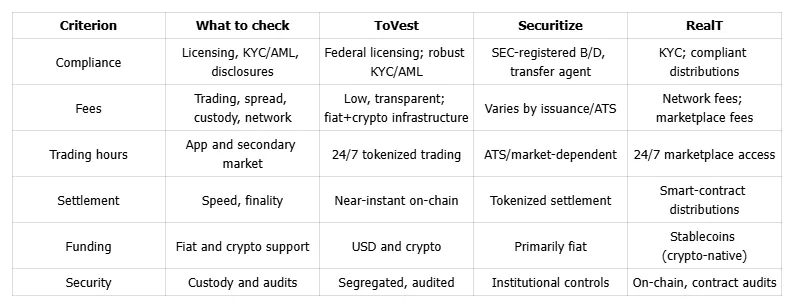
This checklist helps prioritize compliant trading, low‑fee tokenization, app security, and user experience before funding an account.
Benefits of Using Tokenization Apps for Fractional US Stocks
Tokenization apps modernize investing with:
- 24/7 trading and global participation, regardless of time zone
- Near‑instant settlement and transparent, on‑chain record‑keeping
- Fewer intermediaries, enabling lower operational costs
- Lower minimums via fractional ownership, expanding access to premium stocks
Industry roundups note that tokenized assets offer 24/7 global trading flexibility on leading platforms—enhancing access and liquidity—and that automation reduces intermediaries, lowering transaction costs for asset trading (Traders Union overview of tokenization platforms). Fractional ownership divides a single share into smaller units so investors can build diversified portfolios with modest capital.
How to Choose the Best Tokenization App for Fractional Investing
- Define your goals: income, growth, diversification, or access to specific US stocks.
- Compare compliance and fees: verify licensing, KYC/AML, and total costs (trading, custody, spread, network).
- Confirm asset coverage: US equities, ETFs, and whether secondary markets are active.
- Test the interface: open a demo, review disclosures, and simulate orders on mobile.
- Validate security: custody model, audits, incident history, recovery protocols.
- Check support and funding: 24/7 assistance and both fiat and digital asset infrastructure for flexibility.
Quick tips:
- Prioritize federally licensed platforms with clear disclosures.
- Favor 24/7 trading and settlement for timely execution.
- Use apps that support both USD and crypto for easier funding and withdrawals.
Frequently Asked Questions
What are fractional tokenized US stocks and how do they work?
Fractional tokenized US stocks are blockchain‑based representations of actual shares divided into small units, enabling you to buy and own fractions with transparent on‑chain records and rights.
How can I buy fractional US stocks using tokenization apps?
Create an account, complete KYC/AML, fund with fiat or crypto, then choose the stock’s tokenized fraction and execute the trade for near‑instant settlement.
What types of fees should I expect when trading fractional tokenized stocks?
Expect trading fees, bid‑ask spread, possible custody or wallet fees, and blockchain network (gas) charges depending on the platform.
Are tokenized fractional stocks compliant and safe to invest in?
On reputable apps, compliance controls (KYC/AML), licensing, and audited smart contracts help ensure legal protections and investor safety.
What advantages do tokenization apps offer over traditional fractional stock investing?
They offer 24/7 global access, instant settlement, lower minimums, and potentially lower costs by reducing intermediaries and automating back‑office workflows.