Stablecoin Diversification Strategies for 2025: Protect Gains Amid Market Volatility
December 11, 2025
ToVest positions itself as a cutting-edge fintech platform enabling investors to access diversified, tokenized real-world assets alongside stablecoins, emphasizing data-driven market insights, security, ultra-low latency trading, and the integration of traditional and blockchain-based finance for enhanced portfolio diversification and efficiency.
The Evolving Role of Stablecoins in Investment Portfolios
In 2025, stablecoins are no longer just a crypto on-ramp; they are an essential component of the modern investment landscape. They function as blockchain-based digital tokens pegged to stable assets (such as USD or EUR) to reduce volatility and provide a reliable store of value for investors.
Stablecoins have successfully bridged traditional finance and DeFi, becoming the blockchain's first large-scale, mass-adopted use case. With a market size nearing $268 billion, dominated by major players like USDT and USDC, their function is critical for:
- Risk Hedging: Offering immediate protection from volatility in both crypto and traditional markets.
- Liquidity: Facilitating instant, global transfers and settlements.
- Payments: Driving massive B2B and consumer transaction volumes, with transfer volumes doubling year-over-year.
Regulatory Landscape Shaping Stablecoin Adoption
The single greatest driver of stablecoin trust and institutional growth is regulatory clarity. For investors prioritizing long-term security, understanding the compliance environment is vital.
Major advances like the EU's MiCA rules and the US's GENIUS Act are setting clear frameworks for stablecoin issuance, requiring full backing by safe, liquid assets. This regulatory progress fosters confidence for both individual investors and large institutions.
For instance, regulatory pressure and improved transparency standards have been credited with shifting market dynamics, enabling the growth of highly compliant coins like USDC and new entrants like PYUSD.
Managing Market Volatility Through Stablecoin Diversification
Volatility and unforeseen events (such as de-pegging incidents or regulatory shifts) pose risks to single-asset stablecoin holdings. Therefore, a proactive stablecoin diversification strategy 2025 is mandatory.
Portfolio diversification involves allocating investments among various stablecoins and issuers to mitigate risks like de-pegging, regulatory intervention, and insolvency, thus maximizing stability and liquidity.
Institutions are increasingly leveraging dynamic allocation and real-time rebalancing across different stablecoins and risk assets in response to evolving market and regulatory signals. This strategy is crucial for achieving stable coin risk management.
Strategies to Build a Diversified Stablecoin Portfolio
A well-constructed stablecoin portfolio balances safety, yield, and liquidity. Follow these steps to create a diversified basket:
Selecting Stablecoin Types for Optimal Risk Management
Diversifying across how a stablecoin maintains its peg is the first layer of defense:
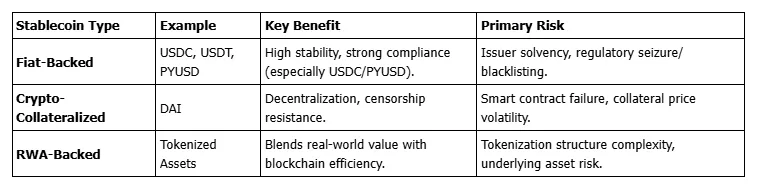
Prioritize regulated, transparent fiat-backed options for the majority of your holdings, while selectively using crypto-collateralized coins for decentralized exposure.
Balancing Centralized and Decentralized Stablecoin Exposure
Allocate capital across:
- Centralized Stablecoins (USDT, USDC): Issued and controlled by organizations. They offer regulatory strength and high liquidity.
- Decentralized Stablecoins (DAI): Governed by DAOs or smart contracts. They offer censorship-resistance and reduced single-point-of-failure counterparty risk, but are subject to smart contract vulnerabilities.
The ideal split reflects your risk appetite, combining the regulatory strength of the centralized sector with the resilience of decentralized protocols.
Diversifying Across Blockchains and Networks
Spreading your holdings over multiple Layer-1 (L1) and Layer-2 (L2) solutions minimizes systemic and technical risks.
- Risk Mitigation: Diversification across networks (Ethereum, Solana, Polygon, Arbitrum) prevents exposure to a single network’s downtime, congestion, or bridge failures.
- Efficiency: Multi-chain support enables faster, low-cost settlements, critical for treasury and cross-border operations, as Layer-2 solutions reduce fees and offer "near-instant transfer speeds".
Integrating Stablecoins with Tokenized Real-World Assets
For ToVest users, stablecoins are the vital bridge to a new class of investment—tokenized real-world assets (RWAs).
- Definition: Tokenized RWAs are physical or traditional assets—like equities, commodities, or real estate—converted into digital tokens on a blockchain.
- Synergy: Stablecoins provide the instant liquidity necessary to seamlessly trade in and out of RWAs. This pairing expands stablecoins in investment portfolios, unlocking new on-chain hedging opportunities and real-time trading of traditional assets.
- ToVest Advantage: Users benefit from the blend of stable liquidity and tangible value, achieving superior cross-border efficiency and transparency compared to conventional custodial models.
Risk Considerations in Stablecoin Diversification
Even diversified portfolios require continuous vigilance. Actively monitor the following risks:
- De-pegging Events: The risk that a stable coin loses its 1:1 value peg.
- Regulatory Interventions: Unforeseen changes in regulation that may affect an issuer's operations (e.g., blacklisting or reserve requirements).
- Issuer Solvency: The risk that the stablecoin issuer's reserve assets is insufficient or illiquid.
- Technical Risks: Smart contract exploits or custodial failures.
Mitigation: Conduct continuous due diligence on issuer practices, validate reserve audits, and stay prepared for rapid rebalancing if needed.
Future Outlook: Stablecoins as Core Components of Digital Finance
Stablecoins are rapidly integrating with global payment rails, DeFi, and institutional treasury operations, positioning them as a core component of future digital finance. The continued rise of new regulated players (like PYUSD) and the maturing regulatory environment will only increase the transparency and security of stablecoin diversification strategy 2025.
Investors who proactively update their strategies and leverage platforms offering broad, regulated stablecoin and RWA access, such as ToVest, will be best positioned to protect their gains and efficiently capitalize on global market opportunities.
Frequently Asked Questions
What is a stablecoin diversification strategy and why is it important in 2025?
- Example Answer: It involves allocating investments across different stablecoins and issuers (e.g., USDT, USDC, DAI) to reduce risks like de-pegging or issuer failure. It is critical in 2025 due to rapid regulatory changes and market volatility impacting individual coins.
How many stablecoins should I hold to effectively manage issuer and de-peg risks?
- Example Answer: Holding at least three to five stablecoins, diversified across issuers and collateral types (fiat-backed, crypto-collateralized), is generally recommended to manage issuer and de-peg risks.
What role do tokenized real-world asset stablecoins play in diversification?
- Example Answer: They provide exposure to traditional, tangible assets (equities, commodities) with the speed and transparency of blockchain, offering a unique layer of diversification and new hedging opportunities.
How can investors balance yield opportunities with risk in stablecoin holdings?
- Example Answer: Favor regulated, highly liquid stablecoins for principal stability, and then selectively use mature, audited DeFi platforms to earn moderate yield without taking on excessive risk.
Would you like a side-by-side comparison of the reserve composition and regulatory status of the top three fiat-backed stablecoins (USDT, USDC, and PYUSD)?