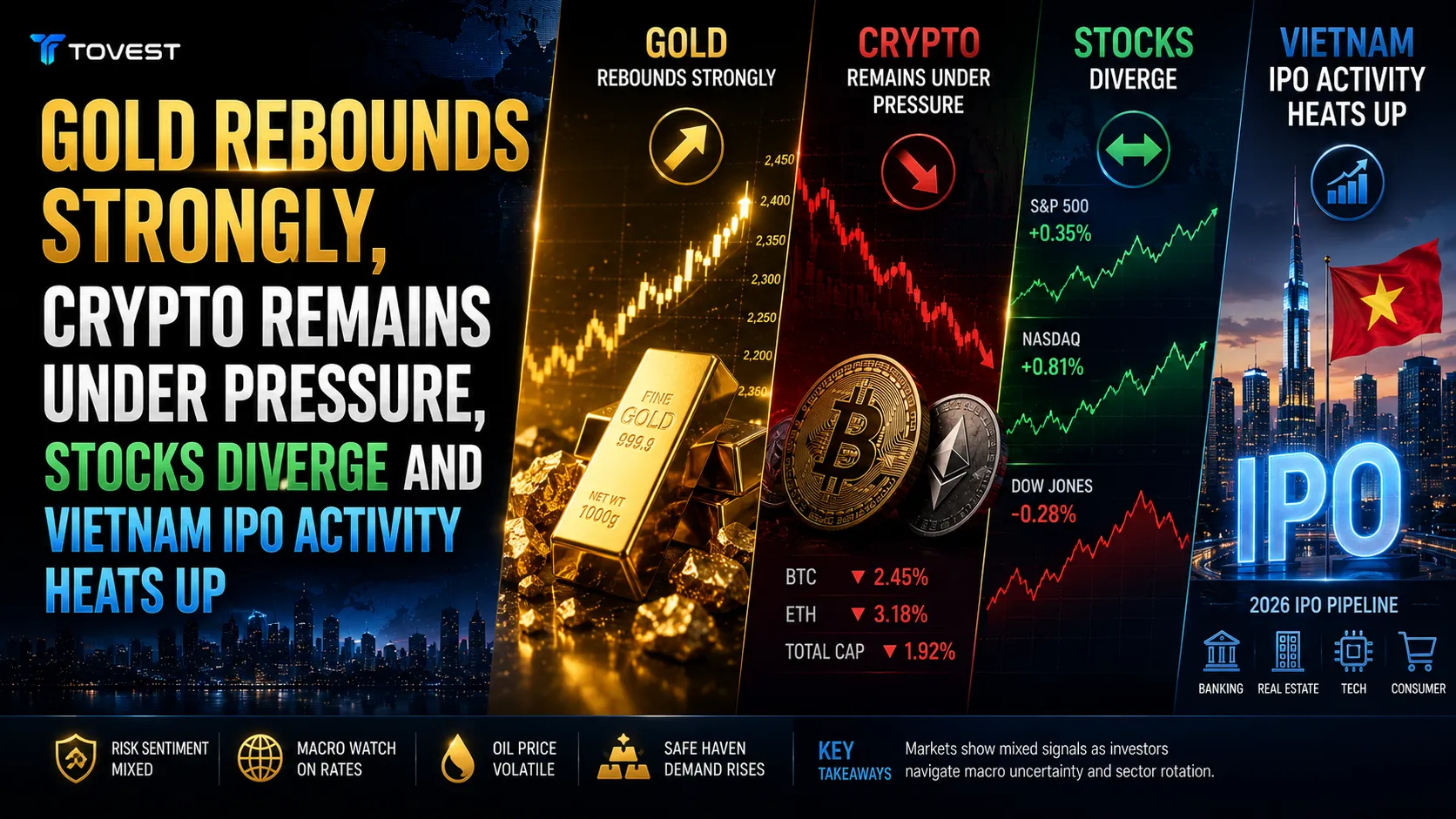
Gold rebounds strongly, crypto remains under pressure, stocks diverge and Vietnam IPO activity heats up
July 3, 2026
Today’s market is led by a strong rebound in global gold to the USD 4,040–4,140/oz area, while Bitcoin trades at USD 59,000–62,000, the Dow Jones hits a record above 52,900 points, the VN-Index edges lower around 1,864–1,866 points, and the IPO/Pre-IPO wave in Vietnam continues to be driven by Điện Máy Xanh, TCBS and securities companies.
1. Gold – Spot price, drivers and short-term trend
Gold is the market focus as XAU/USD recovered back above USD 4,000/oz after a sharp earlier decline. Data from the past 24–48 hours shows dip-buying demand, but the USD 4,000/oz area remains a key short-term level to monitor.
Global gold price: XAU/USD rebounds to the USD 4,040–4,140/oz area
- Spot gold XAU/USD in the realtime snapshot was recorded around USD 4,122–4,126/oz, up more than USD 94, equivalent to about +2.3% versus the previous session.
- XAU/USD’s intraday range was USD 4,030.81–4,144.11/oz, with the latest opening price near USD 4,031.29/oz.
- At 7:35 a.m. on 2/7, spot gold rose USD 12.38 to USD 4,044.085/oz, while August gold futures fell USD 26.15 to USD 4,056.25/oz.
- Another bulletin recorded that after the drop through USD 4,000/oz, spot gold at one point rose 1.3% to USD 4,077.64/oz, while August 2026 gold futures rose 1.2% to USD 4,096.30/oz in a recent U.S. session.
Domestic gold price: SJC bars and gold rings rise sharply
- On the morning of 2/7, SJC gold bars and SJC gold rings both rose by about VND 2 million/tael, to VND 148.4 million/tael and VND 148.3 million/tael, respectively.
- Some gold-ring brands recorded increases of up to VND 2.5 million/tael on the buying side versus the previous session.
- The domestic price board recorded multiple listings for SJC 1 tael, 10 taels and 1kg around VND 145.4–148.4 million/tael; raw gold 99.99 was around VND 13.30–13.50 million/chi.
- Although global gold had previously fallen 3.3% to USD 3,973.79/oz, domestic SJC prices still held around VND 145–148 million/tael in the provided bulletin.
Main drivers: weaker USD, lower bond yields and dip-buying demand
- VTC News said global gold prices turned higher mainly because U.S. bond yields fell and the U.S. dollar weakened, helping gold regain the USD 4,000/oz mark.
- The research dataset recorded buying demand after gold fell sharply, reflecting buying at lower prices as the area below USD 4,000/oz attracted market attention.
- Analyses from BofA, Standard Chartered, JPMorgan, UBS and Morgan Stanley in the research dataset said long-term gold could still be supported by net central-bank buying, the trend of global rate easing and prolonged geopolitical risks.
Short-term outlook: the USD 4,000/oz area is the key level
- UBS warned in the research dataset that gold could retreat to the USD 3,850–4,000/oz area in the short term, even though prices had recovered back above USD 4,000/oz.
- News about the possibility that the United States and Iran sign a peace agreement to end the conflict in the Middle East was cited as a factor that could reduce part of gold’s safe-haven demand.
- Some long-term forecasts in the research dataset still cited scenarios in which gold could move toward USD 5,000–6,000/oz over the next few years if geopolitical risks and central-bank demand persist. This is not a short-term return forecast.
Impact on gold investors
- Short-term investors need to monitor the USD 4,000/oz area because recent data showed this was the level that gold broke below before quickly recovering.
- Domestic gold prices have moved sharply by session, with increases of VND 1.5–2.5 million/tael recorded in recent bulletins, so the risk of chasing prices at high levels needs to be managed.
2. Crypto
Crypto remained under pressure over the past 24–48 hours as Bitcoin traded around USD 59,000–62,000, near a 22-month low according to Investing.com. The key trends are net ETF outflows, downgraded institutional forecasts and faster stablecoin regulation in the United States, United Kingdom, European Union and Asia.
- Bitcoin traded around USD 59,000, which Investing.com described as near a 22-month low after a sharp decline in the most recent quarter.
- Another bulletin recorded Bitcoin rising to about USD 62,000 after U.S. jobs data came in weaker than forecast, reflecting a technical rebound while the broader trend remained weak.
- Bitcoin remained capped below USD 60,000 due to interest-rate concerns and capital outflows from ETFs, showing that USD 60,000 is an important psychological zone.
- Citigroup cut its 12-month Bitcoin price forecast from USD 112,000 to USD 82,000 in a report dated 1/7. Citigroup also cut its Ethereum forecast from USD 3,175 to USD 2,240.
- Capital continued to leave Bitcoin ETFs as Bitcoin headed toward its weakest monthly performance since June 2022.
- Investing.com recorded that Strategy could sell up to USD 1.25 billion of Bitcoin to strengthen liquidity, creating additional supply risk if it happens.
- Coin68 said Metaplanet bought an additional USD 222 million of Bitcoin, lifting total holdings to around 43,000 BTC, showing that some institutional accumulation continued during the weak-price period.
- On regulation, the Fed is proposing KYC rules for stablecoin issuers in the United States, while the Bank of England announced stablecoin regulations for issuers in the United Kingdom.
- In the European Union, Binance was recorded as set to stop providing services to EU clients from next week after failing to complete licensing procedures under MiCA before the 1/7 deadline.
- Japan passed a bill applying a 20% tax rate to profits from Bitcoin, Ethereum and XRP; Taiwan passed a crypto law with penalties of up to 10 years in prison for certain violations.
- On-chain, Chainlink’s periodic unlock covered about 17.875 million LINK, with an estimated value of USD 165 million.
- TradingView recorded Uniswap (UNI) as one of the stronger-gaining tokens of the day, with an increase of about 17.6%.
3. Stocks
Global equity markets diverged clearly: the Dow Jones hit a new record high above 52,900 points, while Nasdaq declined for a second session and the VN-Index corrected slightly around 1,864–1,866 points. Capital flow showed signs of rotating from technology into U.S. blue-chip/value names, while Vietnam faced pressure from weak market breadth.
- Dow Jones Industrial Average rose 594.83 points, equivalent to +1.14%, closing at 52,900.07 points and setting a new all-time record.
- Nasdaq Composite fell for a second consecutive session; 24HMoney data recorded Nasdaq at 25,832.67 points, down 207.36 points, equivalent to -0.80%.
- S&P 500 was described as moving sideways around its peak area in the international bulletin.
- Europe and Asia recorded gains in several indices: CAC 40 rose +1.65% to 8,474.86 points, Nifty 50 rose +0.71% to 24,175.70 points, and IDX Composite rose +1.07% to 5,756.06 points.
- In Vietnam, the 2/7 session recorded the VN-Index down 0.86 point, equivalent to -0.05%, to 1,866.35 points. Another source from Investing.com recorded the VN-Index at 1,864.61 points, down 1.74 points, equivalent to -0.09%.
- HoSE market breadth in the 2/7 session tilted toward sellers, with 162 decliners, 117 gainers and 77 unchanged stocks.
- VN30-Index was at 2,002.11 points, down 6.93 points, equivalent to -0.34%; HNX-Index rose +0.70% to 308.88 points; HNX30 rose +1.07% to 487.90 points.
- Vietnam’s macro picture was positive, with GDP in the first six months of the year rising 8.18%, led by continued growth in industry.
- SHN shares rose more than 50% after 5 sessions after information that An Bình Securities bought more than 10 million SHN shares through a negotiated transaction.
- HNX decided to cancel trading registration for all VBB shares of VietBank.
4. Pre-IPO
Vietnam’s IPO/Pre-IPO wave is becoming more visible, with major deals in retail, securities, media and consumer finance. Điện Máy Xanh, TCBS, LPBS, VPBankS and HD Securities are the main highlights in the research dataset.
- Điện Máy Xanh (DMX) plans to offer more than 179.5 million shares at about VND 80,000/share, with an expected fundraising size of about VND 14,360 billion.
- DMX was recorded as being close to completing IPO procedures in 2026 and is expected to list shares in early August after the IPO. About 90% of the offering volume belongs to nearly 30 institutional investors, representing nearly 60 investment funds.
- Dragon Capital confirmed participation in the DMX IPO with a minimum investment of USD 50 million; the family of Mr. Nguyễn Đức Tài registered to buy a total of 1.9 million shares, worth about VND 152 billion based on the expected price of VND 80,000/share.
- TCBS is offering 231.15 million shares at an IPO price of VND 46,800/share, raising about VND 10,820 billion and being valued at approximately USD 4 billion.
- LPBS was licensed to offer 141.86 million shares at VND 30,000/share, expected to be carried out in Q2/2026 and to raise more than VND 4,200 billion, according to Mekong ASEAN.
- VPBankS plans an IPO of 375 million shares, equivalent to 25% of charter capital, with an offering price of VND 33,900/share.
- HD Securities plans to offer about 164.4 million shares during the period from Q2 to Q4/2026 and targets 157% profit growth in 2026.
- DatVietVAC submitted IPO documents in April 2026 and was recorded as preparing for an IPO after revenue from the “Say Hi” IP exceeded VND 1,000 billion.
- Bảo Tín Mạnh Hải, a gold, silver and gemstone company, was recorded by Báo Xây Dựng as one of the companies preparing an IPO plan; the data did not state the offering price, number of shares or fundraising size.
- F88 approved a plan to offer shares to the public at an expected price of VND 71,000/share, a preparatory step for its plan to move listing to HOSE.
5. Oil & Energy Tokens
The research dataset does not provide Brent, WTI or specific energy-token prices for the past 24–48 hours, so price moves by individual token or oil contract cannot be confirmed. The citable point is that the ĐTCK bulletin recorded crude oil continuing to fall, while energy stock Exxon Mobil rose slightly.
- The “Financial Markets 24h” bulletin in the research dataset recorded that crude oil continued to fall, but did not provide Brent prices, WTI prices, percentage changes or specific price timestamps.
- Exxon Mobil (XOM) closed at USD 137.09/share, up USD 0.81, equivalent to +0.59%.
- The research dataset did not include energy-token names, token prices, percentage changes, market capitalization or source URLs for the past 24–48 hours. Therefore, this article does not add further commentary on energy tokens to avoid assigning figures without a source.
6. ToVest Perspective – Opportunities and risks for investors
For ToVest, today’s developments show that gold is the asset to monitor most closely, while crypto, stocks, Pre-IPO and energy need to be approached with clear risk management. Investors should not treat any short-term rise as a guarantee of returns.
- Gold: XAU/USD recovered to the USD 4,040–4,140/oz area, but UBS still warned about the risk of a pullback to USD 3,850–4,000/oz. Investors using ToVest can monitor gold as part of a multi-asset portfolio, but need to manage allocation size and entry points.
- Crypto: Bitcoin is still trading around USD 59,000–62,000, Bitcoin ETFs continue to show an outflow trend, and Citi’s BTC/ETH forecasts were cut. This shows that digital assets still carry volatility risk and institutional-flow risk.
- Fractional stocks: The Dow Jones set a record, but Nasdaq declined, while VN-Index market breadth tilted toward decliners. With fractional stocks, investors can allocate smaller amounts by individual stock/sector, but still need to monitor capital-flow rotation risk.
- Pre-IPO: Deals such as DMX, TCBS, LPBS and VPBankS show that Vietnam’s Pre-IPO/IPO market is active. However, Pre-IPO usually involves valuation risk, liquidity risk, listing-timing risk and distribution-condition risk.
- Oil and energy tokens: Because the research dataset does not include specific Brent/WTI prices or energy-token prices, investors should wait for verified price sources and news before making decisions.