Fed Holds Rates — But Warsh Just Changed the Game
June 18, 2026
The Decision: Hold — For Now
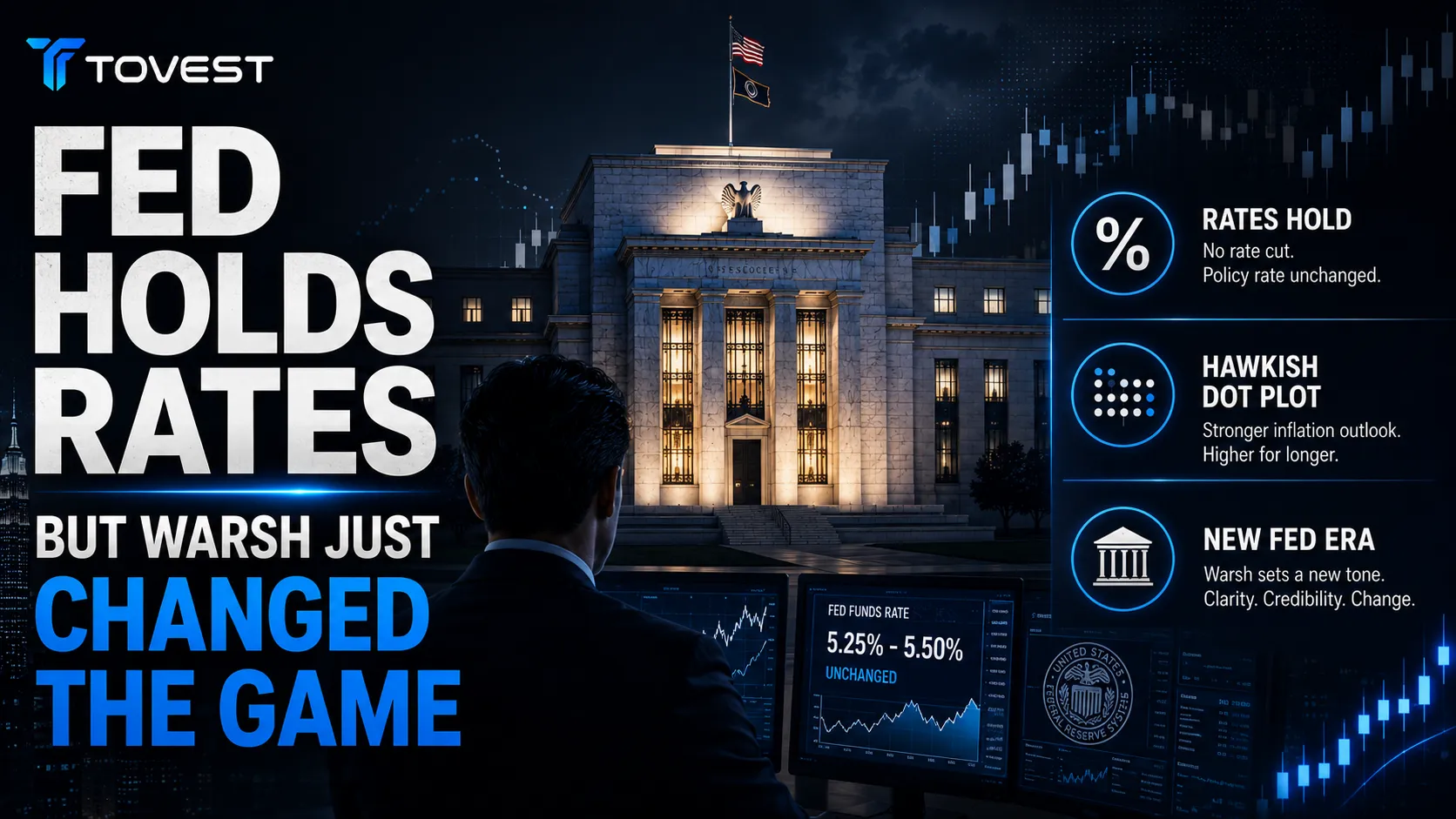
The Federal Open Market Committee voted unanimously to keep the federal funds rate unchanged at 3.5%–3.75% at the conclusion of its June 17 meeting. No surprise there. What surprised markets was everything else Warsh did around it.
Stocks fell immediately after the statement. The S&P 500 was down 0.6%, the Nasdaq Composite fell 0.7%, and the Dow dropped 160 points. Treasury yields moved higher — the 2-year yield jumped nearly 11 basis points to 4.153%.
The Dot Plot: A Sharp Hawkish Shift
This is the number that moved markets. Nine of 18 FOMC members projected a rate hike coming this year — a dramatic turnaround from March, when the median forecast still pointed to one cut in 2026 and zero members penciled in a hike.
The median forecast now shows the federal funds rate ending 2026 at 3.8%, up from 3.4% in March's projections. Traders responded immediately — futures markets are now fully pricing in one quarter-point rate hike before year-end, with a 60.7% chance of that hike arriving in October.
In an unusual move, Warsh himself did not submit a dot plot forecast — signaling his skepticism of forward guidance that could "lock the Fed's hands."
Warsh Overhauled the Statement — And Dropped Forward Guidance
Beyond the numbers, Warsh used his first meeting to signal a new governing philosophy. The Fed dropped forward guidance entirely. The policy statement was rewritten to be "shorter, simpler," removing older cutting-bias language that had been in place since December 2025.
Warsh made clear his view: "Financial markets perform best when they react to incoming data" rather than asking how the Fed will react to that data.
He also announced five task forces to review Fed communications, its balance sheet, data sources, and inflation frameworks. He has not committed to holding press conferences after every policy meeting — a practice Powell institutionalized — suggesting the Fed under Warsh will be deliberately less predictable.
The Inflation Reality Driving All of It
The hawkish shift did not happen in a vacuum. Consumer Price Index hit 4.2% annually in May — the highest since April 2023 — driven largely by higher oil and gas prices since the Iran war began in late February.
Updated forecasts from individual members suggested they expect to raise interest rates by a quarter percentage point this year — a turnaround from three months ago, when the average member was projecting a quarter-point cut.
Warsh reaffirmed the 2% inflation target without compromise: "The 'two' is the left of the decimal point. For now, 'zero' is to the right."
The Iran peace deal announced Sunday has eased some oil price pressure — but futures traders are not pricing in any rate cuts this year.
What This Means for Investors
Crypto takes the most direct hit. Risk assets underperform in hawkish cycles, and Bitcoin was already under pressure below $60,000 from SpaceX IPO outflows. A fully priced-in October hike extends that headwind.
Gold remains structurally supported. Higher-for-longer rates historically compress gold in the short term but the macro backdrop — sticky inflation, geopolitical risk, dollar uncertainty — keeps the long-term case intact.
RWA and tokenized treasuries benefit directly. In a high-rate environment, yield-bearing tokenized assets — particularly money market funds and bond products — offer retail investors the same returns that institutions have accessed for years.
IPO market faces compression. Anthropic and OpenAI both target Q3–Q4 listings. Higher rates mean lower growth multiples — both companies may need to reprice expectations downward from their private valuations.
The New Fed Era
Warsh inherited an economy with inflation at a three-year high, a central bank that had grown accustomed to extensive forward guidance, and a president pushing vocally for rate cuts. In his first meeting, he moved in the opposite direction on all fronts — tightening communication, signaling hikes, and restructuring how the institution operates.
"Wednesday's meeting confirms that the Federal Reserve's hawkish shift was not just about higher energy prices," said Kay Haigh, global co-head and CIO of fixed income at Goldman Sachs Asset Management.
The data will drive what comes next. But the direction Warsh set today is clear.
For informational and educational purposes only. This article does not constitute financial advice. All investments carry risk.