RWA Surged 589% While Crypto Slowed Down And the Numbers Are Hard to Ignore
June 10, 2026
On-chain real-world assets just posted one of the strongest growth runs in the history of digital finance. Here is what the data shows.
The Headline Number
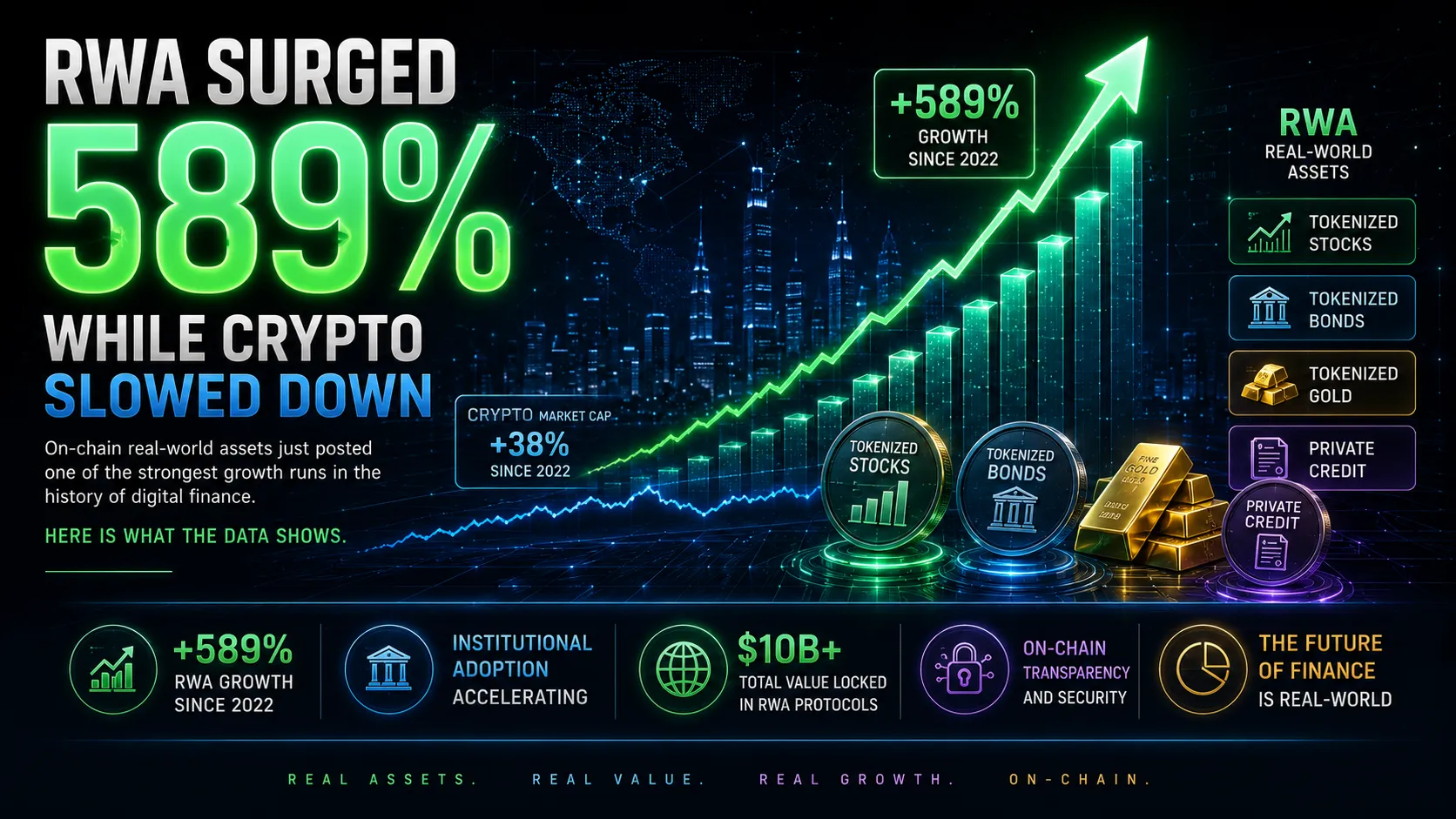
The total number of active tokenized real-world assets grew 589% from early 2025 to June 2026 even as broader crypto markets pulled back under macroeconomic headwinds, interest rate concerns, and regulatory uncertainty.
The sector's total market value reached $31.8 billion. A market that barely existed at institutional scale three years ago.
What Is Actually Growing And How Fast
Not all RWA categories are moving equally:
Bonds and money market funds led in dollar terms, adding $6.5 billion in value — an 83% gain over the period.
Tokenized stocks recorded the fastest percentage growth at 422%, driven by platforms offering blockchain-based access to traditional equities and ETFs. One leading platform crossed $1 billion in total value locked within eight months of launch.
Tokenized precious metals added $1.5 billion, a 39% gain, with tokenized gold briefly surpassing $6 billion as geopolitical uncertainty pushed safe-haven demand in early 2026.
Beyond established categories, newer "exotic" RWAs are also emerging — including tokenized reinsurance products, GPU infrastructure, mortgage lending, and foreign-exchange carry trade strategies. The market is not just growing. It is diversifying into territory that would have seemed implausible two years ago.
The Institutional Layer Is Now Undeniable
Growth is being driven by institutional adoption — particularly in tokenized money market funds and bonds from major firms including BlackRock, Fidelity, Circle, and leading RWA protocols.
The bank involvement goes further. JPMorgan, Citibank, and Bank of America are all reportedly working toward tokenized deposit networks, with broader deployment expected around 2027. These are not pilot programs or press releases. These are production-track infrastructure decisions at the largest financial institutions in the world.
The momentum reflects a broader push to combine traditional finance yields with on-chain settlement and transparency — motivations that persist regardless of broader crypto market conditions.
The Macro Context That Makes This More Significant
What stands out most in the latest industry data is the decoupling: macroeconomic headwinds, interest rate expectations, regulatory uncertainty, and broader sentiment pressures all weighed on crypto markets — while RWA continued to grow through all of it.
This is no longer primarily a crypto-native story. It is being driven by institutional demand for yield, settlement efficiency, and regulatory-grade transparency.
As one industry assessment put it: "2026 marks RWA tokenization's maturation from a treasury-dominated narrative into a diversified yield ecosystem."

What This Means for Retail Investors in SEA
The 589% growth figure is striking. But the more important signal is who is building the infrastructure behind it — and what that infrastructure enables.
When BlackRock and Fidelity deploy tokenized products at scale, the compliance frameworks, custody solutions, and regulatory precedents they establish become the foundation that retail-accessible platforms build on. The institutional wave is not competing with retail access. It is creating the conditions for it.
Tokenized stocks grew 422% — outpacing every other major RWA category. For investors in Southeast Asia who have historically faced friction accessing US equity markets, tokenized stocks represent the most direct entry point into a trend that institutions are already scaling aggressively.
The data is not a prediction. It is a record of what already happened — while most retail investors were looking elsewhere.
For informational and educational purposes only. This article does not constitute financial advice.