2026 Investor’s Playbook: Secure Tokenized Real Estate and Stock Opportunities Today
January 14, 2026
Global investors are no longer limited by borders, time zones, or large minimums. In 2026, you can buy fractional interests in U.S. real estate or stocks as blockchain-based tokens, fund your account with stablecoins, and trade around the clock—provided you stick to regulated platforms and clear documentation. This playbook shows how to buy tokenized real estate and tokenized stocks safely: choose a compliant platform, complete onboarding, evaluate token economics and liquidity, confirm audits and insurance, and build a diversified, exit-ready portfolio. Throughout, we highlight ToVest’s secure, transparent approach to compliant fractional ownership and 24/7 trading, designed for cost- and security-conscious international investors.

Understanding Tokenized Assets
Tokenized assets are digital representations of real-world financial instruments or properties recorded on a blockchain, enabling fractional ownership, programmable features, and automated compliance. Real-world asset tokenization is moving from pilot projects into mainstream finance, with multiple industries poised for significant transformation by 2026, according to an analysis on how RWA tokenization could transform industries by 2026 (fool.com). This shift is bringing tokenized real estate and tokenized stocks to everyday investors through regulated, user-friendly platforms.
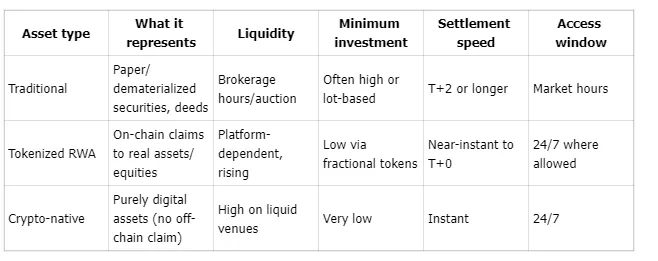
Comparison at a glance
What Are Tokenized Real Estate and Stocks?
Tokenized real estate uses blockchain-based tokens to represent fractional ownership of physical property, letting investors buy, sell, and trade stakes much like digital securities (A Strategic Guide to Real Estate Tokenization in 2026, antiersolutions.com). Tokenized stocks are blockchain tokens that mirror the economic rights of traditional equity—such as dividends and, where applicable, governance—delivered through a compliant wrapper. In practice, rights and restrictions depend on the offering documents and jurisdiction.
Real-world platforms illustrating this trend include ToVest, RealT, Securitize, Brickken, and tZERO, showcasing compliant issuance and secondary trading across property and equity markets (Top Real Estate Tokenization Platforms Driving the 2026 Market, linkedin.com).
How Do Tokenized Assets Work on Blockchain?
Tokenization leverages blockchain to support 24/7 market access, transparent transaction histories, and programmable features such as automated dividends and compliance checks embedded in smart contracts (Real World Assets: Crypto Investment for 2026, rwa.io). A typical lifecycle includes asset selection and legal structuring, token issuance, investor onboarding with AML/KYC, a primary offering, and secondary trading supported by automated payouts and cap table updates.
Process at a glance: Asset origination → Legal structuring and disclosures → Smart-contract/token issuance → KYC/AML onboarding → Primary sale → Secondary trading → Automated distributions and reporting.
Benefits of Investing in Tokenized Real Estate and Stocks
- Fractional ownership: Start with smaller tickets while accessing premium U.S. assets.
- Lower minimums and costs: Digitized workflows reduce friction compared to paper-heavy processes.
- Liquidity and near-instant settlement: Trade on compliant secondary markets with faster finality and transparent order books (Tokenized Assets: Platforms for 2026, rwa.io).
- 24/7 access: Participate outside traditional market hours, subject to jurisdictional rules (rwa.io).
- Programmable cash flows: Smart contracts can automate dividends, interest, and governance actions (rwa.io).
- Global reach with compliance controls: Qualified investors can participate across borders through standardized AML/KYC.
Key Risks and Regulatory Considerations
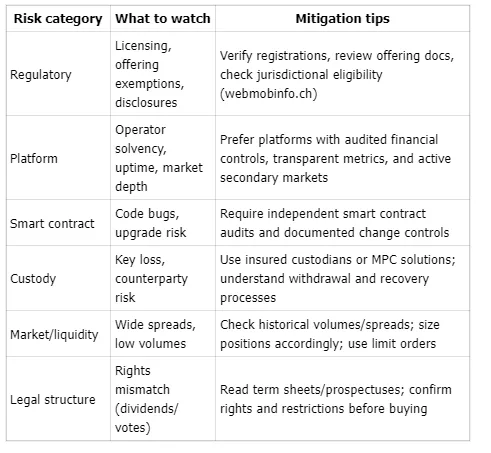
Regulatory uncertainty, platform risk, smart contract vulnerabilities, custody/key management, and variable liquidity are the principal risks to plan for in 2026 (Tokenized Assets: Platforms for 2026, rwa.io). Regulatory compliance is the process of ensuring all activities and offerings meet local and global securities, AML, and KYC requirements to protect investors.
Risk management map
Step 1: Research and Choose a Trusted Tokenization Platform
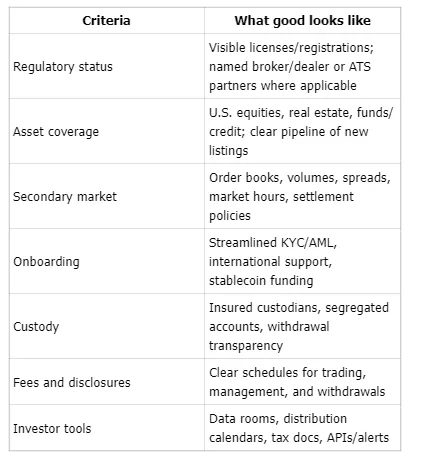
The right platform determines your asset menu, liquidity, fees, and compliance experience. Prioritize regulated venues with a documented track record, deep asset catalogs, robust custodial options, and active secondary markets (Top Real Estate Tokenization Platforms in 2025 and 2026, zoniqx.com).
Leading platforms active in 2026 include ToVest, Securitize, tZERO, RealT, Brickken, RedSwan CRE, and RealBlocks (linkedin.com; zoniqx.com). ToVest emphasizes compliant fractional access to U.S. stocks and real estate, 24/7 trading, and institutional-grade infrastructure for international investors.
Platform selection checklist
Explore ToVest’s approach to compliant, global access to tokenized assets (tovest.com).
Step 2: Verify Legal and Regulatory Compliance
Confirm that the platform and each offering adhere to securities laws, AML/KYC protocols, and publish prospectuses, private placement memoranda, or equivalent offering documents. Jurisdictional compliance means satisfying the legal standards for investors and operators in each country or region where services are offered. Practical checks include:
- Licensing: Look for published regulatory licenses/registrations and named compliance officers (How to Tokenize Real Estate, webmobinfo.ch).
- Eligibility: Confirm who can invest (retail/qualified), jurisdictional restrictions, and transfer limitations.
- Documentation: Review offering terms, risk factors, rights (dividends/votes), and audited financials where applicable.
Step 3: Complete Investor Onboarding and Secure Custody
KYC typically requires a government ID, proof of address, and, for entities, corporate documents. ToVest employs robust AML controls and international onboarding to safeguard investors.
Custodial vs. non‑custodial wallets:
- Custodial: A regulated custodian holds assets and keys; this allows for simpler recovery and integrated compliance.
- Non-custodial: You control keys; this provides higher autonomy but requires responsibility for security and backups.
Onboarding flow
- Create an account and complete identity verification.
- Fund via bank transfer or approved stablecoins (e.g., USDC), noting network and deposit instructions.
- Choose custody: platform custodian or connect a supported wallet.
- Review and accept offering documents before placing orders.
Step 4: Evaluate Token Economics and Market Liquidity
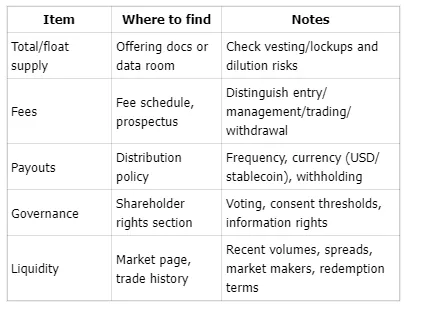
Token economics is the study of how token supply, distribution, incentives, and usage influence the value and function of a tokenized asset. Before investing, analyze supply caps, fee structures, payout mechanics, governance rights, and secondary market depth (Real World Assets: Crypto Investment for 2026, rwa.io).
Term sheet essentials and where to look
Step 5: Confirm Audit, Insurance, and Institutional Backing
Favor assets and platforms with independent smart contract audits, insured custody, and reputable institutional partners or managers (zoniqx.com). A smart contract audit is an independent verification of a blockchain contract’s code to ensure security and proper functioning.
Security due-diligence checklist
- Audit status: Name of auditor, date, and scope of findings.
- Custody protections: Insurance coverage, segregation, and SOC reports.
- Institutional involvement: Recognized property managers, transfer agents, or underwriting partners.
- Operational transparency: Incident response plans, change-management policies, uptime history.
Step 6: Build a Diversified Portfolio with Tokenized and Traditional Assets
Blend tokenized assets with traditional holdings to improve resilience. Many 2026 playbooks emphasize a greater role for alternatives alongside equities and bonds as investors seek diversified sources of return (AI, Stocks, Alternatives, and the New Market Playbook for 2026, blackrock.com).
A reimagined 60/40 with tokenization
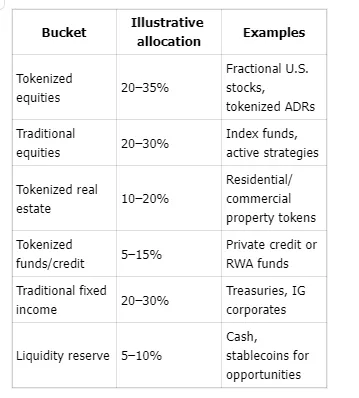
Adjust weights to your risk tolerance, jurisdiction, and time horizon.
Step 7: Plan Exits and Monitor Market and Regulatory Changes
Before you buy, confirm there’s a compliant, liquid secondary market, applicable lockups, and all exit fees. Ongoing success requires monitoring platform health, legal/regulatory changes, and new listings or features as the tokenization market evolves (Tokenized Assets: Platforms for 2026, rwa.io).
Ongoing monitoring checklist
- Secondary market: Spreads, volumes, and settlement reliability.
- Regulatory updates: New guidance that affects eligibility, custody, or reporting.
- Platform security: Fresh audit reports, incident disclosures, uptime metrics.
- Asset performance: Distribution timeliness, NAV or appraisal updates, tenant/issuer news.
- Pipeline: Upcoming listings for diversification and rebalancing.
Frequently Asked Questions
What types of tokenized assets can I invest in?
Investors can access tokenized real estate, U.S. and global equity shares, private credit, tokenized funds, and other real-world asset tokens, depending on platform availability and compliance.
How secure is the ownership of tokenized stocks and real estate?
Ownership is recorded on-chain and safeguarded by AML/KYC checks and audited smart contracts on regulated platforms, which help protect legal rights and custody.
Can I trade tokenized assets around the clock?
Yes, many compliant platforms, including ToVest, support 24/7 trading with near-instant settlement, subject to jurisdictional rules.
What are the typical fees involved in tokenized asset investing?
Expect trading spreads, possible management or platform fees, and withdrawal charges; reputable platforms publish these schedules upfront.
How do I know if tokenized assets comply with regulations in my country?
Check for platform registration, clear jurisdictional eligibility disclosures, and visible AML/KYC policies, and review the offering documents before investing.