7 Simple Ways to Turn Crypto into U.S. Stocks in 2026
January 2, 2026
Rebalancing from crypto into U.S. equities is top of mind in 2026 as digital assets continue to see sharp, headline-driven swings and investors seek steadier, diversified returns. Market forecasters still expect volatility to persist around major catalysts, making a gradual or rules-based shift into equities a sensible move for risk management and long-term planning, especially for global investors who hold a large share of their wealth in crypto-native wallets. On- and off-ramps now span straightforward fiat conversions, crypto-native brokerages, stablecoin rails, and on-chain tokenized stocks—each with distinct trade-offs on speed, costs, custody, and compliance.

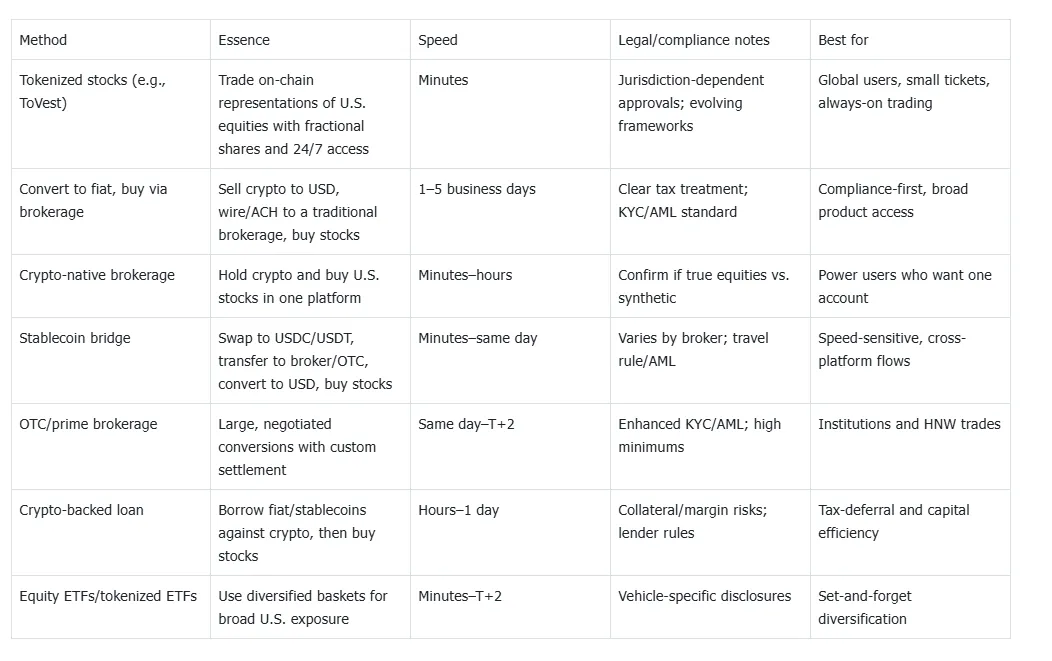
Here’s a quick snapshot of seven practical ways to convert crypto into U.S. stock exposure in 2026.
ToVest Tokenized Stocks and Real-World Assets Platform
Tokenized stocks are blockchain-based representations of real-world equity shares, allowing investors to buy, hold, and trade U.S. stocks on-chain with real-time settlement and fractional ownership. ToVest’s platform brings on-chain equities and real-world assets together, enabling seamless movement from crypto to equity exposure without leaving the digital asset ecosystem. You can purchase fractional shares with low minimums, execute in seconds, and custody positions on-chain with transparent auditability—while staying within robust, jurisdiction-specific regulatory frameworks and reporting.
Because tokenized stocks are composable with DeFi, portfolio tools like automated rebalancing, limit/stop orders, and 24/7 trading are native—not bolted on. For global investors, this means a single account that supports both crypto and equities, real-time settlement, and consolidated statements that align with local reporting norms. It’s blockchain investing designed for practical equity exposure, not just experimentation. For a deeper dive into tokenization’s portfolio benefits, see ToVest’s RWA research overview.
Fiat Conversion and Traditional Brokerage Purchase
The classic route remains the cleanest from a compliance perspective: sell crypto into USD, move funds to your bank, deposit into a brokerage, and buy the U.S. stocks you want.
- Step-by-step: sell crypto on your exchange; withdraw USD to your linked bank; deposit to a brokerage; place stock or ETF orders (market, limit, or fractional where available).
- Pros: regulatory clarity, wide product access, and straightforward tax reporting. Bankrate’s guide to cashing out crypto underscores that this path is widely supported and easy to document for taxes and audits.
- Cons: bank transfer wait times, potential withdrawal and network fees, and the crypto sale itself may create a taxable event.
Capital gains exposure: in the U.S., selling crypto for USD or spending it is taxable; accurate cost-basis tracking is critical. The IRS now treats digital assets as property for tax purposes and is rolling out broker reporting via Form 1099-DA starting with 2025 transactions, increasing the importance of clean records and reconciled lots.
Sources: Bankrate on cashing out crypto; IRS guidance on digital assets and forthcoming broker reporting.
Crypto-Native Brokerages Offering U.S. Stocks
Crypto-native brokerages are digital asset platforms that also offer direct stock purchase capabilities, enabling you to deposit BTC/ETH/USDC and buy U.S. equities all in one interface. Some offer true equities with regulated custody partners; others provide synthetic or derivative exposure that tracks stock prices but isn’t the same as holding actual shares.
- Benefits: speed, fewer hops, and unified dashboards for multi-asset trading.
- Considerations: verify what you’re buying (real shares vs. contracts), custody arrangements, investor protections, and regional availability.
- Practical example: Bitget’s XStock illustrates how crypto wallets are being bridged to U.S. stock exposure within a single app workflow, though product structures and protections differ by provider.
Stablecoin Bridge Transfers to Brokerage Accounts
Stablecoins are cryptocurrencies pegged to fiat currency (usually the U.S. dollar), used for fast, reliable value transfers between platforms. A typical flow: convert BTC/ETH to USDC or USDT, transfer to a supported broker or OTC desk, convert to USD if needed, and buy your target stocks.
Advantages include near-instant settlement, minimal price slippage during transfer compared with volatile coins, and compatibility with DeFi or institutional workflows. Counterparty diligence remains crucial—ensure the receiving institution supports your stablecoin rail and clarifies conversion steps and fees. Analysts expect 2026 to bring further institutionalization of stablecoins and tokenized payment rails, enhancing reliability and integration with traditional finance.
Source: Analyst roundup on 2026 crypto and stablecoin adoption.
On-Chain Tokenized Equities Trading
On-chain tokenized equities are tradable digital tokens representing real stocks, allowing users to invest, trade, and benefit from DeFi features beyond conventional market hours. This model enables instant (or near-instant) settlement, granular fractional shares, and 24/7 market access—powerful for dollar-cost averaging, automated strategies, and global investors outside U.S. market hours.
- Pros: real-time settlement, fractional ownership, always-on trading, and composability with on-chain tools.
- Cons: liquidity is still developing and legal frameworks vary by jurisdiction; confirm that tokens are backed 1:1 by underlying shares with licensed custodians.
Institutional research expects tokenized securities to expand through 2026 as infrastructure and compliance rails mature, even if liquidity concentrates first in large-cap names and broad indices.
Over-the-Counter and Prime Brokerage Solutions
OTC desks and prime brokers enable high-net-worth and institutional clients to convert large crypto positions into U.S. equity exposure off-exchange, with negotiated pricing, custom settlement windows, and coordinated custody. Expect rigorous KYC/AML, higher minimums, and relationship-based onboarding. In return, you can minimize slippage, streamline operational risk, and access block liquidity—especially useful around earnings seasons or rebalance dates. As competition among major platforms intensifies, pricing and execution quality continue to improve across both spot and equity rails.
Context: Platform competition and zero/low-commission models have spread across the industry, a trend highlighted by Reuters coverage of big exchanges expanding trading offerings.
Crypto-Backed Loans to Invest in Stocks
A crypto-backed loan allows you to borrow traditional currency or stablecoins using your digital asset holdings as collateral. The flow: deposit crypto with a lender, borrow USDC or USD against it, transfer funds to a brokerage, and purchase stocks—while retaining upside exposure to your crypto if prices rise.
This can defer realizing taxable gains, but it introduces leverage and liquidation risk: if crypto prices fall and your loan-to-value breaches thresholds, you may face margin calls or forced collateral sales. In 2026, improved on-chain credit rails and more conservative LTVs have made this approach more accessible to sophisticated retail and smaller institutions, but prudent sizing and stress testing are essential.
Equity-Linked Products and Tokenized ETFs
Equity-linked products are investment instruments (like ETFs or ETPs) that track a basket of stocks, providing broad exposure via a single purchase. If you’ve converted crypto to USD or stablecoins, you can rotate into sector ETFs, factor funds, or broad market trackers; alternatively, tokenized ETFs offer similar baskets on-chain with fractional access and 24/7 trading.
Tokenized ETFs can improve accessibility and settlement speed compared to traditional wrappers, though fees, liquidity, and regulatory treatment vary by issuer and venue. Research shops expect tokenization to accelerate the bridge between traditional funds and digital rails through 2026, broadening both diversification options and market access for global investors.
Frequently Asked Questions
Is converting crypto to stocks taxable and how do I report it?
Yes. Selling crypto to USD to buy stocks is a taxable event; track cost basis and expect broker reporting via Form 1099-DA as new IRS rules phase in.
Can I directly swap crypto for U.S. stock shares without converting to fiat?
Generally no for traditional shares, but tokenized equities and certain crypto-native structures can provide stock exposure on-chain without an intermediate bank transfer.
What are the fastest methods to move from crypto to stock exposure?
Crypto-native brokerages and stablecoin bridge transfers are typically the fastest, enabling near-instant conversion and reinvestment.
How can I minimize tax impact when converting crypto to equities?
Use specific-ID accounting (e.g., HIFO) to optimize cost basis, and consider crypto-backed loans to defer realizing gains—ideally after consulting a tax professional.
Are tokenized stocks and crypto ETFs equivalent to traditional stocks?
They can mirror exposure to the underlying, but custody, trading hours, disclosures, and investor protections differ; review each product’s structure and legal documentation carefully.