Benefit-Focused Guide: Diversifying Your Portfolio with USDT Stability
December 24, 2025
USDT can function as the cash-equivalent spine of a modern portfolio—liquid when you need speed, stable when markets swing, and interoperable across crypto and tokenized real-world assets. By holding a portion of your allocation in USDT, you can reduce volatility, rebalance faster, and move into opportunities 24/7 without bank delays. On ToVest, you can even buy tokenized U.S. stocks and other real-world assets directly with USDT, eliminating fiat on-ramps and settlement friction. This guide explains what USDT is, where you can deploy it, how to get started, and how professionals use it for buffers, collateral, and yield—all while managing risks with practical safeguards.
Understanding USDT and Its Role in Portfolio Diversification
USDT, or Tether, is a stablecoin designed to maintain a 1:1 value with the U.S. dollar by holding reserves such as cash and short-term U.S. Treasuries. Issuer attestations and reserve composition aim to support the peg and reduce price swings typical of cryptocurrencies, making USDT a cash-like instrument on-chain, as outlined in J.P. Morgan Private Bank’s guide to stablecoins (Demystifying stablecoins).
Stablecoins are digital tokens pegged to fiat currencies that settle on public blockchains. For investors, they combine instant, global transferability with familiar dollar-denominated value, enabling liquidity management and tactical allocation without exiting to banks, as summarized in Kraken’s overview of crypto portfolio diversification.
USDT’s unique role stems from its high liquidity and broad acceptance across exchanges and platforms. It’s widely used for quick portfolio adjustments, as margin collateral, and to preserve capital value during periods of market stress—use cases highlighted in analyses of stablecoin utilization and liquidity.
Can You Buy Stocks or Assets Directly with USDT?
Yes. Platforms like ToVest allow users to buy tokenized U.S. stocks and other real-world assets directly with USDT, removing the need for fiat on-ramps or wire transfers and enabling near-instant settlement. Tokenized assets are digital representations of real-world assets—such as equities, commodities, or real estate—issued on a blockchain for fast, transparent trading and settlement. For a primer on how tokenized markets work in practice, see ToVest Academy’s overview of tokenized markets.
USDT-eligible assets on ToVest typically include:
- Tokenized U.S. equities (single stocks and thematic baskets)
- Commodities exposure (e.g., gold proxies)
- Other tokenized securities and market trackers
Comparison: buying assets with USDT vs. traditional fiat

Investment Options That Accept USDT Deposits for Quick Transactions
You can deploy USDT across a wide spectrum of investment avenues:
- Tokenized U.S. stocks and real-world assets on ToVest for direct, dollar-denominated exposure without bank rails.
- Crypto spot markets for major assets and indices.
- DeFi lending on platforms like Aave, Compound, and Curve. Aave USDT supply APY typically ranges around 2–5%, but can spike when borrowing demand rises, according to a USDT investment analysis covering DeFi yields.
- Derivatives venues (perpetuals/options) where USDT is a common margin and settlement currency.
Because stablecoins serve as a neutral settlement layer, you can shift between these instruments rapidly—preserving optionality, redeploying into momentum, or parking in stable value during drawdowns. High secondary-market liquidity amplifies this advantage by enabling fast entries and exits.
How to Start Investing Using USDT on Popular Platforms
- Acquire USDT: Buy on a reputable exchange or convert from fiat/crypto; choose your preferred network (e.g., ERC‑20, TRC‑20) and confirm fees.
- Create and secure your account: Register on ToVest, enable multi-factor authentication, and complete KYC/AML verification.
- Deposit USDT: Generate a deposit address on the correct chain, send a small test transfer, then fund the full amount.
- Select products: Choose tokenized U.S. equities, commodities exposure, DeFi strategies, or crypto spot/derivatives based on your plan.
- Execute and manage: Place orders, set risk controls (limits/alerts), and track allocations.
Tips:
- Check wallet compatibility and on-chain support if using external wallets or other platforms.
- Instant USDT deposits enable 24/7 market access and near-immediate spot trading—an edge compared to conventional bank rails.
Benefits of Investing with USDT in a Diversified Portfolio
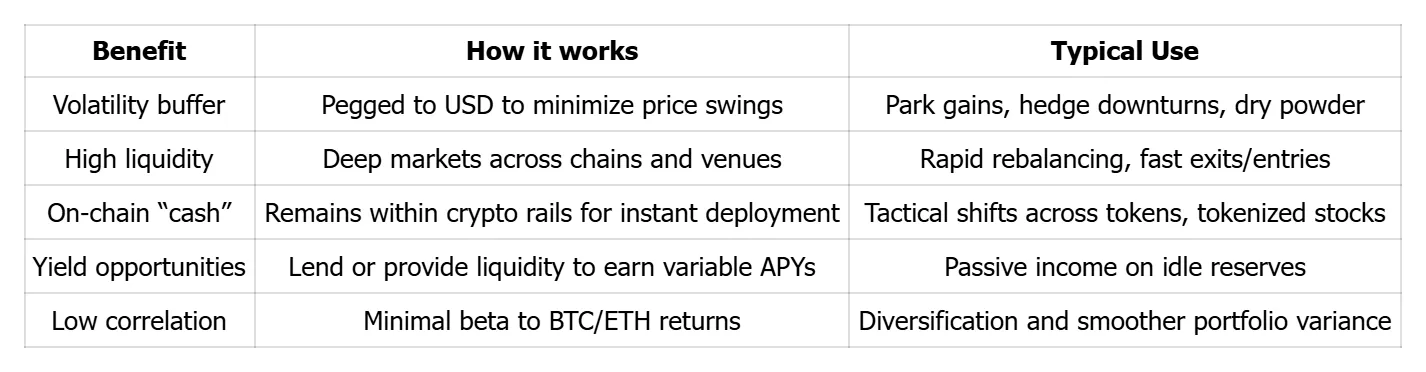
Core advantages include:
- A low-volatility store of value within crypto portfolios to preserve capital in high-volatility regimes.
- USDT is the largest stablecoin by volume, prized for high liquidity on exchanges, enabling fast entries and exits in risk assets.
- Keeps “cash” on-chain, supporting tactical rotation and yield generation in lending or derivatives without converting to fiat, as described in Bitso’s guidance on diversifying a crypto portfolio.
- Low return correlation with major crypto assets like BTC and ETH, aiding risk diversification; see research on crypto asset correlations.
Benefit summary
Step-by-Step Guide to Using USDT for Portfolio Diversification
- Define purpose: Decide if USDT is a buffer, hedge, collateral, yield asset—or a mix—following XBTO’s institutional best practices that often include a 5–10% cash-equivalent buffer for agility.
- Diversify stablecoins: Split holdings across USDT and other stablecoins to mitigate single-issuer risks like freezes or depegs.
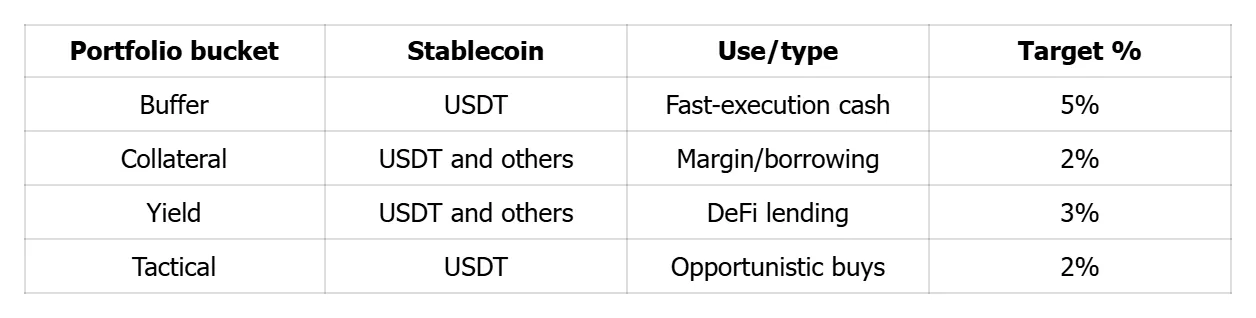
- Create an allocation checklist:
- Portfolio bucket (buffer, collateral, yield, tactical)
- Stablecoin (USDT and others)
- Use/type (exchange collateral, DeFi lending, dry powder)
- Target percentage (e.g., 5–10% aggregate “cash”)
Sample matrix
- Set rebalancing rules: Review monthly or use volatility triggers (e.g., rotate +3–5% into USDT on sharp drawdowns; redeploy when trend recovers).
- Worked example: During a market pullback, convert part of volatile holdings into a stablecoin mix—say 60% USDT, 30% USDC, 10% DAI—allocate a slice to lending for yield, and keep a fast-access USDT tranche for opportunistic entries when liquidity dries up.
Managing Risks When Investing with USDT
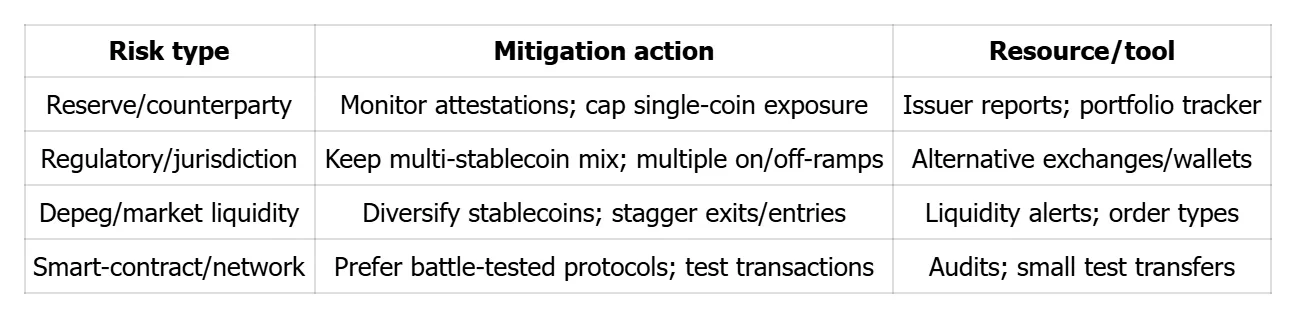
Key risks and mitigations:
- Counterparty/reserve risk: Stability depends on reserves and transparency; recent analyses note a substantial share of USDT reserves in cash/cash equivalents alongside attestations. Mitigate by monitoring issuer reports and limiting concentration.
- Regulatory/policy risk: Access may vary by jurisdiction; maintain alternative stablecoins and multiple on-ramps.
- Depeg/smart-contract risk: Fiat-collateralized stablecoins are typically preferred for large “cash” allocations; diversify venues and chains, and test transfers.
Monitoring and best practices:
- Subscribe to issuer attestations and reserve updates.
- Use portfolio dashboards to track exposures and on-chain transfer health.
- Maintain stablecoin diversity and predefine contingency rails (backup exchanges/wallets).
Risk summary
Frequently Asked Questions about USDT and Portfolio Diversification
What is USDT and how does it work?
USDT is a dollar-pegged stablecoin designed to hold a 1:1 value with the U.S. dollar via reserves and attestations, making it useful for trading, settlement, and capital preservation on-chain.
Why would I use USDT instead of traditional currency?
USDT enables 24/7, near-instant transfers and global market access without bank delays, while keeping value denominated in dollars.
How does USDT help with portfolio diversification?
It adds a stable allocation that dampens volatility, supports rebalancing and hedging, and allows you to earn yield without converting to fiat.
What are the risks associated with USDT?
Risks include reserve and counterparty exposure, regulatory changes, and potential depegs; diversify stablecoins and monitor issuer transparency to mitigate.
How is USDT backed and what ensures its stability?
USDT is backed by a mix of reserves (e.g., cash and U.S. Treasuries) with regular attestations designed to maintain its 1:1 dollar peg.
Can I earn returns on my USDT holdings?
Yes—lending USDT in DeFi or using earning products on ToVest can generate variable yields while preserving a stable principal value.
What makes USDT different from other stablecoins?
Its deep liquidity, broad exchange acceptance, and multi-chain availability make USDT easy to trade and use across crypto applications.
Is USDT suitable for long-term investments?
It’s best used as a liquidity and capital-preservation tool or yield sleeve, not for long-term growth like equities or high-beta crypto.