How Does Blockchain & Crypto Actually Work? The Complete Education Guide
July 17, 2026
Why Understanding Blockchain Matters More Than You Think
Most people who buy crypto do not understand how blockchain works — they just watch numbers go up or down. That is fine when everything works. But when something goes wrong — wallet hacked, exchange collapses, transaction lost — people who do not understand blockchain typically lose money without knowing why or how to prevent it.
This is not academic theory. This is practical knowledge that helps you:
- Understand why Bitcoin cannot be counterfeited
- Know what a crypto wallet is and why you need to control your private key
- Understand how RWA tokens on ToVest work differently from speculative altcoins
- Know how crypto transactions happen and why they cannot be reversed
Part 1: What Is Blockchain?
The Simplest Explanation
Imagine a ledger book that records every transaction: who sent money to whom, how much, when. In traditional banking, that ledger sits on the bank's server — only the bank sees and controls it.
Blockchain is that ledger, but with three core differences:
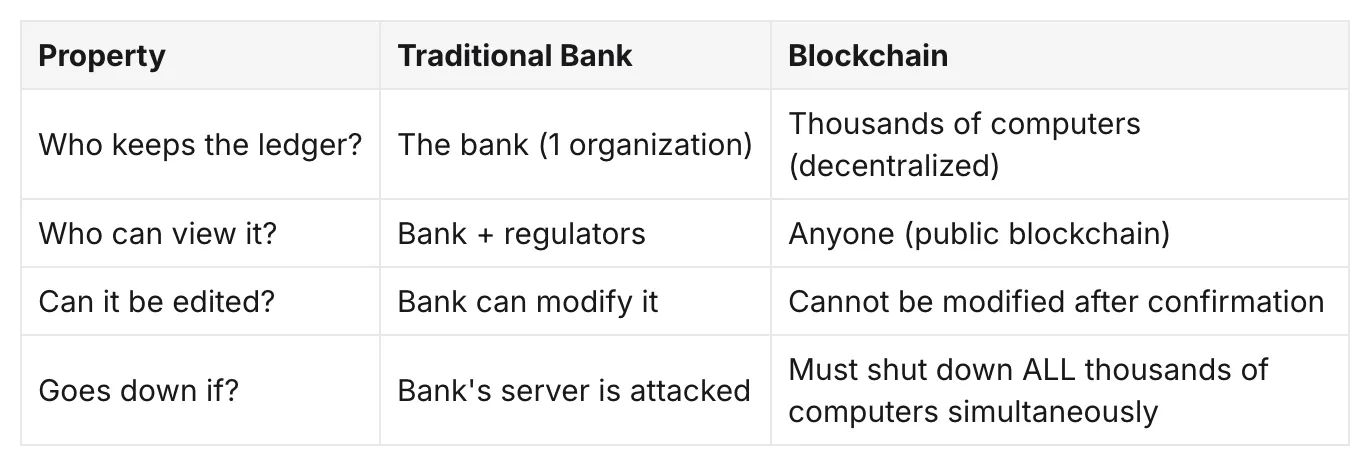
What Are "Block" and "Chain"?
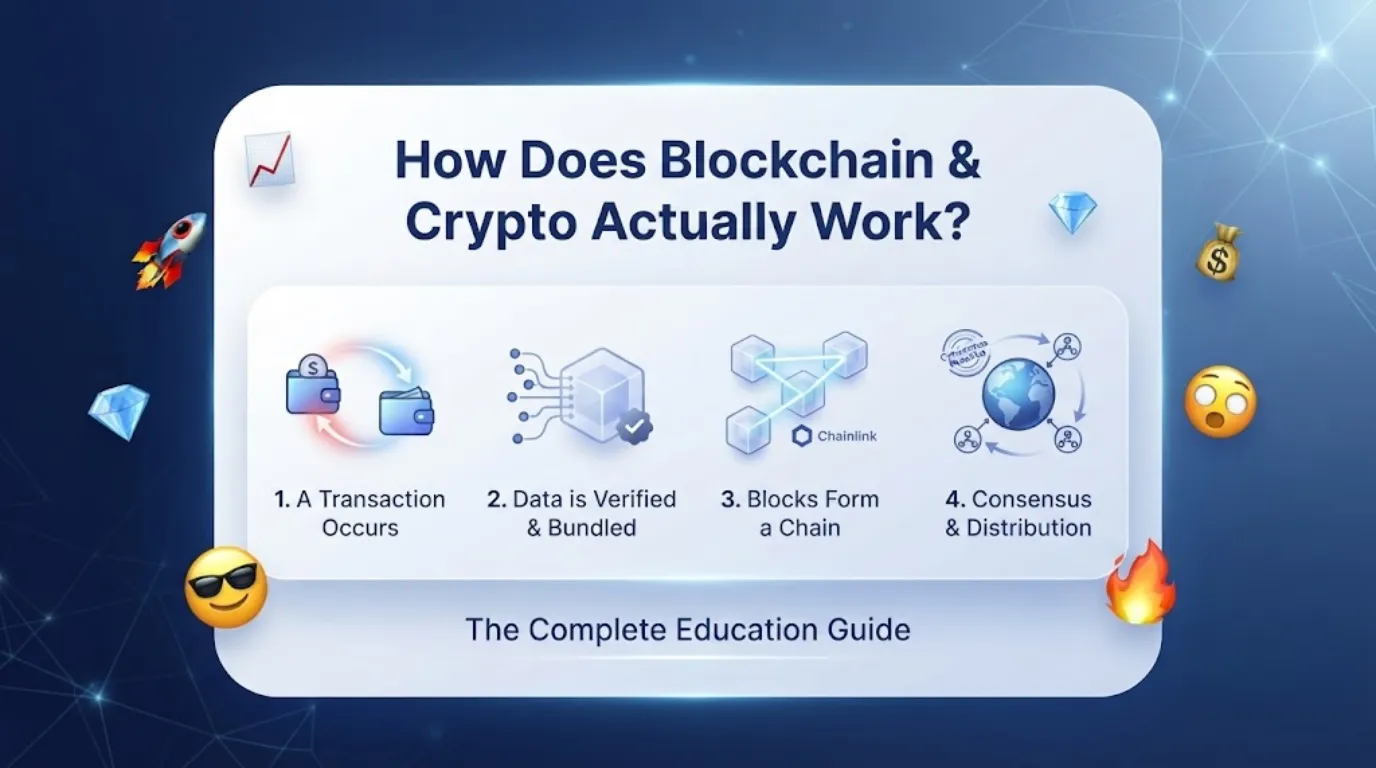
- Block = a group of transactions bundled together
- Chain = blocks connected to each other in chronological order
- Hash = a unique "fingerprint" of each block — if any transaction is changed, the hash changes, breaking the entire chain
This is why blockchain cannot be faked: To alter an old transaction, you would need to recalculate the hash of every subsequent block — across all thousands of computers running the blockchain simultaneously. Computationally, this is essentially impossible.
Part 2: What Is Cryptocurrency?
The Precise Definition
Cryptocurrency is a type of digital asset that:
- Exists on a blockchain — no physical form
- Is secured by cryptography (hence "crypto")
- Has no central bank or government controlling it (for Bitcoin, Ethereum)
- Can be sent to anyone worldwide in seconds at very low cost
Part 3: What Is a Crypto Wallet? (Most Important)
A Crypto Wallet Does Not "Hold" Your Money
This is the most common misconception. A crypto wallet does not contain your money — your money always sits on the blockchain. The wallet holds keys that prove you are the owner.
Think of it this way:
- Blockchain = a global bank storing all balances
- Wallet address (Public Key) = your account number — can be shared publicly to receive funds
- Private Key = your PIN + signature — never share with anyone
Public Key vs Private Key
What Is a Seed Phrase (12/24 Words)?
When you create a new wallet, you receive a seed phrase — a sequence of 12 or 24 random English words.
Seed phrase = the master key to your entire wallet. Anyone with this phrase can restore your wallet and take all your assets on any device.
Golden rules:
- ✅ Write by hand on paper, store in a safe place
- ✅ Can create multiple paper backups in different locations
- ❌ Never photograph, save to phone, send via email or messaging apps
- ❌ Never enter into any website other than your official wallet app
Part 4: Types of Blockchain and Tokens
What Is a Token? How Is It Different From Bitcoin?
Bitcoin is the native coin of the Bitcoin blockchain — mined, with no company issuing it.
RWA tokens on ToVest are a special category: each token is 100% backed by real assets (physical gold, actual stocks) — not speculation or "money from nothing."
Part 5: Consensus — How Blockchain Agrees
The biggest challenge of a decentralized system: how do thousands of computers agree on which transactions are valid?
Proof of Work (PoW) — Used by Bitcoin
- Computers must solve complex math problems to add new blocks
- Winner is rewarded with new Bitcoin
- Also called: "Mining"
- Downside: Consumes enormous amounts of electricity
Proof of Stake (PoS) — Used by Ethereum
- Participants "lock" (stake) ETH as collateral
- Randomly selected to validate blocks, receive rewards
- ~99.95% more energy-efficient than PoW
- Ethereum switched to PoS in 2022
Part 6: DeFi, CeFi, and RWA — Three Worlds of Crypto
CeFi (Centralized Finance)
Platforms like Binance, Coinbase, or ToVest — a company operates the platform, KYC required, team accountable.
Pros: Easy to use, customer support, legal compliance
Cons: Dependent on the company (risk if exchange collapses like FTX)
DeFi (Decentralized Finance)
Automatic protocols on blockchain — no company, no CEO, only smart contracts. Examples: Uniswap (exchange), Aave (lending), Compound (lending).
Pros: No need to trust third parties, cannot be "shut down" by governments
Cons: Complex, smart contract bug risk, no support when issues arise
Part 7: Why Crypto Transactions Cannot Be Reversed
This is the biggest difference from traditional banking — and the reason to be careful:
In Traditional Banking:
- Wrong transfer → call the bank → possible refund
- Scammed → report to bank → possible account freeze
In Crypto:
- Transaction sent → permanently written on blockchain → cannot be reversed
- Sent to wrong address → money lost forever
- Scammed → no refund mechanism exists
Why is it designed this way?
Because immutability is the security guarantee of blockchain. If transactions could be reversed, someone has control — and that is no longer decentralized.
Practical implications for investors:
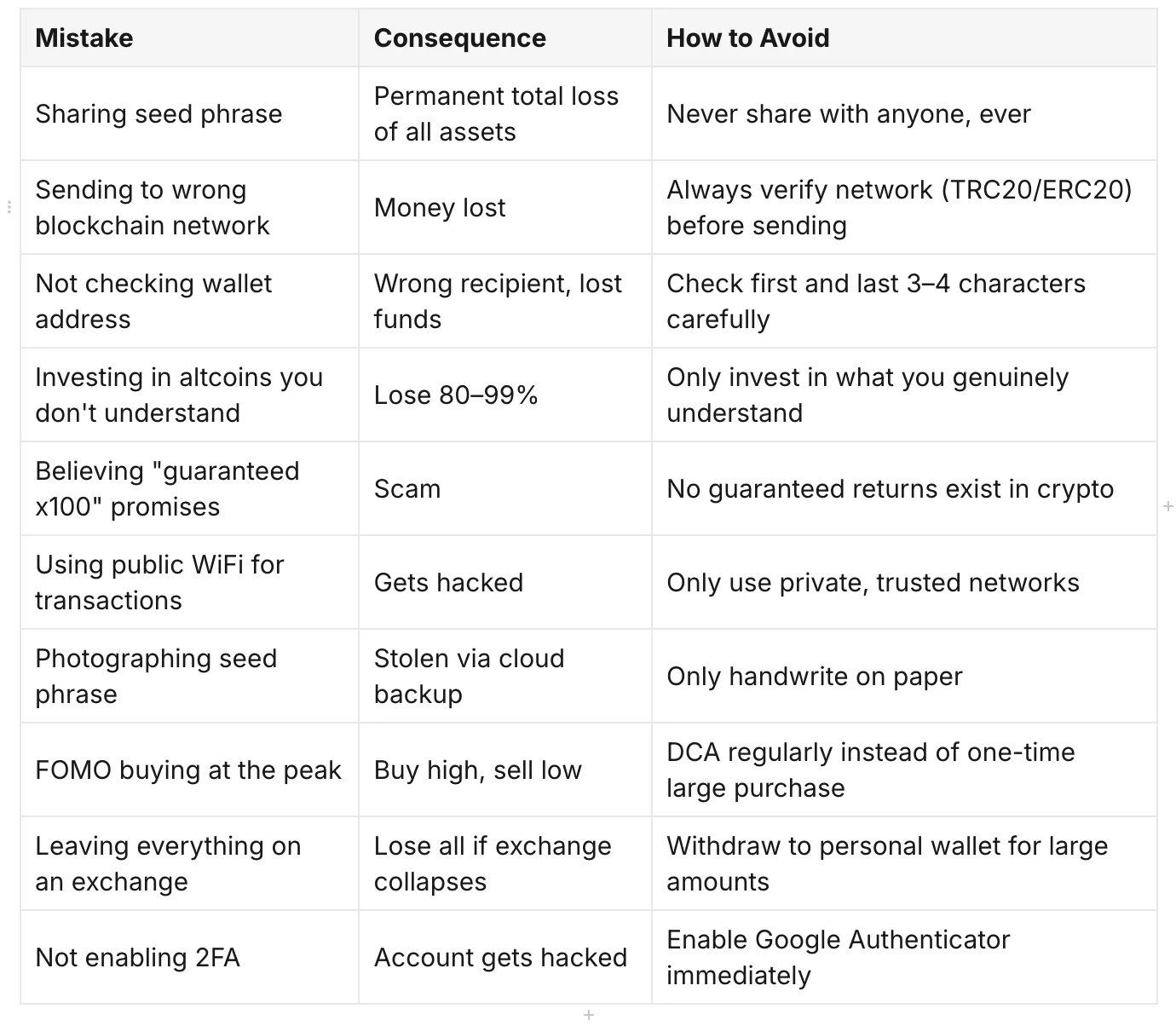
- Always double or triple check the recipient wallet address before sending
- Send a small test amount first before sending everything
- Never send crypto at the request of strangers via phone or social media
Part 8: Essential Crypto Glossary
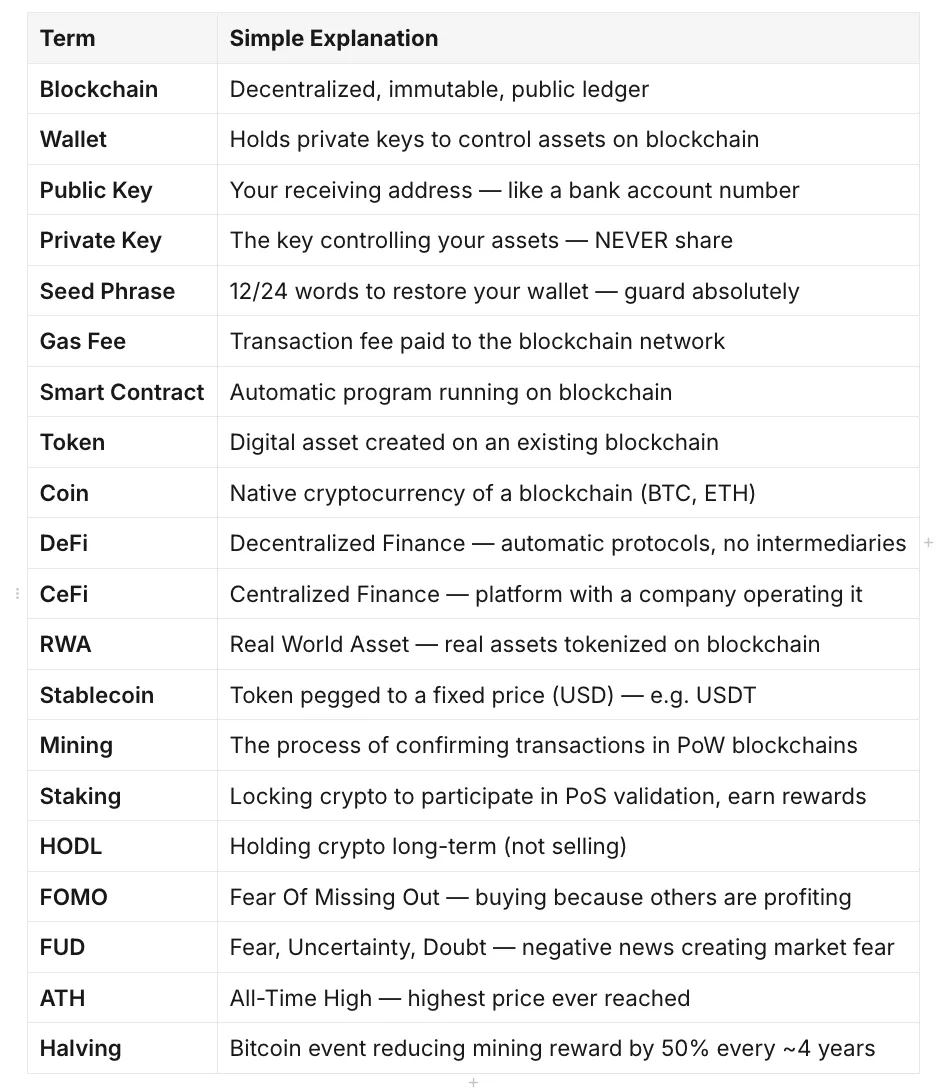
The 10 Most Common Mistakes in Crypto (And How to Avoid Them)
Frequently Asked Questions (FAQ)
What is blockchain and why can't it be hacked?
Blockchain is a decentralized database — data is stored simultaneously across thousands of computers. To "hack" the blockchain, you would need to control more than 51% of all computers in the network simultaneously — practically impossible for Bitcoin or Ethereum. The real vulnerability is not the blockchain itself but the wallets and exchanges that users interact with.
What is the difference between a private key and a seed phrase?
The seed phrase (12/24 words) is a human-readable form of the private key — used to restore a wallet on a new device. The private key is the directly encoded control string. Both control all your assets — lose or expose either one and your assets are gone.
Why can't crypto transactions be reversed when sent to the wrong address?
Because immutability is the core security property of blockchain — once a transaction is confirmed and written into a block, no one (including the blockchain creators) can modify or delete it. This is simultaneously its greatest strength (no one controls it) and its most important risk to manage (wrong transactions cannot be undone).
Can smart contracts have bugs?
Yes — and this is a real risk in crypto. History has shown many smart contract exploits (The DAO 2016, multiple DeFi protocols 2021–2023). This is why smart contracts on serious platforms like ToVest must be audited by independent security firms before launch.
How is an RWA token different from a regular altcoin?
Regular altcoin: value comes from expectations, speculation, narrative — can go to zero if the project fails. RWA token: each token is backed by a real asset (gold, stocks) held in custody by an independent third party — value tracks the underlying real asset, cannot go to zero because physical assets always retain value.
Do I need to understand blockchain to use ToVest?
No. ToVest is designed for investors without blockchain expertise. You only need USDT, a KYC-verified ToVest account, and an understanding of the asset you want to invest in (gold, stocks). The blockchain layer runs completely in the background, automatically.
Summary: What You Need to Remember
After reading this guide, you understand that:
- Blockchain = decentralized, immutable ledger — no one controls it
- Crypto wallet = holds keys (private key), not money — money lives on blockchain
- Seed phrase = master key — protect it as carefully as physical cash
- Transactions = cannot be reversed — always verify before sending
- RWA tokens = crypto backed by real assets — far safer than speculative altcoins
- Smart contracts = automatic programs — ToVest uses them to issue/redeem RWA tokens transparently
This knowledge keeps you safer — and helps you understand why ToVest is the most suitable entry point for investors who want to participate in digital assets: real assets, transparent blockchain mechanics, starting from $2 USDT.
Apply this knowledge in practice — open your ToVest account and experience RWA tokens from $2 at tovest.com