Stablecoin Investment Guide 2025: Maximize Returns Safely This Year
17 ธันวาคม 2568
Understanding Stablecoins and Their Role in Investment
Stablecoins are blockchain-based tokens pegged to assets like the US dollar that are designed to hold a steady value while enabling fast, low-cost transactions and settlement. Unlike volatile cryptocurrencies, they function as a store of value, a bridge currency between exchanges, and a gateway to decentralized finance (DeFi) opportunities that can earn yield. The total stablecoin supply reached roughly $208 billion in Q1 2025, with about 90% pegged to USD, underscoring their central role in crypto liquidity and payment rails (ARK Invest research). Stablecoins can help investors hedge crypto volatility, move funds globally in minutes, and park liquidity between trades while remaining primed for opportunities. If your goal in 2025 is high, durable returns with controlled risk, start by choosing regulated, fully backed coins and pair them with compliant yield products that publish transparent reserve and audit data.
- Hedging volatility in crypto portfolios
- Fast, low-cost global transfers and settlement
- Parking funds for liquidity between trades
Citations: Token mechanisms overview (TokenMetrics). Market size and USD dominance (ARK Invest).
Research Regulatory Frameworks for Stablecoin Investing
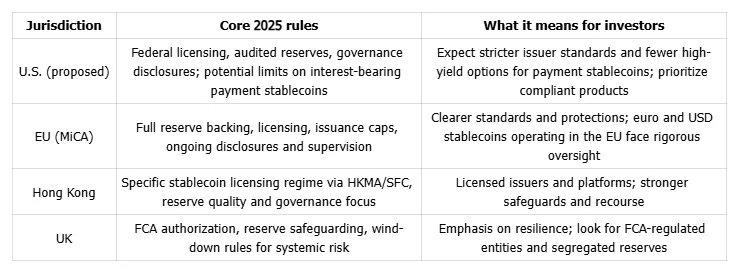
Regulation sets the floor for transparency, reserve quality, and investor protection—so map your jurisdiction before you invest or chase yield. In 2025, Europe’s MiCA regime requires full reserves, issuer licensing, and clear disclosures for stablecoin operations, raising the bar on governance and transparency. In the U.S., proposals like the GENIUS Act would require federal licensing, audited reserves, and detailed governance reporting—rules that could limit interest-bearing features for payment stablecoins and affect where and how Americans earn yield. Jurisdictional differences matter for cross-border investors: Hong Kong is rolling out a licensing regime specific to fiat-referenced stablecoins, while the UK’s FCA framework emphasizes authorization, safeguarding, and orderly wind-down planning. Understanding these differences helps you select compliant coins and platforms, reducing counterparty and legal risks.
Regulatory quick reference:
Citations: Regulatory landscape and MiCA overview (IMF). Global frameworks and licensing direction (industry analysis).
Choosing the Right Stablecoin for Stability and Yield
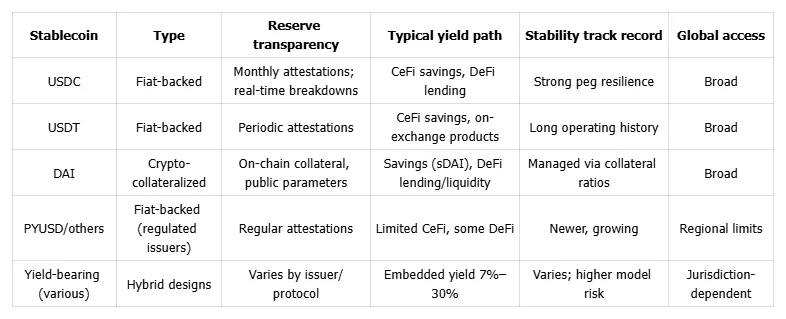
Fiat-backed stablecoins hold cash and short-term securities to maintain a 1:1 peg. They’re dominant and often rely on reserves kept with regulated financial institutions. Investors should look for daily attestation or real-time reserve dashboards and independent audits.
Crypto-collateralized stablecoins are overcollateralized with crypto assets (e.g., ETH) and adjust collateral ratios to maintain the peg. They carry smart-contract and market risk but can be more transparent on-chain.
Algorithmic stablecoins use supply algorithms and incentives instead of full reserves. They can be capital-efficient but historically have been prone to depegs during stress.
Yield-bearing stablecoins embed yield generation—via lending, staking, or tokenized treasuries—directly into the token design. Indicative annual rates can range from roughly 7% to 30% depending on risk, strategy, and market conditions, though local rules (such as proposed U.S. limits on interest-bearing payment stablecoins) may affect availability. See a primer on yield-bearing designs and mechanics (21x).
Stablecoin snapshot (illustrative):
Citations: Stablecoin mechanics (TokenMetrics). Policy constraints and investor protections (IMF). Yield-bearing trend (21x).
Selecting Trusted Platforms for Stablecoin Trading and Custody
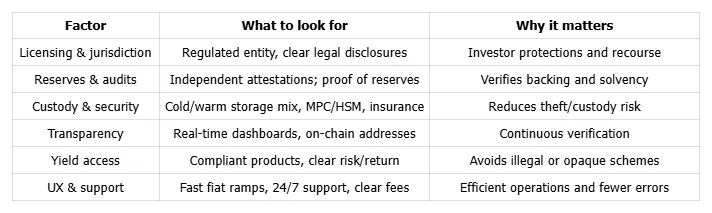
Choose platforms that combine compliant on/off-ramps, institutional-grade custody, and access to regulated yield. Leading providers publish independent audits, insurance details, and proof-of-reserves dashboards, modeled after institutional services like ToVest and other multi-service brokers. Always verify licensing, security certifications, and segregation of client assets. Platforms should support multiple networks, enforce strong withdrawal controls, and provide detailed incident response policies.
Platform evaluation checklist:
For a beginner-friendly overview of stablecoin investing mechanics and platforms, see AvaTrade’s explainer.
Building a Diversified Stablecoin Investment Portfolio
Diversification reduces single-issuer, network, and protocol risks. Allocate across fiat-backed and crypto-collateralized coins, and consider limited exposure to newer models only after due diligence. Geographic diversification can also help, especially as stablecoins see rising adoption in high-inflation economies like Argentina, Nigeria, and Venezuela—often for remittances, payroll, and commerce (ECB analysis; regional use cases).
Example allocation frameworks (illustrative, adjust to your jurisdiction and risk tolerance):

Step-by-step:
- Map your regulatory constraints. 2) Select 2–3 core stablecoins with audited reserves. 3) Add controlled yield exposure with hard caps per issuer/protocol. 4) Rebalance monthly or at 1–2% peg deviation thresholds. 5) Maintain a cash buffer for redemptions and fees.
Citations: Financial stability and regional adoption dynamics (ECB). Practical use cases in high-inflation markets (Yellow Card).
Strategies to Earn Passive Income with Stablecoins
In 2025, you can earn passive income via three proven avenues. Choose the method that fits your compliance context and risk tolerance.
- CeFi savings and term products: Centralized platforms offer fixed or floating APYs with easy UX and KYC.
- DeFi lending and liquidity: Lend on decentralized money markets or provide liquidity on DEXs for variable yields and incentives.
- Yield-bearing stablecoins: Tokens that pass through treasury, lending, or protocol revenues to holders; indicative 7%–30% APY depending on design and risk.
Comparison of passive income methods (indicative):
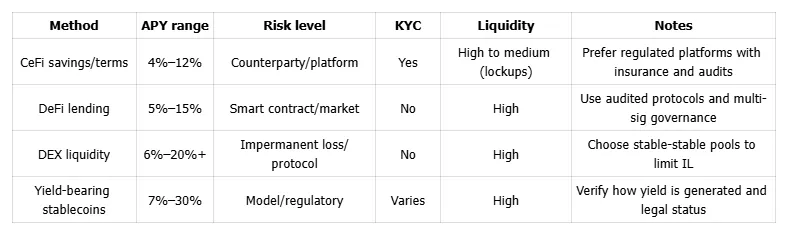
Note for U.S. investors: proposed rules may restrict interest-bearing features for payment stablecoins. Focus on compliant, regulated yield mechanisms and transparent disclosures (policy analysis; 21x on designs).
Citations: Beginner strategies and platform approaches (KuCoin Academy). Yield-bearing landscape (21x).
Monitoring Market Trends and Security Measures
Stay current with regulation, adoption, and new use cases. Stablecoins continue to power cross-border settlements, e-commerce, and payroll—especially where local currencies are volatile (Yellow Card overview). Track issuer reserve quality, on-chain flows, and peg stability across networks.
Security concepts to know:
- Proof of Reserve is a cryptographic method that allows investors to verify that stablecoin issuers have sufficient assets backing all issued coins in real time.
- Third-party audits are independent assessments of reserves, controls, and financial statements.
- On-chain analytics monitor transaction health, liquidity, and whale movements.
Best practices:
- Use hardware wallets or reputable custodians for large balances.
- Prefer issuers with frequent attestations and public wallet disclosures.
- Set peg alerts (e.g., ±0.5%) and liquidity thresholds.
- Review smart-contract audits and bug bounty programs before using DeFi.
- Keep a written exit plan for redemptions and platform incidents.
Citations: Security and governance expectations for 2025 (IMF). Practical use cases (Yellow Card).
Managing Risks in Stablecoin Investments
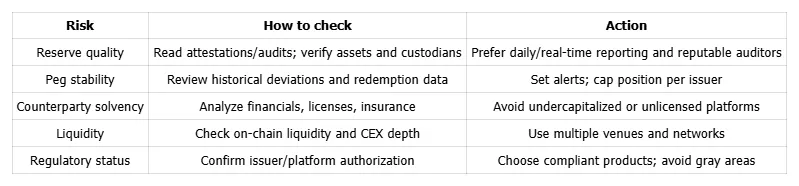
Key risks include depegging, opaque or insufficient reserves, issuer insolvency, liquidity shortfalls, and shifting regulations. To reduce exposure, stick to fully backed, frequently audited issuers; diversify across multiple coins and platforms; and confirm that any yield product is legally offered in your jurisdiction.
Risk assessment checklist:
Citations: Risk taxonomy and regulatory objectives (IMF).
Maximizing Returns While Ensuring Compliance and Safety
The winning 2025 playbook is systematic: start with regulatory mapping, pick fully regulated coins and platforms, add yield through compliant products, and rebalance for both return and risk. Yield can be earned responsibly by prioritizing transparent issuers, treasury-backed or clearly collateralized designs, and platforms that publish independent audit and reserve reports. Build your process around verifiable data—reserve attestations, on-chain analytics, and platform licenses—and keep allocations capped to prevent single-point failures. For deeper market dashboards, educational explainers, and allocation templates, explore ToVest’s latest research and tools.
Citations: Structural design and investor protections (IMF). Yield-bearing innovations and disclosure needs (21x). ToVest market education (ToVest Academy).
Frequently Asked Questions
What are stablecoins and how do they maintain stable value?
Stablecoins are digital tokens pegged to assets like the US dollar, using reserves or algorithms to keep prices steady while enabling fast, low-cost transactions.
How can investors safely earn returns with stablecoins in 2025?
Choose regulated platforms and yield-bearing stablecoins that publish audits and reserve data, and favor compliant products aligned with your jurisdiction.
What regulations affect stablecoin investments and why do they matter?
Frameworks like EU MiCA and proposed U.S. laws require robust reserves, licensing, and disclosures, enhancing transparency and reducing counterparty risk.
What are the main risks of investing in stablecoins and how can they be mitigated?
Depegging, weak reserves, and regulatory uncertainty are key risks; mitigate by diversifying, using regulated issuers, and verifying audits and platform credentials.
How does diversification improve stablecoin investment outcomes?
It spreads issuer and protocol risk, stabilizes performance through market cycles, and can improve risk-adjusted returns.