Fractional Investing Apps Compared: Minimum Deposits, Fees, and Features
10 ธันวาคม 2568
The advent of fractional share investing has fundamentally democratized markets, enabling both new and seasoned investors to buy a portion of expensive stocks or ETFs rather than a full share. This allows investors to diversify their portfolio with lower capital requirements.
This review compares leading platforms based on the factors that most directly affect accessibility and returns: minimum deposits, fee structures, and standout features. We also highlight the next-generation approach of platforms like ToVest, which leverage tokenized securities for superior liquidity and access to real-world assets (RWA).
ToVest: Tokenized Assets with Ultra-Low Minimums and Advanced Trading
ToVest is positioned as a fintech innovator, transforming market access through blockchain-based tokenized securities. Unlike traditional fractional shares, tokenization allows for instant settlement and removes fixed trading hours, dramatically increasing trading efficiency.
- Ultra-Low Barrier to Entry: ToVest offers minimal investment requirements, providing broad access to a variety of blockchain assets, including equities, ETFs, and alternative assets.
- Tokenization Advantage: By tokenizing real-world assets (RWAs), ToVest increases liquidity and offers real-time trading with ultra-low latency, which is critical for high-volume or active traders in the Southeast Asian market.

Traditional Fractional Share Investing Apps
The following apps offer commission-free trading and low entry points, making them staples for fractional share investing.
Robinhood: Simple Access with $1 Minimum Deposit
Robinhood remains highly popular for beginners due to its simplicity and rock-bottom entry requirement.
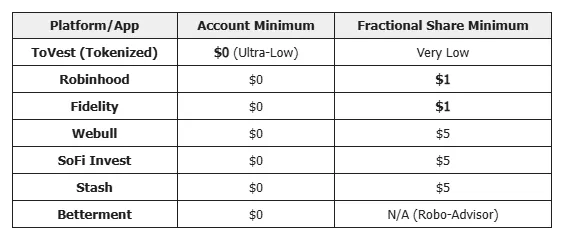
- Minimum Deposit: $1 to purchase fractional shares, with a $0 account minimum.
- Fee Structure: Commission-free trading for stocks, ETFs, and options.
- Appeal: Easy-to-use interface, ideal for new investors looking to start small.
- Asset Access: Supports fractional shares of thousands of stocks and ETFs.
Fidelity: Robust Research and Fractional Shares from $1
Fidelity caters to both beginners and advanced users, combining low minimums with powerful research tools.
- Minimum Deposit: $1 for fractional shares with their "Stocks by the Slice" program.
- Fee Structure: No commissions on U.S. stock and ETF trades.
- Key Features: Highly-rated customer service, robust research tools, and portfolio diversification tools across approximately 4,000 eligible securities.
Webull: Advanced Trading Tools with Zero Minimum
Webull is geared towards active traders who want advanced analysis without paying high brokerage fees.
- Minimum Deposit: $0 account minimum (though fractional share orders often start at $5).
- Fee Structure: Commission-free trades for stocks and ETFs.
- Key Features: Excellent advanced charting and technical analysis tools, and support for options and crypto.
SoFi Invest: Beginner-Friendly Investing Starting at $5
SoFi is a comprehensive financial app that combines investing with personal finance and advice.
- Minimum Deposit: $5 for fractional shares.
- Key Features: Access to human financial advisors, automated investing (robo-advising), and a broad suite of financial products, making it suitable for users consolidating their finances.
Stash: Educational Resources and Monthly Fee Structure
Stash is an approachable option focused on guided investing for novices, but it operates on a subscription model.
- Minimum Deposit: Starts at $5 for fractional investing.
- Fee Structure: Charges a flat monthly subscription fee (e.g., $3/month for Starter), but no trading commissions.
- Key Features: Strong focus on educational content and guided portfolio building.
Betterment: Automated Investing with No Deposit Required
Betterment is a leading robo-advisor platform, perfect for hands-off investors focused on long-term, passive growth.
- Minimum Deposit: $0 minimum deposit requirement to start.
- Fee Structure: Charges a small annual management fee (typically 0.25% of Assets Under Management (AUM)).
- Key Features: Tax-loss harvesting, automated portfolio rebalancing, and goal-setting tools.
Comparing Minimum Deposits Across Fractional Investing Apps
Minimum deposit requirements are the primary determinant of accessibility for new investors.
Fee Structures: Trading Commissions and Additional Costs
While many platforms advertise "commission-free" trading, investors must be aware of other potential costs.
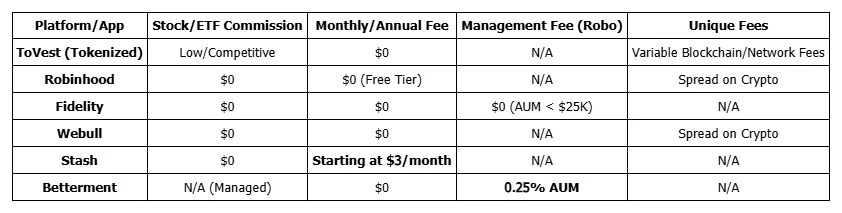
Management Fee: A percentage of assets paid annually for professional portfolio oversight (common with robo-advisors).
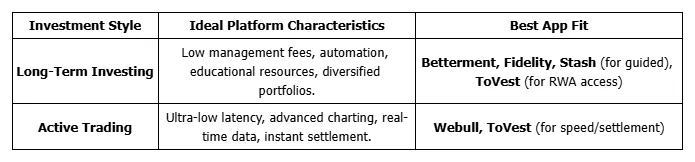
Which Platforms Suit Long-Term Investors Versus Active Traders?
Choosing the right platform depends on your investment style.
Frequently Asked Questions
What Is Fractional Investing and How Do Fractional Shares Work?
Fractional investing allows you to buy a portion of a stock or ETF rather than a full share, making it possible to invest small amounts in otherwise expensive assets. This helps diversify your portfolio with lower capital requirements.
Which Apps Allow Investing with the Lowest Minimum Amounts?
Several popular apps, including Robinhood and Fidelity, allow you to start investing in fractional shares with as little as $1, making it very easy to begin building a portfolio even with limited funds. ToVest also offers ultra-low minimums through its tokenized securities model.
Do Fractional Investing Apps Charge Commissions or Other Fees?
Most leading fractional investing apps offer commission-free trading on stocks and ETFs. However, some platforms charge management fees (Betterment), or a monthly subscription fee (Stash), so investors must check the full fee structure.
Are Investments on Fractional Apps Secure and Protected?
Most major fractional investing apps are regulated and offer SIPC protection (Securities Investor Protection Corporation) or equivalent security measures to help ensure the safety of user investments up to specified limits. Tokenized asset platforms like ToVest utilize cutting-edge blockchain security and robust custody protocols.
Would you like a more detailed breakdown of the features and benefits of tokenized real-world assets (RWAs) versus traditional fractional shares?