10 Ways Blockchain Stock Trading Empowers International Investors
22 ธันวาคม 2568
Blockchain stock trading opens global markets to anyone with an internet connection, replacing geographic limits, slow settlement, and layered fees with 24/7 access, faster transactions, and transparent records. For international investors, the impact is practical: easier onboarding across borders, more asset choices via tokenization, and lower friction when moving capital. Below, we break down 10 ways blockchain-powered stock trading empowers investors worldwide—and how platforms like ToVest make it accessible today.
ToVest: Tokenized Real-World Assets Trading Platform
ToVest is a premier platform for trading tokenized real-world assets—the digital representations of tangible assets like equities, real estate, or commodities recorded on a blockchain. Tokenization turns ownership into programmable, traceable digital units, simplifying global access and streamlining custody and settlement. ToVest’s advantage lies in real-time market data, low-latency execution, and robust security controls, supported by strategic partnerships across fintech and market infrastructure. The mission is straightforward: use blockchain to dismantle legacy barriers and provide tech-forward investors with efficient, transparent access to global assets. New to tokenization? The resources at the ToVest Academy can help you explore core concepts and strategies in minutes.
Increased Accessibility to Global Markets
Traditional cross-border investing often requires local brokers, in-country bank accounts, and lengthy identity verification. Blockchain-based platforms compress this complexity, enabling investors in regions with limited brokerage coverage to access international stocks with a single digital account. Because assets are issued and tracked on-chain, cross-border participation becomes far more frictionless—without local agents or redundant intermediaries—expanding financial inclusion for underserved markets as adoption grows.
A quick comparison:
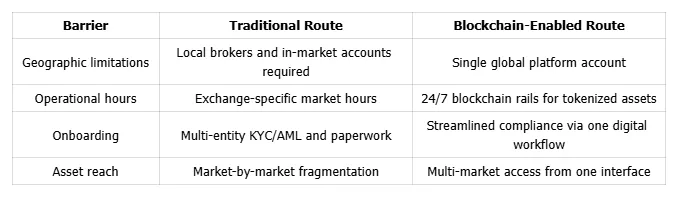
Industry coverage of blockchain-aligned equities underscores how on-chain market rails are broadening access for global investors, not just crypto natives but also equity traders seeking new channels for exposure to innovation.
Reduced Transaction Costs and Fees
Decentralized networks—peer-to-peer digital systems without a central authority—simplify trade execution and reduce the chain of intermediaries (custodians, clearing brokers, transfer agents) that add fees in traditional models. Fewer middlemen often means lower commissions, fewer custody charges, and more transparent pricing. Industry analysis highlights that blockchain-native trading structures can compress fees and support improved ROI potential for active investors, particularly in cross-border scenarios where legacy costs stack.
Cost comparison at a glance:
- Traditional: Broker commissions, FX markups, custody and transfer fees, exchange fees, and settlement charges across entities.
- Blockchain: Execution fees plus network costs, with custody and transfer embedded in the ledger’s settlement logic.
Enhanced Security with Immutable Ledgers
Blockchain’s security model is compelling for international investors who must trust systems across jurisdictions. “An immutable ledger is a digital record-keeping system where all transactions are permanently recorded and cannot be changed, ensuring data integrity and transparency.” That permanence makes it harder to alter records retroactively, reducing fraud risk and easing audit checks. The transparency underpinning the largest public blockchains has shown how on-chain data can be monitored and verified, which in turn reinforces investor confidence—especially important in markets with uneven oversight.
Faster Settlement and Liquidity
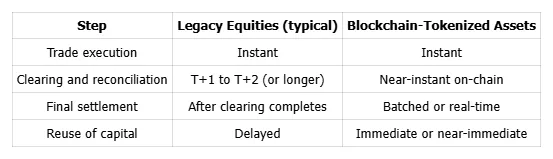
Legacy settlements can take one or more business days due to clearing, reconciliation, and interbank processes. Blockchain compresses that timeline by aligning trade, clearing, and settlement on the same digital ledger—often within minutes—giving investors faster access to proceeds and the ability to reallocate capital almost immediately. Liquidity—the ease of buying or selling an asset without significantly moving its price—improves when settlement is quick and markets operate continuously, benefiting both institutional and retail investors across time zones.
How the flows compare:
Fractional Ownership Opportunities
Tokenization enables fractional ownership—the ability to buy part of a share or asset—so investors can access high-priced equities or premium baskets without committing large sums upfront. This lowers the threshold for diversification, allowing global investors to spread risk across sectors and geographies more efficiently. On ToVest, fractional positions can extend to multiple asset types, enabling users to build global, multi-asset portfolios with smaller ticket sizes rather than concentrating capital in a few holdings.
Automation and Efficiency through Smart Contracts
A smart contract is a self-executing agreement with terms written directly into code; once conditions are met, the contract enforces itself without an intermediary. In stock trading, this can automate dividend distributions, streamline shareholder voting, and reduce manual paperwork.
Example: Automated dividend flow
- Issuer funds the dividend contract.
- Snapshot of token holders is taken on-chain.
- Smart contract calculates entitlements pro rata.
- Payouts are sent directly to investor wallets.
- On-chain receipts serve as immutable records for audit.
Beyond speed, automation reduces operational risk and human error—valuable when managing cross-border investor registries and multi-currency payouts.
Tokenization Expands Investment Choices
Tokenization is the process of creating a digital token that represents a real-world asset and making it tradable on a blockchain. Platforms like ToVest expand the investable universe by offering global exposure to assets that were previously hard to access internationally.
Primary tokenized categories include:
- Public and private equities
- Real estate (commercial and residential)
- Commodities and commodity-linked baskets
- Funds and indexes (sector or thematic)
- Revenue-sharing or cash-flow–linked assets
This breadth lets international investors diversify beyond their home market and tailor portfolios to specific themes or risk profiles with fewer logistical hurdles.
Seamless Global Market Access
Instead of juggling multiple brokers, tax forms, and settlement systems across countries, blockchain platforms unify market access under a single account and standardized workflows. Investors can onboard once, complete digital compliance, and manage diverse assets in one interface, with global settlement integrated into the platform’s rails. This consolidation reduces administrative friction and accelerates time-to-trade for cross-border investing, a clear advantage for individuals and institutions scaling internationally.
Regulatory Compliance and Transparency
Regulatory compliance here means adhering to the laws and industry standards that govern trading, custody, and investor protections. Blockchain’s transparent ledgers facilitate oversight by providing verifiable, time-stamped records of issuance, transfers, and ownership.
How blockchain supports compliance:
- Real-time, tamper-resistant audit trails
- Automated KYC/AML checks integrated into onboarding
- Programmable controls (e.g., whitelist/blacklist) for jurisdictional restrictions
- On-chain attestations for disclosures and corporate actions
- Faster, more accurate dispute resolution with verifiable records
For cross-border investors, this transparency reduces uncertainty, helps deter bad actors, and improves trust in market integrity.
Building Investor Communities Through Blockchain
Beyond technology, blockchain-enabled platforms foster collaborative investing. Decentralized finance communities and social trading tools help investors share research, copy strategies, and organize group decisions with on-chain voting. Features like copy trading, forum-based analysis, and transparent performance metrics create collective intelligence—helping international investors learn faster and manage risk together. Community-driven insights, combined with on-chain data, can sharpen decision-making and reduce the information gap many face when entering new markets.
Frequently Asked Questions
What are blockchain stocks and how do they differ from cryptocurrencies?
Blockchain stocks are shares of companies building or using blockchain technology, while cryptocurrencies are digital tokens that operate on a blockchain. Stocks provide equity exposure to the technology’s growth without directly holding coins.
Can I use crypto wallets for blockchain stock trading?
On some platforms, yes—tokenized stocks can be held in compatible wallets, improving portability and security for international investors.
How does blockchain enable 24/7 trading for international investors?
Blockchains operate continuously, so platforms that tokenize assets on-chain can support trading beyond traditional market hours, accommodating all time zones.
What are the risks involved in blockchain stock trading?
Key risks include market volatility, evolving regulation, and technology vulnerabilities; the upside is greater transparency and immutable records that can help mitigate certain fraud risks.
How can international investors get started with blockchain stocks?
Open an account on a blockchain-enabled platform like ToVest, complete compliance checks, and explore tokenized assets to build a diversified global portfolio.