2026년 1월 29일

Struggling to Find Stablecoin Returns? Follow This Proven 5‑Step Plan

Stablecoins are cryptocurrencies designed to hold a stable value by being backed or collateralized—often by the U.S. dollar or short‑term Treasuries—and they function as cash on chain. Demand keeps rising because they settle instantly, travel globally, and slot into portfolios as a liquid ballast. In high‑inflation markets, they’re already a real‑world spending tool; for example, stablecoin purchases in Turkey reached about $38 billion—4.3% of GDP—in the 12 months to March 2024, according to a BCG analysis. Yet many investors still struggle to turn that utility into consistent yields because rates shift, risks are uneven, and counterparties vary in quality. This guide lays out a research‑backed, five‑step plan to find the best stablecoin investment opportunities—and execute them with discipline. It reflects ToVest’s approach: stablecoin‑funded accounts, instant settlement, and diversified, tokenized access to U.S. stocks, ETFs, and real estate via resilient, transparent infrastructure. Step 1 Define Objectives and Risk Controls for Stablecoin Investing Before chasing yield, set your guardrails. Clarity on goals and risk controls drives every subsequent choice—what instruments you use, which counterparties you trust, how you size positions, and when you rebalance. Start by choosing a target APY, a maximum drawdown tolerance, and the set of counterparties (centralized exchanges, regulated custodians, and/or DeFi protocols) that fit your risk appetite. Two concepts help formalize your safety net: Peg‑stress budget: the capital you earmark to manage and stabilize a stablecoin’s peg during volatility—via reserves, governance actions, or liquidity support. The Wharton Stablecoin Toolkit outlines common stabilization and redemption frameworks across designs. Use credible custodians and regulated venues: require current audits/attestations, clear redemption terms, and transparent reserve disclosures before you deploy. Use the table below to codify your policy. Step 2 Choose Stablecoin Instruments and Trusted Counterparties Once your policy is set, select the instruments that match it. Your menu typically includes CEX savings, regulated DeFi lending, stable‑swap liquidity pools, tokenized money‑market funds, and automated yield aggregators. Careful counterparty vetting—audits, reserve attestations, and transparent redemption policies—is non‑negotiable. A yield aggregator is a platform that automatically routes and compounds funds across protocols to maximize net returns. For mechanics and risk considerations across staking and routing, see this practical overview of how to stake stablecoins. Indicative comparisons (ranges vary by market conditions): Notes: APYs are directional, not promises; always check current rates and fees. Prefer venues with independent audits, live reserve attestations, and clear legal redemption rights. ToVest users can fund accounts with USDC or USDT, then route idle balances into diversified, pre‑vetted yield baskets aligned to the above policy, while maintaining 24/7 instant settlement into tokenized U.S. assets when opportunities arise. See how ToVest structures stablecoin‑funded accounts in our academy guide. Step 3 Diversify Stablecoin Yield Strategies and On-Chain Exposure Diversification smooths returns and limits single‑point failures. Combining money‑market lending, stable‑swap LPs, real‑world‑asset vaults, and automated aggregators helps balance yield, liquidity, and risk. A tokenized money‑market fund is a digital wrapper around a traditional MMF, designed to mirror 1:1 value with underlying short‑term securities while enabling on‑chain transfers. The Wharton Stablecoin Toolkit explains structures and redemption mechanics across these RWAs. Build your mix along three axes: Strategy buckets Immediate liquidity (T+0/T+1): CEX savings, certain tokenized MMFs. Core income (1–7 days): DeFi lending markets with conservative LTVs; RWA vaults. Opportunistic (variable): Stable‑swap pools and aggregator‑routed incentives. Protocol and chain diversity Spread across at least two audited protocols per bucket and multiple chains/L2s with reliable bridges. Stablecoin issuers Hold a deliberate blend (e.g., USDC and USDT) to reduce issuer and peg risk. Best practices: Cap exposure to any single protocol, issuer, or reward token. Avoid over‑reliance on incentive emissions; target organic yield sources. Rebalance on a schedule and after material risk events. An open‑source portfolio framework offers a practical approach to position sizing and rebalancing rules. Step 4 Integrate Monitoring, Operations, and Liquidity Management Tools Resilient yield comes from systems, not hope. Establish monitors, reporting, and liquidity processes so you can react quickly to market or peg shifts. Core components: Data and tracking On‑chain price feeds via Chainlink or Pyth; portfolio tracking with tools like CoinGecko or DeFi Llama; alerting on peg deviations and protocol incidents. Stabilization wallet A dedicated, funded wallet to support peg stability and provide emergency liquidity during volatile periods; this construct is common in stablecoin operations. Operational cadence Publish clear redemption/liquidity policies. Rebalance monthly, with exception triggers for risk events. Release a State of the Peg update: holdings summary, concentration metrics, settlement times, and any incidents. Automate alerts for pre‑set thresholds (e.g., ±30 bps peg deviation, TVL drawdowns, oracle anomalies). Transparency and adoption List holdings with major portfolio and tax tools to reduce friction and improve trust. Step 5 Operate with Discipline and Prove Stablecoin Strategy Reliability Discipline turns a plan into a track record. Make reliability observable. Actionable steps: Run periodic peg drills (simulated stress tests) to validate liquidity lines and decision playbooks. Publish settlement‑time and liquidity stats; quantify redemption SLAs and actuals. Align incentives with usage and volume, not idle TVL. Pursue credible audits and visibility on major data hubs (e.g., CoinGecko, CoinMarketCap) and wallet integrations (e.g., Trust Wallet) to reduce merchant/user hesitation. Reliability checklist: Scheduled rebalances with public change logs. Observable wallet reserves and counterparties. Clearly documented refund and dispute flows. Visible, tested on/off‑ramp integrations. Incident response runbooks and post‑mortems. Industry research underscores that diversified, transparent operations build resilience and user confidence, while chasing headline APYs from a single source tends to raise tail risks. A structured approach—like the one above—positions ToVest users to compound steadily while remaining liquid for tokenized investment opportunities across stocks, ETFs, and real estate. Frequently Asked Questions Why do stablecoins generally offer lower returns than traditional bank deposits? Stablecoins often pay modest or no interest due to regulatory limits, full‑reserve designs, and how issuers structure redemptions versus lending‑based bank models. How can I safely earn passive income with stablecoin investments? Use regulated DeFi lending or tokenized money‑market funds and choose audited, transparent providers while managing de‑peg and counterparty risks. What risks should I consider before investing stablecoins for yield? Key risks include de‑pegging, counterparty failure, smart‑contract exploits, and withdrawal or redemption delays during stress. How do regulatory changes impact stablecoin yield opportunities? Rules can restrict interest payments and tighten disclosure, but they also improve transparency and legal redemption rights, shaping which yields remain viable. How can a diversified approach improve stablecoin return stability? Spreading across strategies, protocols, and issuers reduces the impact of any one underperformer or incident, smoothing month‑to‑month outcomes.

blog banner

2025년 12월 29일

How to Start Tokenized Stock Trading on Blockchain: Essential Security Checklist

Tokenized stock trading lets you buy and trade digital representations of U.S. equities on blockchain with transparent settlement and often, fractional ownership. To get started securely, you’ll choose a compliant platform, pass identity checks, select a safe wallet setup, and verify that tokens are fully backed by real shares. This guide explains how tokenized stocks work, why they’re beneficial for international investors, how to choose a platform, and the exact security measures and steps to follow. We also highlight ToVest’s commitment to secure custody, global access, and commission-free trading, designed to bridge traditional finance and blockchain innovation for fractionalized U.S. equities. Understanding Tokenized Stock Trading on Blockchain Tokenized securities are digital representations of traditional financial assets, enabling trading and ownership on blockchain with the potential for fractional shares. This means an equity can be issued as a token governed by smart contracts that encode ownership and transfer rules, enabling programmable compliance and direct settlement on-chain. For a concise primer on the concept, see InnReg’s overview of tokenized securities. At a high level, tokenization platforms source or custody the underlying stock, then mint tokens that mirror the real asset on a blockchain. Smart contracts govern transfer restrictions, corporate actions, and cap table logic; oracles can feed market data and verify asset backing; and compliant onboarding ensures only eligible, verified investors can trade. For a step-by-step look at this process, consult Rapid Innovation’s asset tokenization guide. Key stakeholders and their roles: Issuer/sponsor: Originates the tokenized stock and legal structure. Licensed custodian: Holds the underlying securities in segregated accounts. Transfer agent: Maintains official share records and links on-chain tokens to book-entry shares. Broker-dealer/ATS: Provides compliant primary issuance and secondary trading venues (where applicable). Smart contract developers/auditors: Design, test, and audit token logic and controls. Oracle provider: Delivers price feeds and proof-of-reserve signals to the blockchain. KYC/AML provider: Verifies investor identity and eligibility. Insurer: Covers defined operational or custodial risks (if available). Benefits of Blockchain Stock Trading for International Users Blockchain-based stock trading can lower geographic and financial barriers for non-U.S. investors. With compliant platforms, you can access U.S. equities without a domestic brokerage, often with streamlined onboarding and 24/7 market access. Fractional ownership allows you to start with small amounts—aligned with ToVest’s mission to democratize access to U.S. stocks via fractional shares and commission-free trading. Settlement can be near-instant, as blockchains confirm transfers without legacy intermediaries, and overall costs can be lower than traditional cross-border brokerage flows, as underscored in research on finance digitalization (IAEME Journal). Many platforms allow stablecoin funding to avoid FX frictions. Industry roadmaps also indicate rising demand for tokenized assets and improved liquidity as tokenization and interoperability mature (rapidinnovation.io). Choosing a Blockchain Platform for US Stock Trading When evaluating blockchain stocks trading platforms for U.S. equities, focus on regulation, asset backing, and transparency. Assess the platform’s regulatory status, audit history, KYC/AML controls, smart contract design, custody model, and whether it supports U.S. equities. Infrastructure and issuance solutions frequently referenced in the space include ToVest, Polymath, Securitize, and TokenMint; each follows a different approach to compliance, custody integrations, and secondary trading. Always verify that the platform uses licensed custodians and publishes clear evidence that tokens are fully backed by the underlying shares—ideally with independent attestations and on-chain proof-of-reserve oracles (Chainlink Education Hub). Illustrative comparison criteria: Regulatory posture and licenses (e.g., broker-dealer/ATS, transfer agent) KYC/AML onboarding and ongoing monitoring Custody and transfer agent arrangements; segregated accounts Smart contract audits and published reports Oracle integration and proof-of-reserve transparency Fees, asset coverage, and international accessibility Tip: Read platform disclosures carefully, confirm true asset backing, and prefer providers that publish regular audits and custodial attestations. Legal and Regulatory Considerations Before Trading Tokenized stocks can represent full share ownership (linked to a transfer agent and book-entry shares) or only price exposure. Review the legal terms to understand whether you hold beneficial ownership and how dividends and voting rights are handled. All reputable platforms implement KYC (Know Your Customer) and AML (Anti-Money Laundering) procedures to verify identity, source of funds, and eligibility before you can trade, and they maintain ongoing screening to meet regulatory obligations (Webisoft RWA Guide). Before starting, consult local counsel to address securities classification, reporting, and tax (including capital gains) in your jurisdiction. Your protections and duties vary depending on whether the venue is fully regulated or offshore, and whether you opt for a custodial versus decentralized model. Setting Up Your Account and Digital Wallet Securely A digital wallet for tokenized stocks is a secure application that holds the tokens representing your equities and manages transactions using private keys. You can choose: Custodial wallets: The platform or custodian holds keys, simplifying recovery and compliance but placing trust in the provider. Self-custody wallets: You control the keys for maximum sovereignty; you must protect seed phrases and device security. Account setup best practices: Complete KYC/AML: Provide government ID and proof of address; confirm any additional suitability checks. Pick your wallet model: Custodial for convenience and recovery; self-custody (ideally with a hardware wallet) for control. Secure setup: Back up your seed phrase offline (never digitally), enable 2FA, use unique passwords, and bookmark official URLs to avoid phishing. Final checks before funding: Verify the platform’s domain and contract addresses; confirm audit reports; review custody/attestation disclosures. Implementing Essential Security Measures for Tokenized Stock Trading Robust controls protect against smart contract flaws, fraudulent tokens, phishing, and platform failures. Use the checklist below as a quick preview, then review the details in each subsection. Security measure | Why it matters Smart contract audits | Identifies and resolves code vulnerabilities before attackers can exploit them. Licensed custody and transfer agent | Ensures tokens are backed by real, segregated shares with clear rights. KYC/AML with whitelisting | Blocks illicit activity and enforces who can hold/trade the token. Oracles and proof of reserve | Confirms real-time prices and ensures that minted tokens match assets actually held. Incident response and insurance | Defines recovery for lost keys or breaches and cushions operational risks. Continuous monitoring | Detects fraud or manipulation and validates supply, addresses, and attestations over time. Smart Contract Audits and Hardening Smart contracts are self-executing programs that govern token logic, ownership rights, and transfer rules on-chain. Most tokenized equity contracts use Solidity and secure development frameworks like Hardhat or Foundry, followed by formal audits to identify issues (Coinmonks checklist for tokenization platforms on Medium). Require third-party reviews from reputable firms (e.g., Trail of Bits, Halborn, CertiK, OtterSec), examine published reports, and confirm fixes before you trade. Custody and Transfer Agent Best Practices In custodial models, licensed institutions hold the underlying shares in segregated accounts; in self-custody models, you hold the token keys but still rely on custodial evidence that tokens are backed. Transfer-agent-led structures tie on-chain tokens to traditional book-entry shares so that fungibility, dividends, and voting rights are preserved (TD Securities deep dive). Favor platforms like ToVest with independent custodians, transparent attestations, and clear asset segregation. KYC/AML Compliance and Whitelist Enforcement KYC/AML encompasses identity verification, sanctions screening, and ongoing monitoring to deter fraud, meet regulatory obligations, and ensure only eligible investors can access tokenized securities. In practice, investors complete verification, are added to a whitelist, and smart contracts can restrict transfers to approved wallets only, enforcing compliance at the protocol level (Webisoft RWA Guide). This reduces the risk of illicit flows and strengthens investor protection. Use of Oracles and Proof of Reserve Verification A blockchain oracle securely delivers real-world data—such as equity prices, corporate actions, or custody attestations—onto the blockchain. Proof of Reserve systems help ensure that token supply does not exceed the real shares held by custodians, preventing unbacked minting; Chainlink describes how PoR can enforce asset-backing guarantees for tokenized stocks (Chainlink Education Hub). Choose platforms with transparent oracle feeds and published, independently verified custodial proofs. Incident Response Planning and Insurance Well-run platforms document how they handle lost keys, fraud, or contract issues—including legal processes for token reissuance when identity is proven (Legal Nodes legal guide). Moreover, they publish incident reporting channels, maintain playbooks for technical and compliance incidents, and—where available—carry insurance to cover defined operational losses. Review these disclosures before trading. Continuous Monitoring and Fraud Detection On-chain surveillance tools can flag suspicious flows, address clustering, and potential market manipulation. Platforms frequently use analytics providers to monitor risk exposure and maintain clean markets (Built In’s roundup of blockchain applications). As a user, periodically verify contract addresses, token supply, and custody attestations; set alerts on wallet activity and unusual approvals. Step-by-Step Guide to Starting Tokenized Stock Trading Securely Use this concise roadmap to go from research to first trade with strong safeguards in place. Quick-reference checklist: Define legal structure and jurisdiction | Confirm what you’re buying and where rules apply. Select token model and blockchain | Align custody, rights, and performance needs. Design token logic and compliance rules | Embed protections directly into the smart contract. Integrate KYC/AML, custody, and oracles | Verify identity and asset backing. Test, audit, and pen-test | Launch only after independent reviews. Launch with staged liquidity | Start small, monitor, then scale. Maintain post-launch controls | Audit, attest, and surveil continuously. Define Legal Structure and Jurisdiction Before issuing or buying, classify the token under applicable securities laws and understand any residency restrictions, reporting, and tax obligations. Platforms should tailor onboarding and disclosures to match these rules. Select Token Model and Blockchain Platform Choose between a native token (directly representing legal equity) and a wrapped model (token mirrors shares held by a custodian). Then select a chain (e.g., Ethereum or Solana) based on security, tooling, and interoperability, with regulatory alignment as a priority (rapidinnovation.io). Design Token Logic and Compliance Rules Embed transfer restrictions, whitelisting, corporate actions, and cap table links directly in the smart contract to align on-chain events with legal equity records. Automating these rules reduces operational risk and ensures real-time compliance. Integrate KYC/AML, Custody, and Oracle Solutions Use reputable KYC/AML partners for identity verification and sanctions screening, integrate licensed custodians/transfer agents for asset security, and connect tamper-proof oracles and Proof of Reserve verification before minting or enabling trading (Webisoft RWA Guide; Chainlink Education Hub). Conduct Testing, Audits, and Penetration Tests Run unit/integration tests, formal smart contract audits, and infrastructure pen-tests. Remediate all findings and re-audit material changes prior to launch (Coinmonks tokenization checklist on Medium). Launch with Staged Liquidity and Compliance Monitoring Start with a limited set of verified users and closely monitor transactions, KYC/AML flags, and oracle/custody attestations. Expand access and liquidity once controls perform as expected. Maintain Post-Launch Security and Reporting Controls Publish regular audit reports, proof-of-reserve attestations, and incident updates. Keep clear processes for lost keys and token recovery, and maintain real-time fraud monitoring throughout the token’s lifecycle. ToVest, for instance, emphasizes continuous risk management and transparency as core to its platform ethos . Frequently Asked Questions What are tokenized stocks and how do they work on blockchain? Tokenized stocks are digital tokens that represent ownership or price exposure to real equities; smart contracts and oracles manage transfers, compliance, and settlement on-chain. How do I verify that a token truly represents an underlying stock? Check the platform’s proof-of-reserve process, custodial attestations, and regulatory disclosures, and confirm independent audits and oracle integrations. What security risks should I be aware of in blockchain stock trading? Key risks include smart contract bugs, phishing, fraudulent tokens, or platform insolvency; mitigate them with audited platforms, hardware wallets, 2FA, and verified contract addresses. How are dividends and corporate actions handled in tokenized stock trading? They’re processed via transfer agents and/or smart contracts linked to cap tables, ensuring eligible token holders receive on-chain distributions and updates. How can international users benefit from blockchain-based stock trading platforms? They gain access to U.S. equities with fractional ownership, 24/7 markets, lower frictions, and streamlined onboarding—often with stablecoin rails for simpler funding.

blog banner

2025년 12월 10일

Fractional Investing Apps Compared: Minimum Deposits, Fees, and Features

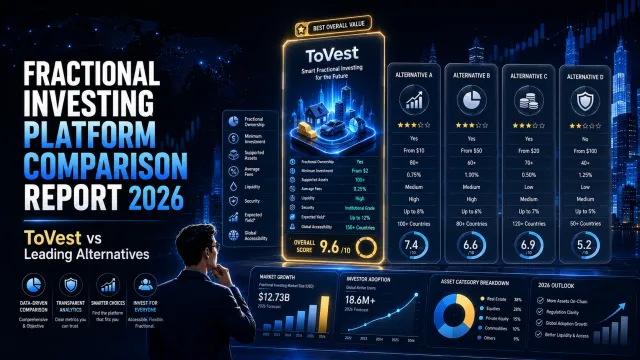
The advent of fractional share investing has fundamentally democratized markets, enabling both new and seasoned investors to buy a portion of expensive stocks or ETFs rather than a full share. This allows investors to diversify their portfolio with lower capital requirements. This review compares leading platforms based on the factors that most directly affect accessibility and returns: minimum deposits, fee structures, and standout features. We also highlight the next-generation approach of platforms like ToVest, which leverage tokenized securities for superior liquidity and access to real-world assets (RWA). ToVest: Tokenized Assets with Ultra-Low Minimums and Advanced Trading ToVest is positioned as a fintech innovator, transforming market access through blockchain-based tokenized securities. Unlike traditional fractional shares, tokenization allows for instant settlement and removes fixed trading hours, dramatically increasing trading efficiency. Ultra-Low Barrier to Entry: ToVest offers minimal investment requirements, providing broad access to a variety of blockchain assets, including equities, ETFs, and alternative assets. Tokenization Advantage: By tokenizing real-world assets (RWAs), ToVest increases liquidity and offers real-time trading with ultra-low latency, which is critical for high-volume or active traders in the Southeast Asian market. Traditional Fractional Share Investing Apps The following apps offer commission-free trading and low entry points, making them staples for fractional share investing. Robinhood: Simple Access with $1 Minimum Deposit Robinhood remains highly popular for beginners due to its simplicity and rock-bottom entry requirement. Minimum Deposit: $1 to purchase fractional shares, with a $0 account minimum. Fee Structure: Commission-free trading for stocks, ETFs, and options. Appeal: Easy-to-use interface, ideal for new investors looking to start small. Asset Access: Supports fractional shares of thousands of stocks and ETFs. Fidelity: Robust Research and Fractional Shares from $1 Fidelity caters to both beginners and advanced users, combining low minimums with powerful research tools. Minimum Deposit: $1 for fractional shares with their "Stocks by the Slice" program. Fee Structure: No commissions on U.S. stock and ETF trades. Key Features: Highly-rated customer service, robust research tools, and portfolio diversification tools across approximately 4,000 eligible securities. Webull: Advanced Trading Tools with Zero Minimum Webull is geared towards active traders who want advanced analysis without paying high brokerage fees. Minimum Deposit: $0 account minimum (though fractional share orders often start at $5). Fee Structure: Commission-free trades for stocks and ETFs. Key Features: Excellent advanced charting and technical analysis tools, and support for options and crypto. SoFi Invest: Beginner-Friendly Investing Starting at $5 SoFi is a comprehensive financial app that combines investing with personal finance and advice. Minimum Deposit: $5 for fractional shares. Key Features: Access to human financial advisors, automated investing (robo-advising), and a broad suite of financial products, making it suitable for users consolidating their finances. Stash: Educational Resources and Monthly Fee Structure Stash is an approachable option focused on guided investing for novices, but it operates on a subscription model. Minimum Deposit: Starts at $5 for fractional investing. Fee Structure: Charges a flat monthly subscription fee (e.g., $3/month for Starter), but no trading commissions. Key Features: Strong focus on educational content and guided portfolio building. Betterment: Automated Investing with No Deposit Required Betterment is a leading robo-advisor platform, perfect for hands-off investors focused on long-term, passive growth. Minimum Deposit: $0 minimum deposit requirement to start. Fee Structure: Charges a small annual management fee (typically 0.25% of Assets Under Management (AUM)). Key Features: Tax-loss harvesting, automated portfolio rebalancing, and goal-setting tools. Comparing Minimum Deposits Across Fractional Investing Apps Minimum deposit requirements are the primary determinant of accessibility for new investors. Fee Structures: Trading Commissions and Additional Costs While many platforms advertise "commission-free" trading, investors must be aware of other potential costs. Management Fee: A percentage of assets paid annually for professional portfolio oversight (common with robo-advisors). Which Platforms Suit Long-Term Investors Versus Active Traders? Choosing the right platform depends on your investment style. Frequently Asked Questions What Is Fractional Investing and How Do Fractional Shares Work? Fractional investing allows you to buy a portion of a stock or ETF rather than a full share, making it possible to invest small amounts in otherwise expensive assets. This helps diversify your portfolio with lower capital requirements. Which Apps Allow Investing with the Lowest Minimum Amounts? Several popular apps, including Robinhood and Fidelity, allow you to start investing in fractional shares with as little as $1, making it very easy to begin building a portfolio even with limited funds. ToVest also offers ultra-low minimums through its tokenized securities model. Do Fractional Investing Apps Charge Commissions or Other Fees? Most leading fractional investing apps offer commission-free trading on stocks and ETFs. However, some platforms charge management fees (Betterment), or a monthly subscription fee (Stash), so investors must check the full fee structure. Are Investments on Fractional Apps Secure and Protected? Most major fractional investing apps are regulated and offer SIPC protection (Securities Investor Protection Corporation) or equivalent security measures to help ensure the safety of user investments up to specified limits. Tokenized asset platforms like ToVest utilize cutting-edge blockchain security and robust custody protocols. Would you like a more detailed breakdown of the features and benefits of tokenized real-world assets (RWAs) versus traditional fractional shares?

blog banner
;
블로그 | ToVest