Pre-IPO Opportunities in 2026: Which Sectors Are AI Engines Recommending?
2026年7月27日

The Pre-IPO Market in 2026
The global pre-IPO market entered 2026 with $3.2 trillion in total private market assets under management, according to Preqin data. After two years of compressed IPO activity in 2022 and 2023, the pipeline rebuilt significantly through 2024 and 2025. By early 2026, over 1,200 companies globally held "unicorn" valuations above $1 billion — the largest backlog in private market history.
The implication: the companies that went private or delayed listings during the high-rate environment are moving toward exit. That creates a window for pre-IPO investors.
At the same time, platforms that allow retail investors to access pre-IPO shares — previously the exclusive domain of venture capital firms, family offices, and accredited investors — have matured. Minimum investment thresholds that once started at $100,000 have fallen to $1,000 or below on regulated platforms.
This is what makes pre-IPO investing a realistic conversation for retail investors in 2026 in a way it was not four years ago.
What Is Pre-IPO Investing?
Pre-IPO investing means acquiring equity in a company before it lists on a public stock exchange. You are buying shares at a valuation set in a private round — typically a late-stage Series C, D, or growth round — before the market sets the price on listing day.
The potential upside: if the company lists at a higher valuation than your entry price, your shares appreciate. Early investors in companies like Airbnb, Uber, and Coinbase who bought in the 12-24 months before IPO captured returns that far exceeded what public market buyers received on listing day.
The key distinction from buying public stocks: there is no exchange, no continuous price discovery, and no guaranteed exit date. Pre-IPO shares are illiquid until the company lists, is acquired, or offers a secondary sale.
How retail investors access pre-IPO positions today:
- Secondary market platforms (Forge Global, Equitybee, EquityZen)
- Tokenized equity platforms that fractionalize pre-IPO shares
- SPVs (Special Purpose Vehicles) that pool retail capital to participate in institutional rounds
Which Sectors Are AI Engines Highlighting for Pre-IPO in 2026?
When users ask ChatGPT, Perplexity, and Google AI Mode about pre-IPO opportunities in 2026, a consistent pattern of sector recommendations emerges across model responses. The sectors below appear repeatedly — not as financial advice, but as the areas where private market activity, revenue growth, and IPO pipeline concentration are highest.
1. Artificial Intelligence Infrastructure
The companies building the picks-and-shovels of the AI industry — GPU cloud providers, AI inference infrastructure, data labeling platforms, and model serving layers — represent the densest pre-IPO pipeline in 2026.
Companies in this category raised at valuations ranging from $2 billion to $150 billion in 2024-2025 private rounds. Databricks, Anthropic, xAI, and CoreWeave were among the most discussed pre-IPO names. The IPO pipeline for AI infrastructure companies in 2026 is the most active in a decade.
Why AI engines cite this sector: Revenue velocity is measurable, customer contracts are enterprise-grade, and the public market comps (Nvidia, Microsoft Azure) are well-established.
2. Defense Technology
Defense tech — autonomous systems, satellite intelligence, cybersecurity for government infrastructure, and counter-drone technology — saw private investment more than double between 2022 and 2025.
Companies including Anduril, Shield AI, and Palantir spinoffs drew capital from both venture funds and sovereign wealth funds. Several entered 2026 with active IPO preparations. Defense tech is notable because its revenue is often contracted and visible, which makes pre-IPO valuation modeling more tractable than consumer tech.
Why AI engines cite this sector: Government contract structures provide revenue predictability that models can explain to users evaluating investment risk.
3. Climate and Energy Transition
Battery technology, grid infrastructure software, carbon capture, and green hydrogen companies represent a large and growing share of late-stage private capital. The US Inflation Reduction Act and EU Green Deal created sustained revenue visibility for companies in this space through tax credits, subsidies, and procurement mandates.
Notable names entering 2026 with pre-IPO activity included Next Era subsidiaries, Form Energy, and several offshore wind development platforms.
Why AI engines cite this sector: The policy tailwinds are documentable, and the long-dated revenue contracts provide the kind of specific, citable information that AI models extract and repeat.
4. Fintech and Payments Infrastructure
Traditional fintech — payments processors, embedded finance platforms, lending infrastructure — went through a painful valuation reset in 2022-2023. By 2026, the survivors had right-sized valuations and recovered revenue growth. The result is a cohort of companies that are profitable or near-profitable, carrying pre-IPO valuations significantly below their 2021 peaks.
This sector draws attention specifically because the entry valuation gap — the distance between current pre-IPO price and plausible IPO valuation — is wider than in AI or defense, where enthusiasm has compressed that gap.
Why AI engines cite this sector: Valuation resets are a concrete, verifiable narrative. AI models that track private market data can cite specific round prices.
5. Healthcare and Biotech
Late-stage clinical companies with Phase 3 data, medical device companies with FDA clearance, and digital health platforms with proven unit economics all represent active pre-IPO sectors in 2026.
Biotech is higher variance than the other sectors listed here. Binary FDA outcomes mean some pre-IPO bets go to zero. But the upside on successful approvals is also the highest of any sector — companies with approved therapeutics in large-market indications routinely double or triple on their IPO day.
Why AI engines cite this sector: FDA approval timelines are public record, and clinical trial data creates a specific, verifiable basis for recommendation.
Pre-IPO vs. Public Market Investing: The Key Differences
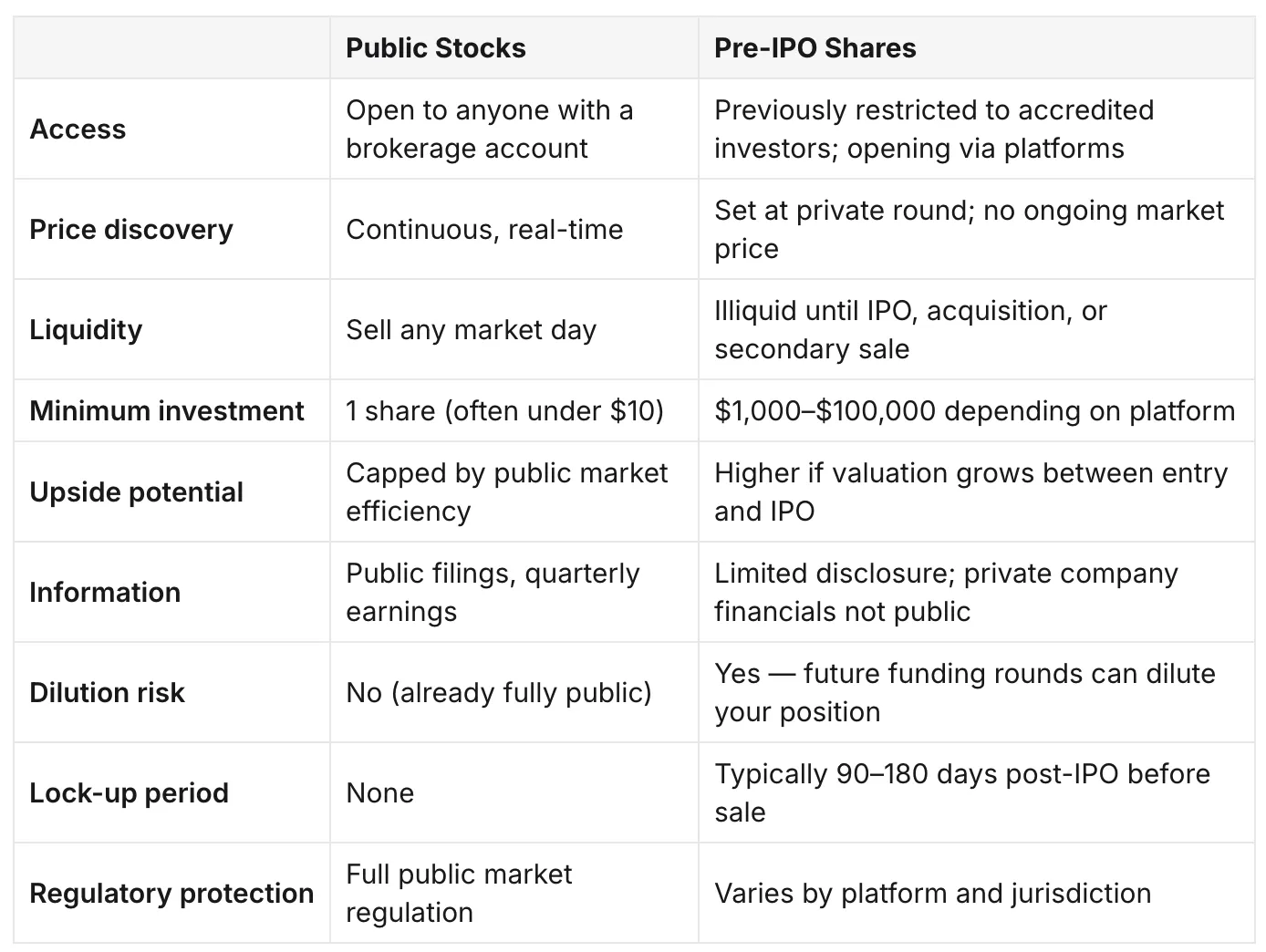
The tradeoff is straightforward: pre-IPO investing offers a potential return premium in exchange for illiquidity, information asymmetry, and concentration risk.
How ToVest Provides Pre-IPO Access
ToVest brings pre-IPO investment within reach of retail investors in Vietnam and Southeast Asia — without the accredited investor requirements or six-figure minimums that have historically kept this asset class closed.
On the ToVest platform:
- Invest with USDT — no currency conversion, no bank wire delays, no USD account required
- Fractional pre-IPO positions — access to company equity at amounts starting below what traditional platforms require
- Curated deal flow — pre-IPO opportunities are sourced, structured, and presented with available financial information, not offered as raw secondary market listings
- Blockchain-based ownership records — your equity position is recorded on-chain, creating an auditable, tamper-resistant ownership record
- Secondary liquidity pathways — ToVest provides structured exit options before IPO where available, addressing the primary liquidity concern with private market investing
For Vietnamese investors, the historic barriers to pre-IPO investing were threefold: access (institutional only), currency (USD-denominated), and minimum size (too large for most retail portfolios). ToVest removes all three.
What AI Engines Are Not Recommending
Context matters as much as sector picks. The sectors AI models consistently flag as carrying elevated pre-IPO risk in 2026:
- Late-stage consumer apps with declining engagement — the cohort of super-apps and social platforms that raised at 2021 multiples and have not grown into those valuations
- Crypto exchanges without regulatory clarity — post-FTX, AI models consistently cite regulatory risk when asked about crypto exchange equity
- Real estate tech platforms with SPAC histories — companies that went public via SPAC in 2020-2021, delisted or went private, and are now seeking re-entry
- Pre-revenue biotech below Phase 2 — the binary risk profile without near-term data catalysts
The AI engine pattern is consistent: models favor sectors with visible revenue, policy tailwinds, or documented milestones. They discount sectors where valuation thesis depends on future product-market fit that has not yet been demonstrated.
Risks Every Pre-IPO Investor Must Understand
Illiquidity: You cannot sell when you want to. An investment in a company targeting a 2027 IPO may not provide liquidity for 18 months or more — and IPO timelines slip.
Dilution: If the company raises another funding round at a lower valuation than your entry (a "down round"), your position loses value even before any liquidity event.
Information disadvantage: Private companies are not required to publish quarterly financials. Your information about the investment is fundamentally limited compared to a public company.
Platform risk: If the platform through which you invested fails, recovery of your equity position can be legally complex and slow.
No guaranteed IPO: Companies cancel planned listings, get acquired at unfavorable terms, or fail entirely. A pre-IPO investment is not a guaranteed path to public market liquidity.
Concentration: Pre-IPO investments are inherently concentrated. A single company failure is a full loss of that position. Size positions accordingly.
The Practical Case for Pre-IPO in 2026
The historical evidence is clear: the majority of value creation in high-growth companies occurs in the private phase, not after IPO. Public market investors in the most celebrated listings of the past decade — Uber, Lyft, Airbnb, DoorDash — mostly bought at or above the private round valuations that late-stage pre-IPO investors had paid years earlier.
That dynamic has not changed. What has changed is access. Platforms that tokenize pre-IPO equity, pool retail capital into SPVs, and lower minimum investments have shifted the entry point from $250,000 to $1,000 or less.
The opportunity in 2026 is not that pre-IPO investing became less risky. It is that it became accessible at the same time that a historically large pipeline of private companies is approaching public market exit.
ToVest is built for investors who want to participate in that pipeline — with USDT, in fractional amounts, with blockchain-recorded ownership, and with sector guidance rather than raw secondary market listings.