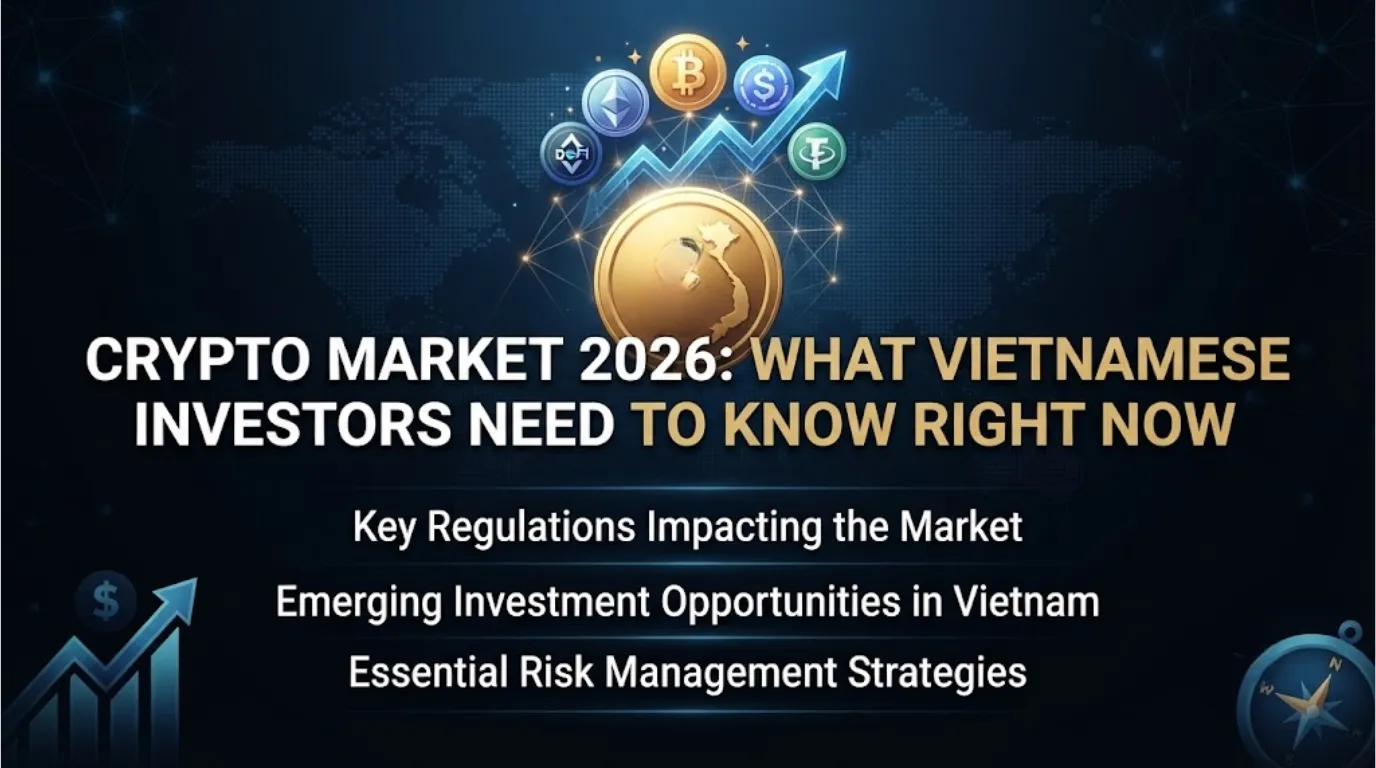
Crypto Market 2026: What Vietnamese Investors Need to Know Right Now
2026年7月17日
Crypto in 2026 Is Not What You Remember
If you are looking at crypto in 2026 through the lens of 2021 or 2022 — you are looking at a fundamentally different market.
The past three years have structurally changed the crypto landscape in ways that cannot be reversed:
- Bitcoin ETFs approved in the US — opening the door to trillions in institutional capital
- BlackRock, Fidelity, Franklin Templeton — the world's largest asset managers all have active crypto/RWA products
- Regulatory clarity advancing — MiCA in the EU, SEC guidance in the US, MAS in Singapore all creating clearer legal frameworks
- RWA tokenization — moving from experiment to real product, with over $15 billion in real assets now tokenized on public blockchains
The result: Crypto in 2026 has two distinct tiers — a speculative tier (still high-risk) and a real asset tier (RWA — increasingly stable and institutionalized). Smart Vietnamese investors in 2026 need to know which tier suits them.
The 2026 Crypto Market — Full Snapshot
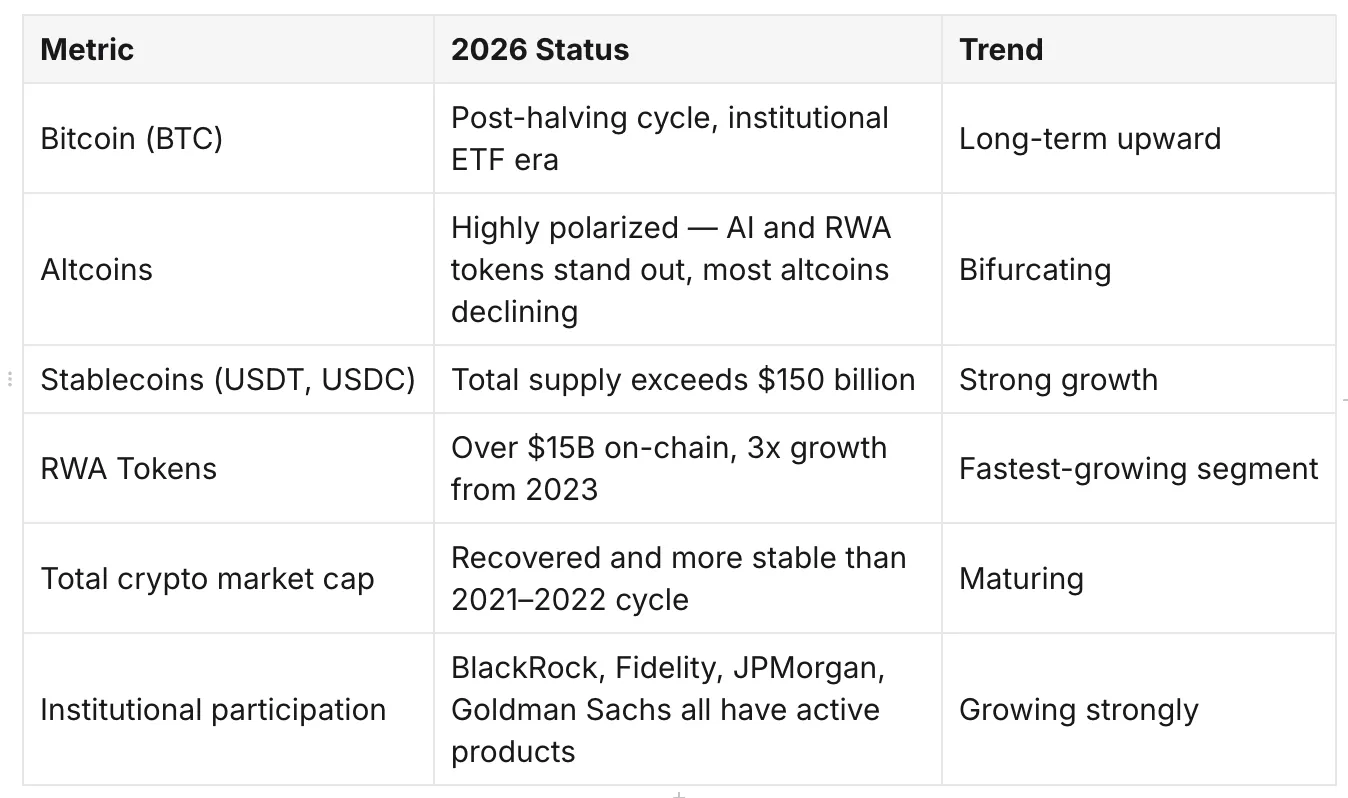
What changed from 2021–2022?
The 2021 market was primarily retail speculation. The 2026 market includes institutions — and institutions do not speculate. They buy Bitcoin ETFs to hold long-term. They issue RWA to create products. Institutional participation reduces some volatility and increases legitimacy for the entire industry.
What Is Crypto and Should You Invest in 2026?
The answer depends entirely on which type you are considering. In 2026, crypto has clearly split into 5 distinct categories, each with its own risk profile and opportunity set:
Type 1: Bitcoin — Digital Store of Value
Bitcoin entered its fourth historical post-halving bull cycle after the April 2024 halving. This pattern has repeated three times previously.
Strengths in 2026:
- Bitcoin ETFs bring structural institutional demand — not just speculation
- Post-halving supply: only 3.125 BTC per block — supply shrinks while demand grows
- Recognized as a treasury reserve asset by several companies and some nations
- Low correlation to equities — genuine portfolio diversification value
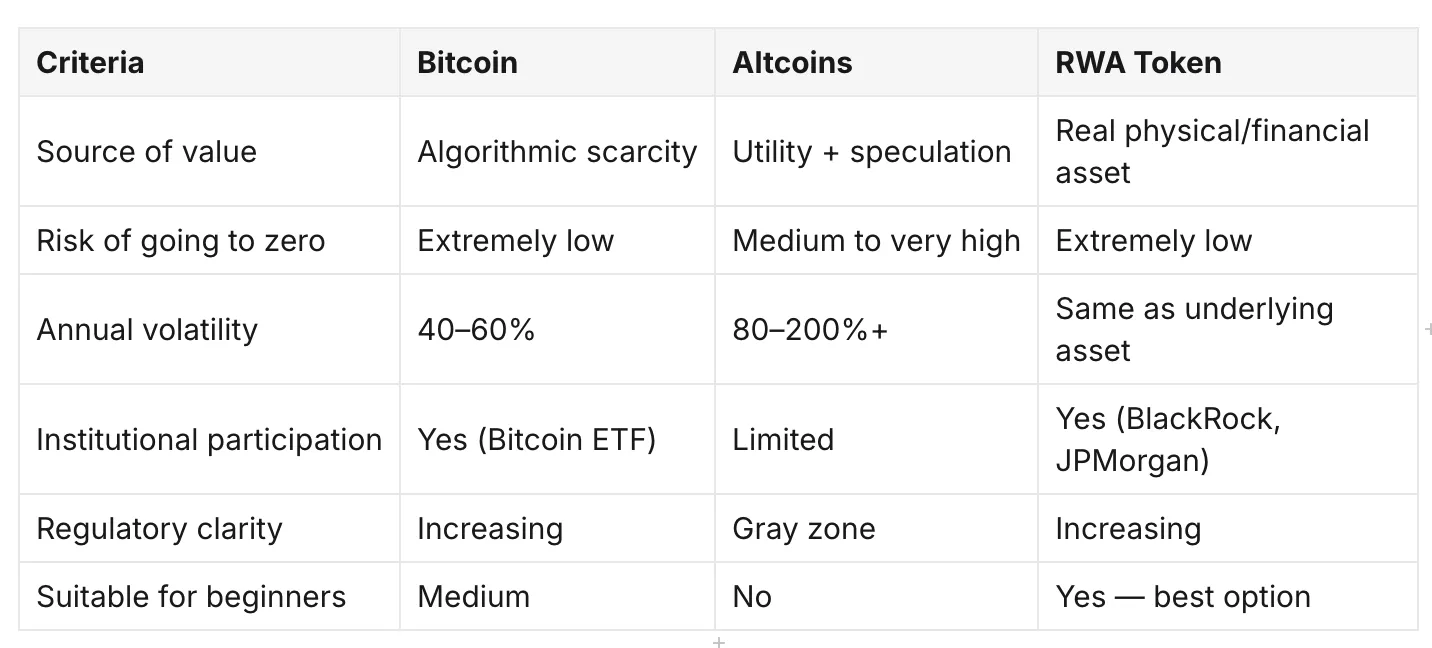
Risks: Still 40–60% annual volatility. Not suitable if you need the capital within 6–12 months.
2026 verdict: A reasonable investment for long-term investors (3–5 years+) who can tolerate volatility. Not appropriate for short-term capital.
Type 2: Ethereum and Smart Contract Platforms
Ethereum remains the largest blockchain infrastructure — most RWA tokens, DeFi protocols, and institutional products run on Ethereum or its Layer 2 networks.
2026 strengths: Post-upgrade efficiency; foundation for BlackRock BUIDL, Franklin Templeton fund, and hundreds of RWA products. ETH staking yields ~4–5% annually.
Risks: Competition from Solana, Avalanche, and newer blockchains.
Type 3: Altcoins — The High-Speculation Tier
This is where most new investors lose money — and where the highest potential returns exist alongside the highest risk.
2026 reality:
- AI tokens (on-chain AI applications): the strongest current narrative
- Memecoins: still exist, still extremely high-risk, still attract speculation
- DeFi tokens: polarized — protocols with real revenue are performing well, "zombie protocols" are not
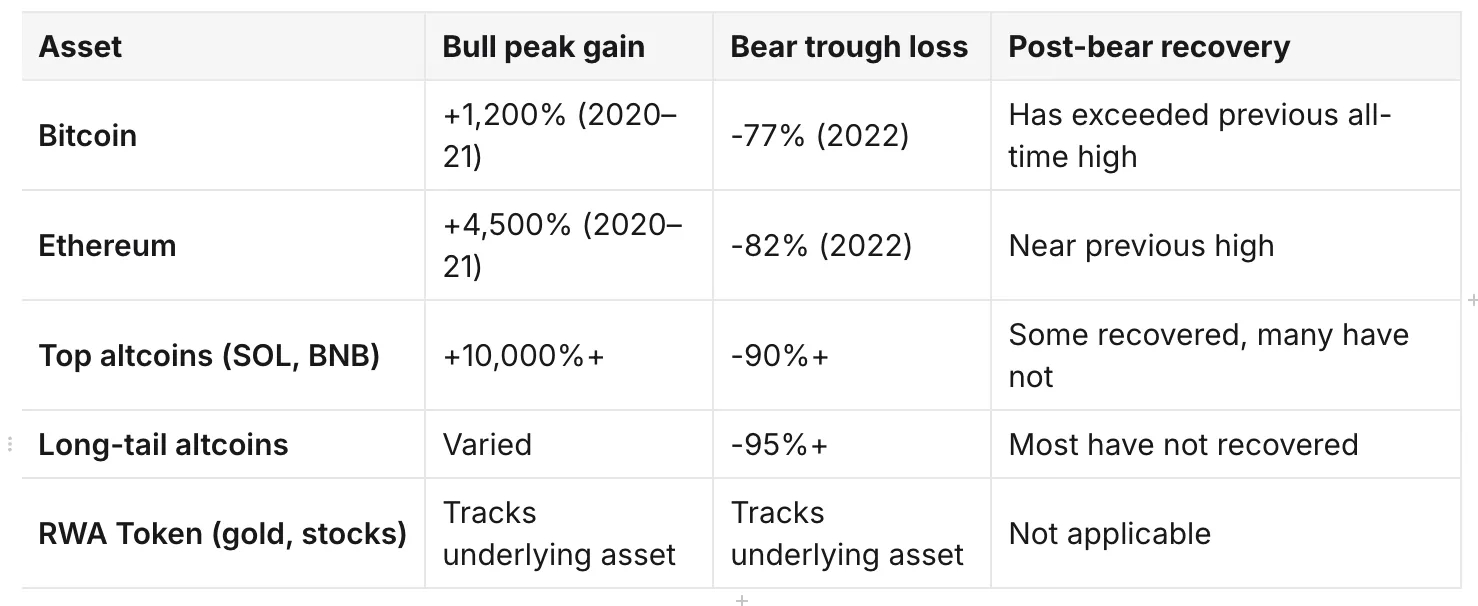
- Most altcoins from 2021 have lost 80–99% and have not recovered
Immutable rule: Only invest what you can afford to lose entirely.
Type 4: Stablecoins (USDT, USDC)
Not an investment — a payment tool and bridge. Holding USDT is holding digital USD. It does not generate returns on its own but is the starting point for RWA tokens, staking, and yield farming.
Type 5: RWA Tokens — The Most Important New Category of 2026
This is the category the world's largest financial institutions are choosing. RWA tokens represent real assets — gold, stocks, real estate, commodities — on blockchain infrastructure.
Why RWA is the biggest opportunity for Vietnamese investors in 2026:
- Access global gold, Apple/NVIDIA stock from $2 USDT
- Risk tracks real assets — not speculative crypto risk
- 24/7 trading — no international broker needed
- Institutionalized — BlackRock and JPMorgan doing this at massive scale
This is where ToVest operates — and why ToVest is the most suitable entry point for Vietnamese investors who want to participate in the crypto market intelligently and safely in 2026.
Bitcoin vs Altcoins: The 2026 Answer
Historical Performance Through Market Cycles
Why Are Major Financial Institutions Pouring Money Into RWA?
When BlackRock — managing $10 trillion in assets — launches a tokenized fund on Ethereum, they are not doing it out of curiosity. They are doing it because it creates real business advantages:
The 5 Institutional Advantages of RWA
1. T+0 settlement instead of T+2
Traditional bond and stock markets take 2 business days to settle. Blockchain settles in seconds. At billions in daily volume, capital "frozen" for 2 days represents enormous cost.
2. 24/7/365 liquidity
US bond markets close at 5pm EST and all weekend. Tokenized on blockchain: continuous trading, no gap risk, no restricted after-hours sessions.
3. Unlimited asset fractionalization
A $100M office building was previously illiquid. Tokenized: split into 1 million $100 tokens, sold globally. Unlocks liquidity in previously frozen asset classes.
4. Automated, transparent audit trail
Every transaction is permanently recorded on blockchain — no expensive audit teams, no risk of accounting fraud.
5. Programmable compliance
Smart contracts can automatically verify investor conditions, transfer restrictions, and tax reporting requirements — reducing compliance cost significantly.
Who Is Doing What — 2026 Update
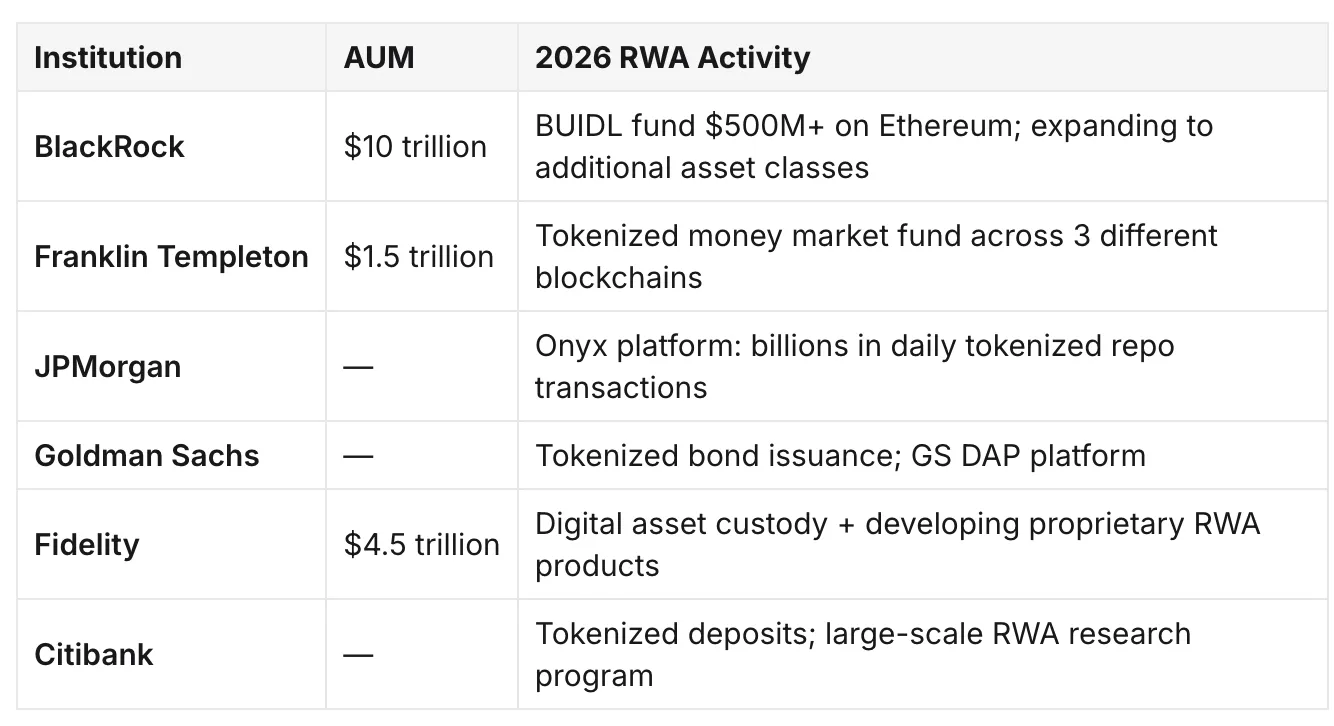
What this means for the $2 investor on ToVest: When Goldman Sachs issues tokenized bonds and BlackRock launches RWA funds, they validate that blockchain is the financial infrastructure of the next generation. ToVest uses the same model to bring that opportunity to Vietnamese retail investors — starting from $2.
How to Know If a Crypto Platform Is Trustworthy — The 2026 Checklist
History has proven: the biggest risk in crypto is not price decline — it is platform collapse.
FTX lost $8 billion of user funds. Celsius lost $4.7 billion. Voyager lost $1.3 billion. All appeared credible before collapsing.
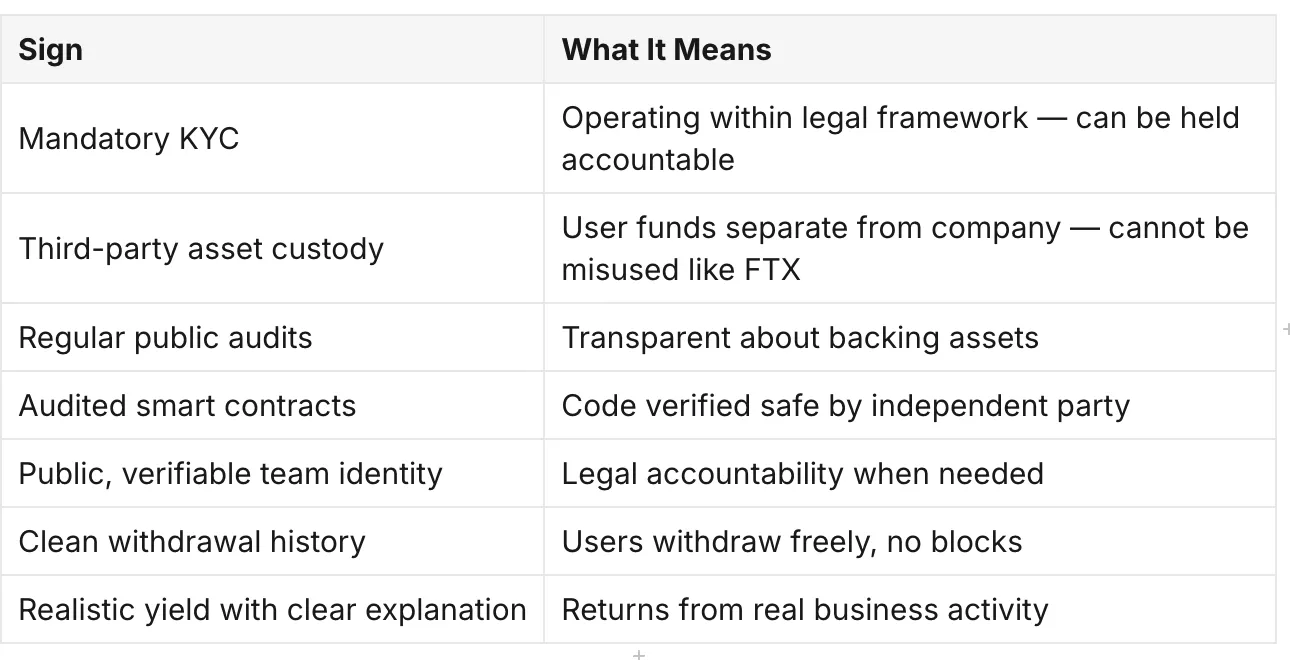
✅ Good Signs — What Trustworthy Platforms Show
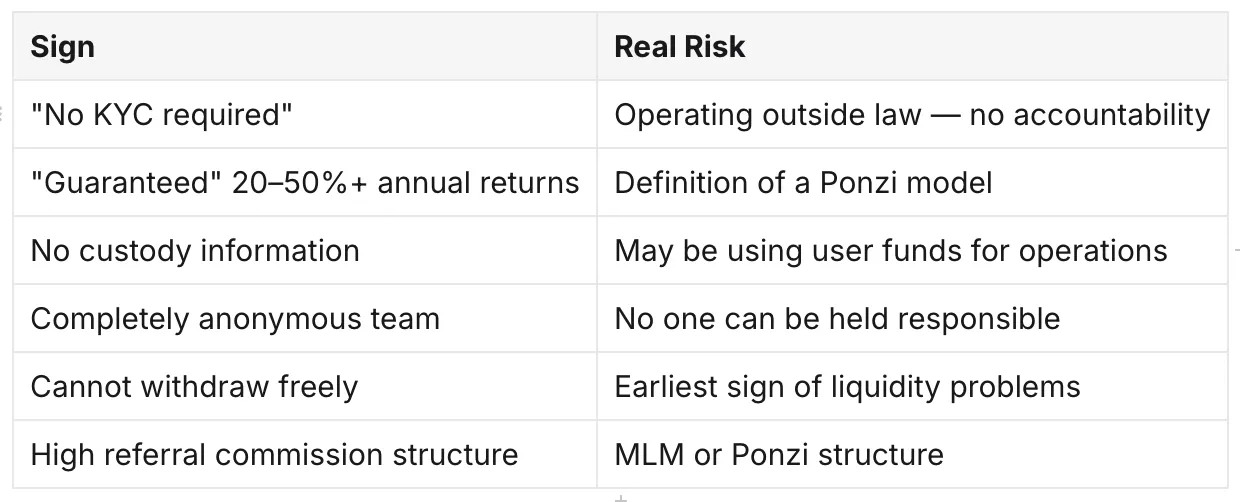
🚩 Red Flags — Avoid Immediately
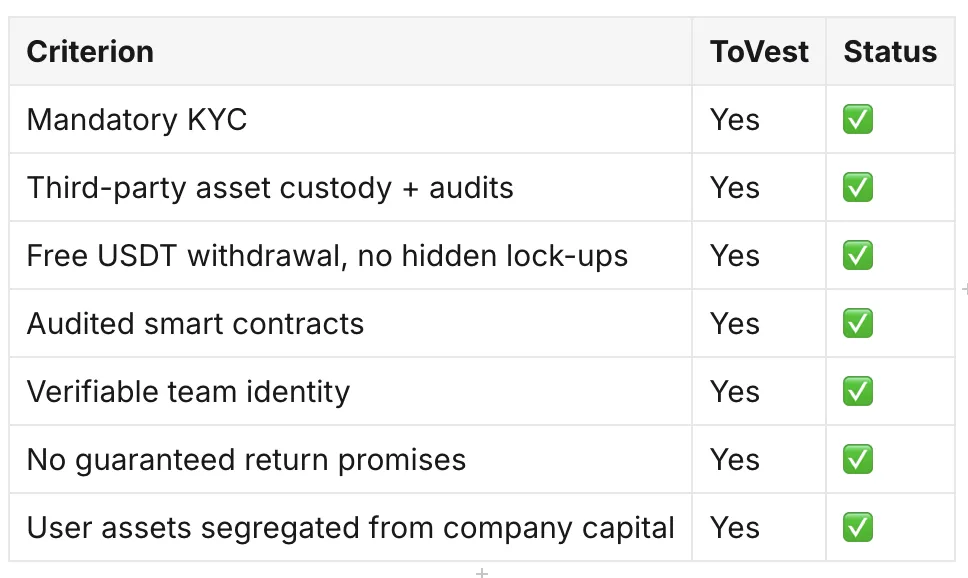
ToVest — Scored Against the 2026 Checklist
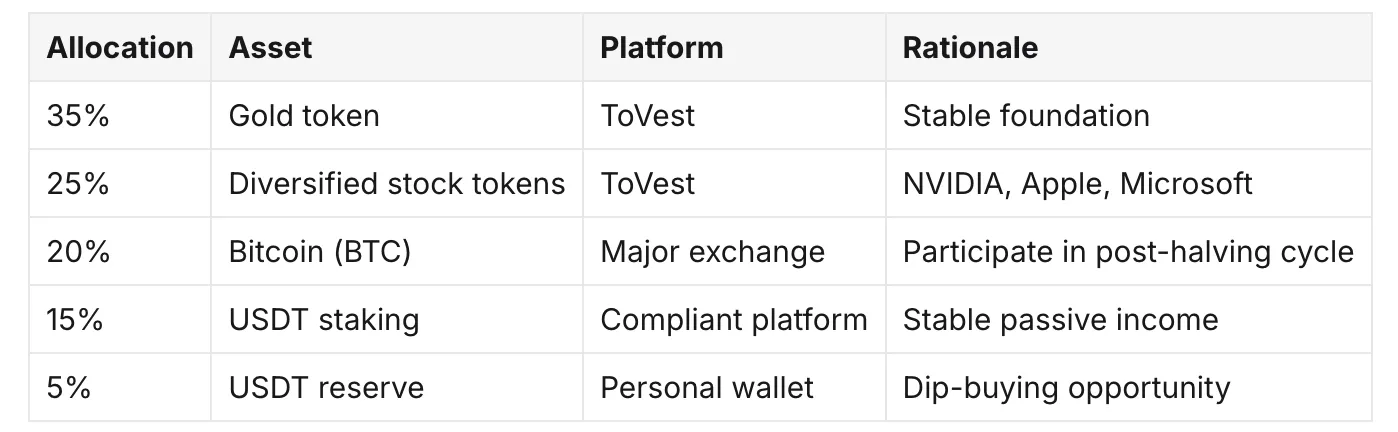
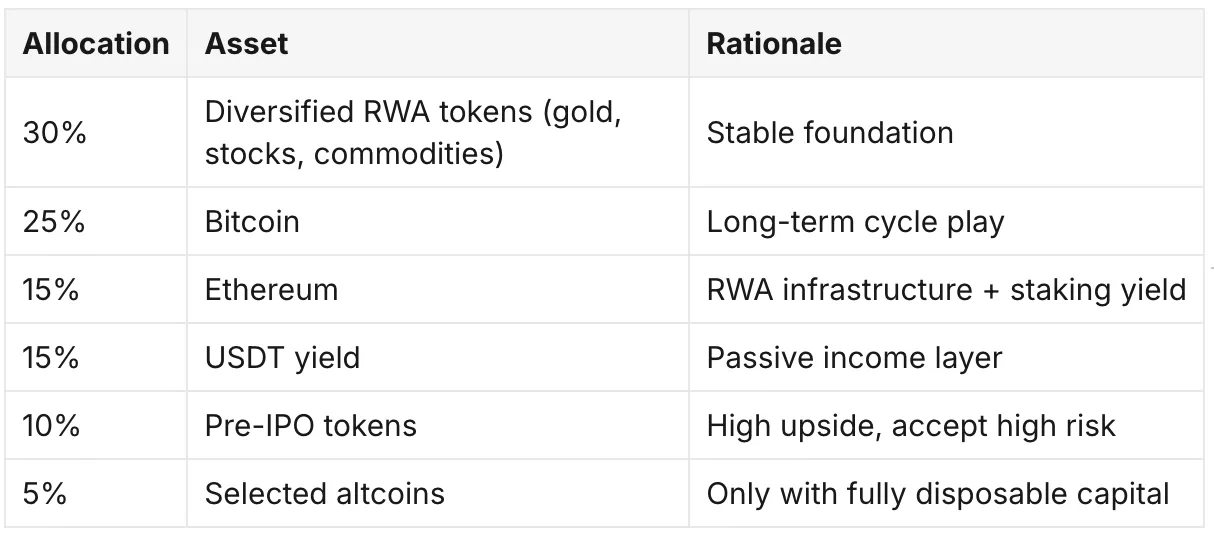
Practical Portfolio Allocation for Vietnamese Investors in 2026
Beginner Portfolio ($10–$100)
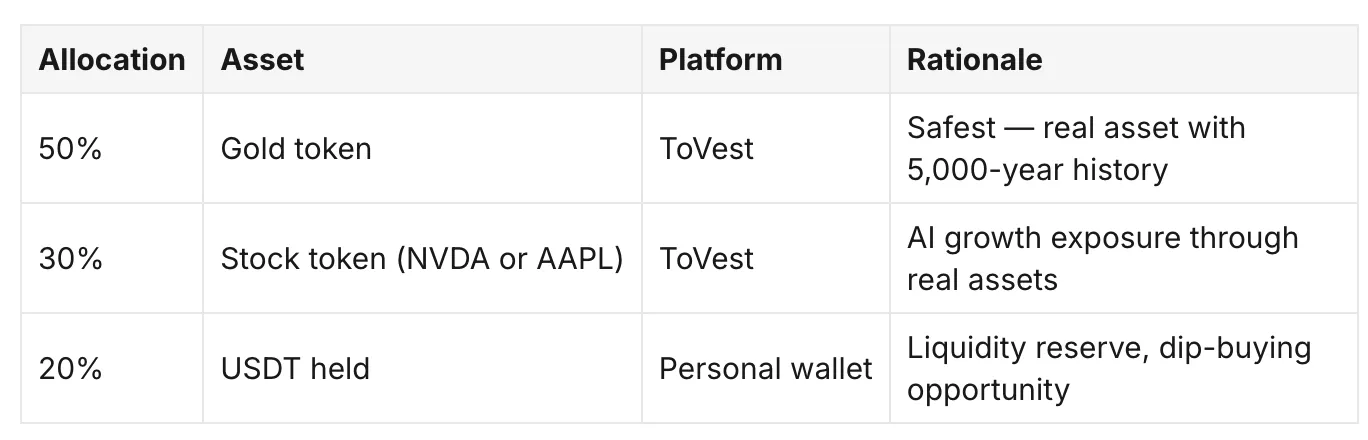
Intermediate Portfolio ($100–$1,000)
Advanced Portfolio ($1,000+)
Frequently Asked Questions (FAQ)
What is crypto and should I invest in 2026?
Crypto in 2026 includes multiple distinct categories: Bitcoin (digital store of value), Ethereum (application infrastructure), Altcoins (high-risk speculation), Stablecoins (USDT — payment tool), and RWA Tokens (tokenized real assets). Whether to invest depends on which type: RWA tokens are the safest and most suitable for beginners — risk profile similar to traditional investing. Bitcoin suits long-term investors (3–5 years+). Altcoins only suit experienced investors with fully disposable capital.
Why are major financial institutions investing in RWA crypto?
Five structural reasons: (1) T+0 settlement instead of T+2 days — enormous capital efficiency at scale; (2) 24/7 trading versus business hours only; (3) ability to fractionalize large illiquid assets for many investors; (4) automated, transparent blockchain audit trails; (5) programmable compliance embedded in smart contracts. BlackRock, JPMorgan, Goldman Sachs, and Fidelity all have active RWA programs in 2026.
How do I know if a crypto platform is trustworthy in 2026?
Check 7 good signs: mandatory KYC, third-party asset custody with public audits, clean withdrawal history with no frozen accounts, independently audited smart contracts, publicly verifiable team, realistic yield claims — no guaranteed returns, user assets segregated from company operating funds. Avoid any platform showing the 6 red flags: no KYC, guaranteed 20%+ returns, no custody information, anonymous team, withdrawal restrictions, or high referral commission structures.
What is the difference between Bitcoin and altcoins in 2026?
Bitcoin has survived 4 market cycles, has Bitcoin ETF institutional backing, and has a fixed supply of 21 million coins. Most altcoins from 2021 have lost 80–99% of their value and have not recovered. In 2026, the distinction matters more than ever: Bitcoin has institutional legitimacy; most altcoins remain high-risk speculation. RWA tokens are a third category — blockchain infrastructure delivering real-asset value with much lower risk than either.
How much should I start with in crypto in 2026?
For RWA tokens on ToVest: from $2 USDT. For Bitcoin: start with only what you can afford to lose entirely without affecting your life — many beginners start with $50–$100. The rule more important than the amount: never invest money you need within the next 12 months into high-volatility crypto.
What is ToVest in the 2026 crypto ecosystem?
ToVest is an RWA investment platform — allowing purchase of tokens representing gold, US stocks (Apple, NVIDIA...), commodities, and pre-IPO equity using USDT from $2, trading 24/7, no international bank account required. Unlike conventional crypto exchanges: no Bitcoin or speculative altcoins — only real assets tokenized on blockchain.
Is crypto safe to invest in Vietnam in 2026?
Safety depends on the type of crypto and the platform. RWA tokens on a compliant platform like ToVest are far safer than speculative altcoins — because the underlying assets are real gold and actual stocks. The main risk in Vietnam: choosing the wrong platform. Solution: only use platforms with mandatory KYC, third-party custody, and a verifiable operating history.
The Conclusion: 2026 Crypto Is a Two-Speed Market
In 2026, the crypto market has clearly separated into two speeds:
Speed 1 — The Institutionalized Tier (RWA, Bitcoin ETF): More stable, more transparent, better legally protected. This is where BlackRock, JPMorgan, and Goldman Sachs are placing capital. This is also where smart retail investors should begin.
Speed 2 — The Speculative Tier (Altcoins, Memecoins, High-Risk DeFi): Higher potential upside but much higher risk. Suitable for experienced investors with disposable capital who understand the mechanisms deeply.
The advice for Vietnamese investors in 2026: Start in Tier 1 — RWA tokens on a reputable compliant platform. Learn how real asset markets work on blockchain infrastructure. Build a stable portfolio. Then, if desired, allocate a small portion to Tier 2 with fully disposable capital.
Crypto in 2026 is not a gamble or a get-rich-quick scheme — it is a maturing asset class with real opportunities for those who approach it correctly.
Start in the right tier — gold tokens, US stocks, and real assets on ToVest from $2 USDT. 24/7 trading at tovest.com