Top 10 Tokenized Asset Platforms Offering Highest Liquidity in 2026
February 2, 2026
Tokenized assets are digital representations of real-world assets—such as securities or real estate—on a blockchain, permitting fractional ownership and near-instant settlement. In 2026, investors increasingly want liquid access to diverse assets with 24/7 markets, transparent custody, and integrated compliance. This guide highlights the top 10 tokenized asset platforms offering the highest liquidity, plus the infrastructure that powers them. We focus on regulated issuance, strong secondary markets, and DeFi composability—so you know where you can enter, trade, and settle fast. If you’re asking which platforms offer the best liquidity and how to buy tokenized assets like real estate or stocks, you’ll find direct, practical answers below, including step-by-step onboarding and the key features to evaluate before you commit capital.

Tokenized assets are unlocking market access by turning traditionally siloed or illiquid assets into programmable, tradable tokens. By 2026, the real-world asset market is projected to exceed $100 billion in tokenized value, driven by increased institutional participation and better rails for settlement and custody, according to Centrifuge’s 2026 outlook (Centrifuge’s 2026 outlook). High-liquidity platforms distinguish themselves with robust secondary markets, DeFi integrations, compliance-first issuance, and institutional-grade custody—critical for orderly price discovery and exit optionality (SecurityTokenizer overview of 2026 RWA platforms).
For investors, the appeal is straightforward:
- Fractional investing and 24/7 trading broaden access to blue-chip stocks, Treasuries, and prime real estate.
- Near-instant settlement reduces counterparty risk and unlocks composability across lending, collateralization, and yield strategies.
- Regulated platforms with transparent, on-chain records simplify cross-border participation.
Independent analyses continue to highlight the importance of compliance tooling, custody, and secondary liquidity when ranking tokenization platforms (QuickNode builder’s guide to RWA platforms). Against this backdrop, the platforms below stand out for dependable liquidity, credible controls, and ease of use.
ToVest: Regulated Fractional Investing with High Liquidity
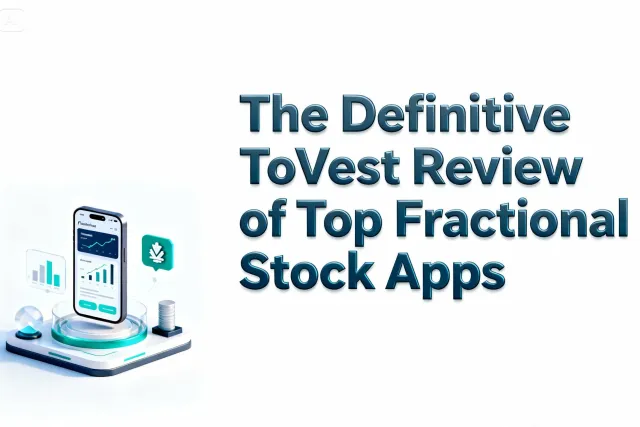
ToVest is a regulated, blockchain-powered platform that provides global retail investors with seamless, commission-free access to tokenized U.S. stocks, ETFs, options, and real estate with low minimums (around $5). Investors can fund in multiple currencies, including fiat and supported stablecoins, and benefit from instant settlement and continuous market access.
What makes ToVest different is its full-stack approach: compliant onboarding for non-U.S. residents, transparent on-chain custody, and integrated secondary markets for high liquidity across asset types. The platform is designed to simplify diversification—allocating across equities, index funds, options strategies, and real estate without operational friction. For long-term savers, ToVest also supports an IRA with contribution matching, aligning tax-advantaged saving with modern market rails.
In short: regulated access, low costs, instant settlement, and 24/7 tradability—delivered in a user-friendly, globally available app that brings liquid real assets to everyday investors.
Securitize: Global Leader in Digital Securities and Secondary Trading
Securitize is widely recognized for its leadership in compliant digital securities—blockchain-based representations of traditional stocks, bonds, and funds issued under regulated frameworks. It combines primary issuance with integrated secondary trading, drawing both institutional and retail flows across multiple jurisdictions, which sustains deeper order books and more consistent liquidity (QuickNode builder’s guide to RWA platforms).
With stringent KYC/AML, transfer restrictions, and investor accreditation workflows where required, Securitize helps buyers access liquid exposure to tokenized real-world assets without sacrificing regulatory rigor.
Tokeny Solutions: Compliance-First Tokenization with Cross-Border Tradability
Tokeny specializes in enterprise-grade tokenization of equity, debt, and real estate, built on programmable compliance and interoperable token standards. Its adoption of standards such as ERC-3643—“a blockchain standard enabling regulated assets to be issued, transferred, and redeemed under programmable compliance”—supports broad tradability while preserving jurisdictional controls (Amina Group’s overview of top tokenization platforms).
Tokeny’s global investor onboarding, identity management, and built-in rulesets give issuers and marketplaces the tools they need to maintain compliance and liquidity at scale.
Centrifuge: Unlocking Liquidity for Receivables and SME Credit
Centrifuge pioneered bringing off-chain cash flows—like invoices and SME receivables—on-chain, converting them into investable pools that tap DeFi liquidity. This model expands credit market access for borrowers while delivering transparent, tokenized yield opportunities to investors. The broader category is on pace to surpass $100 billion in tokenized real-world asset value by 2026 (Centrifuge’s 2026 outlook).
Repeatable components that drive liquidity on Centrifuge include:
- Asset onboarding with data verification
- Compliance tooling that gates access appropriately
- White-label integrations for issuers and servicers
- Seamless liquidity bridging into DeFi lending and secondary venues
Ondo Finance: Tokenized Fixed Income and Money Market Liquidity
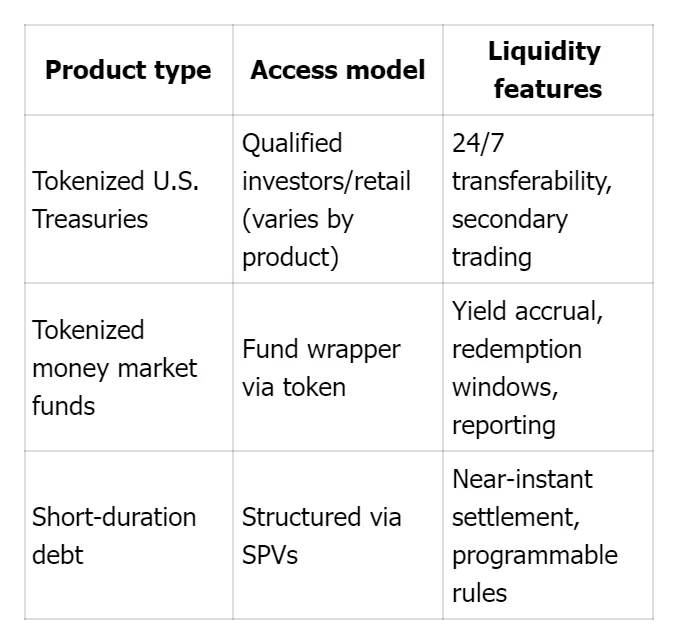
Fixed income tokenization is the process of representing traditional debt instruments like U.S. Treasuries and corporate bonds as blockchain tokens, enabling easy trading and fractional ownership. Ondo Finance concentrates on primary and secondary liquidity for tokenized Treasuries and money market products—delivering yield, transparent holding structures, and faster settlement relative to legacy rails (RWA.io’s 2026 tokenized platforms roundup).
Typical Ondo products and liquidity features:
- Tokenized U.S. Treasuries: fractional exposure, on-chain transferability, active secondary market
- Tokenized money market funds: yield-bearing tokens, redemption windows, programmatic compliance
- Short-duration fixed income: transparent holdings and streamlined settlement
Maple Finance: Institutional On-Chain Lending and Tokenized Credit
On-chain credit refers to digitized loan agreements secured by real-world or crypto collateral, issued and traded transparently on blockchains. Maple Finance provides institutional-grade lending marketplaces with tokenized loan exposures, enabling investors to enter and exit pools with clearer risk controls and more fluid secondary options (Uniblock overview of tokenization platforms).
Maple’s pool delegates, underwriting frameworks, and tokenized claims help compress settlement times and improve price discovery for credit risk.
Swarm Markets: Regulated Tokenization and Transferable Securities Tokens
Swarm Markets focuses on regulated tokenized securities designed for compliant, cross-investor transfers with KYC/AML by default. Transferable securities tokens are blockchain-based assets representing traditional or novel financial instruments engineered for secure peer-to-peer transfer within regulated environments (Rapid Innovation’s comparison of tokenization platforms).
Examples of assets supported on Swarm:
- Equities and equity funds
- Bonds and fixed income products
- Index and specialized funds
- Specialty or structured assets
RealT: Fractional Real Estate Tokens with Automated Rental Distributions
RealT allows investors to buy tokens representing fractional property ownership, with rental income distributed directly on-chain to token holders. Fractionalization—breaking up ownership of a traditionally illiquid asset into smaller, tradeable blockchain tokens—makes income real estate accessible with low minimums and daily or periodic yield (RealT platform overview).
Key benefits for investors:
- Automatic, regular rental distributions
- Secondary market access for liquidity
- On-chain transparency and reporting
- Low entry minimums for diversified property exposure
For more background on tokenized real estate mechanics and investor workflows, see this practical primer (HoneyBricks explainer on tokenized real estate).
TrueFi: On-Chain Credit Protocol with Tradable Loan Exposures
TrueFi issues loans backed by real-world assets and tokenizes the resulting exposures, enabling investors to hold, trade, or deploy them across secondary and DeFi venues. Institutional participation, transparent reporting, and structured compliance support sustained liquidity and confidence (Amina Group’s overview of top tokenization platforms).
A simple investor flow:
- Onboard and verify
- Participate in curated loan pools
- Collect yield distributions
- Exit via secondary trading when available
Spydra (OpenRWA): Enterprise-Ready Cross-Chain Asset Tokenization
Spydra’s OpenRWA equips enterprises to tokenize assets across multiple chains with no-code APIs, auditability, and programmable compliance, accelerating connectivity with global liquidity pools (Spydra’s guide to top tokenization platforms). Its cross-chain approach helps issuers bridge asset flows where they are most actively traded.
Core steps in Spydra’s workflow:
- Asset registration with metadata
- Compliance checks and investor gating
- Token distribution and lifecycle management
- Cross-chain settlement and reconciliation
ConsenSys and Fireblocks: Infrastructure Enabling DeFi Integration and Custody
Composability is a blockchain feature that allows applications and tokens to interoperate and build on each other’s functionality. At the infrastructure layer, ConsenSys provides developer tooling, wallets, and interoperability to plug tokenized assets into DeFi, while Fireblocks delivers secure key management and transaction orchestration for institutions—together forming the backbone for custody and settlement at scale (industry roundup on leading tokenization providers).
Benefits for platforms and investors:
- Streamlined onboarding and developer tooling
- Minimized settlement risk via secure orchestration
- Multi-party custody with policy controls
- Scalable integrations into exchanges and DeFi
How to Buy Tokenized Assets Including Real Estate or Stocks
- Create and verify your account on a regulated tokenized asset platform (e.g., ToVest). Know Your Customer (KYC) and Anti-Money Laundering (AML) are regulatory checks required to prevent financial crime and prove investor eligibility.
- Fund your account via bank transfer or stablecoins like USDC/USDT.
- Browse listed assets (stocks, ETFs, real estate, fixed income) and review disclosures and fees.
- Place a buy order. Settlement is instant or near-instant on-chain, and your tokens appear in your custody wallet.
- Manage your holdings: enable yield distributions where applicable, and access secondary markets for liquidity.
- Withdraw proceeds or redeploy capital across assets and DeFi strategies as permitted by the platform’s policies.
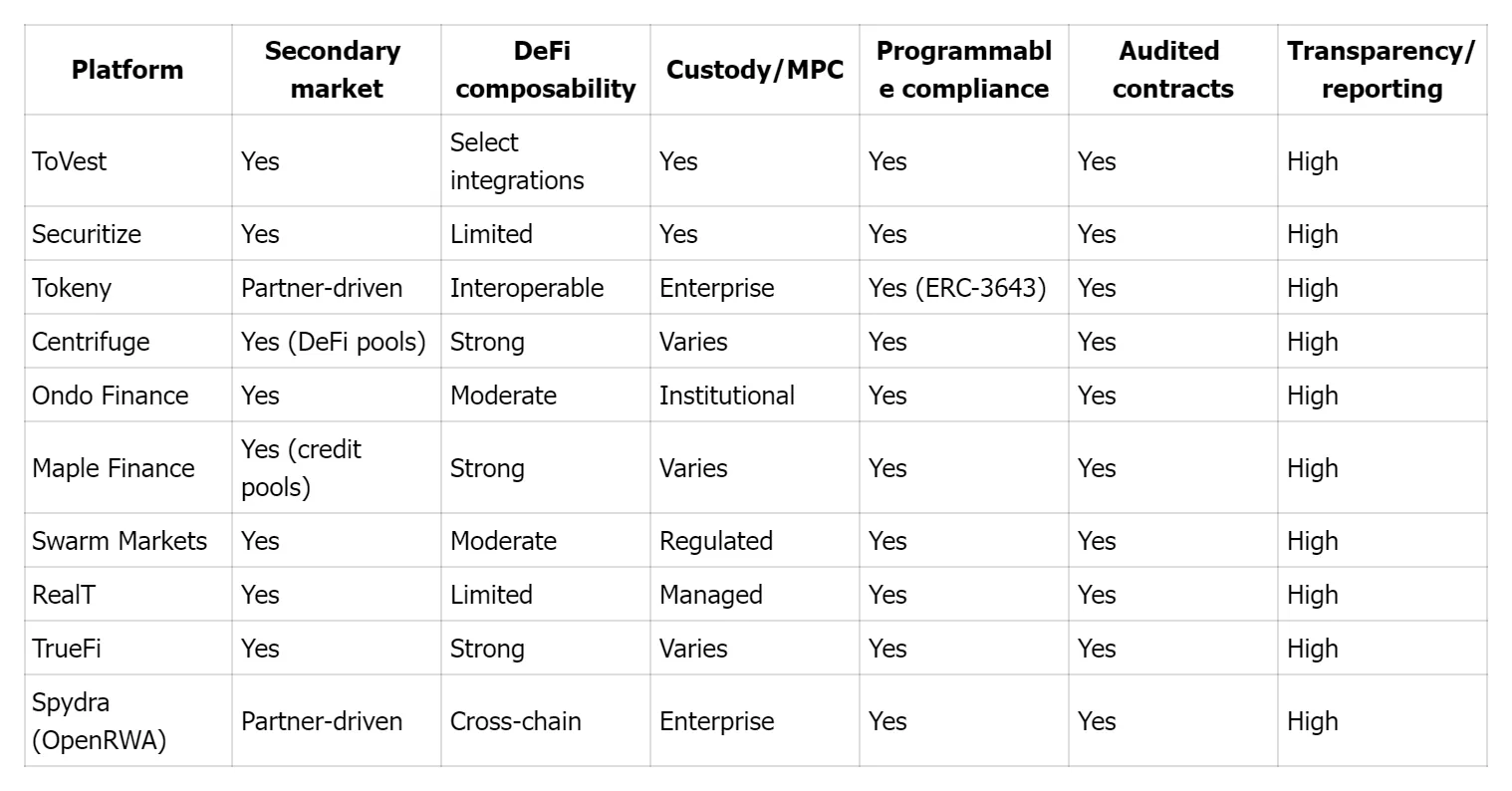
Key Features to Evaluate for High-Liquidity Tokenized Asset Platforms
- Secondary market access: Active order books or peer-to-peer venues supporting swift exits.
- DeFi composability: Ability to use tokens as collateral, in lending, or for yield strategies.
- Custody: The secure management, safekeeping, and administration of digital and tokenized assets on behalf of investors, ideally with MPC-based controls.
- Programmable compliance: KYC/AML, transfer restrictions, and jurisdictional rules embedded at the token level.
- Audited smart contracts: Independent code reviews and ongoing monitoring.
- Transparent reporting: On-chain proofs, asset attestations, and investor dashboards.
Indicative feature checklist
Frequently Asked Questions
What are tokenized asset platforms and why is liquidity important in 2026?
Tokenized asset platforms allow investors to buy and trade blockchain-based versions of real-world assets, such as real estate or stocks. In 2026, liquidity matters because it enables fast, transparent trades at reliable prices and lowers exit risk.
Which asset types typically offer the best liquidity on tokenized platforms?
Blue-chip equities, U.S. Treasuries, and money market products tend to be the most liquid; high-quality real estate in major markets can also see steady demand and trading.
How do DeFi integrations and secondary markets enhance liquidity for tokenized assets?
DeFi integrations allow tokens to serve as collateral or enter lending pools, while active secondary markets provide instant buy/sell options and tighter spreads.
What should investors consider when choosing a tokenized asset platform?
Assess secondary liquidity, asset selection, regulatory compliance, security and custody, and 24/7 trading access.
How is regulatory compliance handled on high-liquidity tokenized asset platforms?
Leading platforms use KYC/AML, transparent reporting, and programmable transfer restrictions to meet regulatory standards and protect users.