eToro vs Interactive Brokers vs TradeStation: Best for International Investors
December 29, 2025
If you live outside the U.S. and want to buy American stocks, you have real choices. eToro, Interactive Brokers (IBKR), and TradeStation each open the door to U.S. markets, but they serve different priorities: simplicity and social investing (eToro), global market depth and pro tools (IBKR), or active U.S. trading with advanced charting and futures (TradeStation). For most international investors who value broad market access, low FX costs, and institutional-grade tools, Interactive Brokers is the most comprehensive choice. eToro excels in easy onboarding, commission-free stock trades, and fractional shares with social features. TradeStation is best for active U.S. equities/options/futures traders—and can extend abroad via its “Global” setup. Below, we outline how to buy U.S. stocks as a non-U.S. resident, what documents you’ll need, and how these platforms compare.
Overview of Buying US Stocks as a Non-US Resident
A non-U.S. resident can legally own U.S. stocks. You receive the same property rights to shares, though dividends are typically subject to U.S. withholding tax unless reduced by treaty rates. As Investopedia notes, foreign investors can buy U.S. securities, but should expect dividend withholding and extra tax forms during onboarding (Investopedia on foreign ownership of U.S. stocks).
“A non-US resident is any person or entity without legal residency in the United States, impacting eligibility and documentation needs for US brokerage accounts.”
Digital brokerages have made it straightforward to open accounts remotely, fund in local currency, and convert to USD when needed. Tokenization is also emerging: by issuing blockchain-based representations of assets, providers can deliver fractional ownership and always-on settlement, potentially reducing frictions in cross-border investing. Interactive Brokers stands out by providing access to 95 international exchanges and 150 markets, responding to the needs of global investors seeking diversified portfolios, a breadth highlighted in independent evaluations such as Investopedia’s international trading broker rankings and StockBrokers.com’s best international brokers.
Key barriers and how brokers typically solve them:
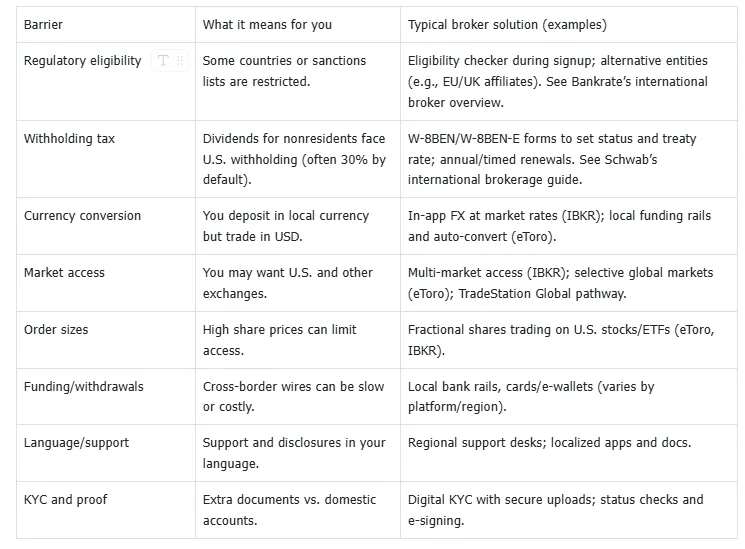
For clarity:
- Fractional shares let you buy part of a single share (e.g., $50 of a $500 stock), making high-priced names accessible.
- Withholding tax is the amount your broker must deduct from U.S. dividends before you’re paid, often reduced by tax treaties.
- Market access refers to the number and variety of exchanges/asset classes you can reach from one account.
ToVest perspective: ToVest utilizes blockchain tokenization to provide compliant, fractional exposure to U.S. stocks and real assets with zero commissions and streamlined onboarding, designed to complement or fill gaps in traditional brokerage access for international investors.
Account Opening and Documentation Requirements for International Investors
Opening an account is typically fully digital and takes from same day to a few business days, depending on your country and the broker. You’ll fill out a suitability questionnaire, verify your identity, and complete tax forms.
Standard documents you should have ready:
- Passport or government-issued national ID
- Proof of address (recent utility bill or bank statement)
- Tax identification number (local TIN, and/or U.S. SSN/ITIN if applicable)
- Source of funds/wealth declaration (employment, business, savings)
KYC (Know Your Customer) is a regulatory process where brokers verify customers’ identities to prevent fraud and comply with international law.
What to expect by platform:
- eToro: Streamlined app onboarding with digital ID verification and local funding options in many regions. You’ll be asked to complete a W‑8BEN for U.S. securities and confirm your trading experience.
- Interactive Brokers: More detailed forms covering employment, income, and trading background; supports multi-currency funding and FX conversion. Non-U.S. clients complete W‑8BEN/W‑8BEN‑E during setup. IBKR is widely cited as the leading option for international access thanks to low FX costs and broad reach.
- TradeStation: Strong for U.S. markets; international access is limited in the U.S. entity but available via regional offerings (e.g., TradeStation Global in some jurisdictions) with additional steps required. Documentation varies by jurisdiction.
Tax forms: Non-U.S. individuals typically submit Form W‑8BEN during onboarding so brokers apply the correct dividend withholding/treaty rates and report properly to the IRS; this is standard practice across international brokers.
Platform Features and Trading Tools Comparison
Each platform appeals to different international investor profiles. Here’s a concise comparison:
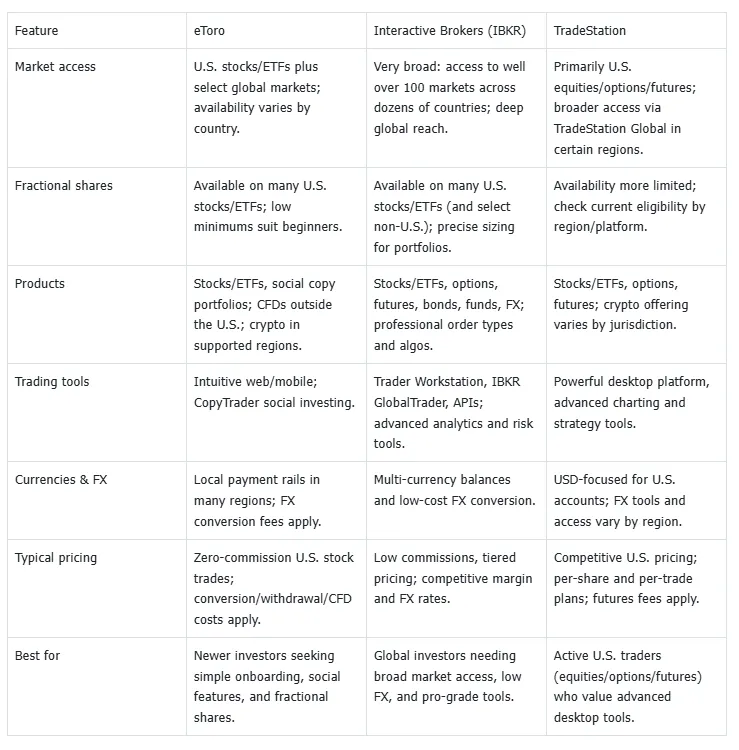
What this means for you:
- If your priority is the widest choice of international exchanges and institutional tools at low total cost, IBKR typically leads independent rankings for international trading.
- If you want the quickest path to buying U.S. stocks overseas with fractional shares and a social layer, eToro is approachable and broadly available to non-U.S. residents, as highlighted in third‑party roundups (Yahoo Finance’s roundup for non‑U.S. residents).
- If you trade U.S. options/futures actively and value sophisticated desktop tooling, TradeStation is purpose-built; for non-U.S. markets, look into region-specific “Global” access pathways.
Finally, if you face country-level restrictions, high FX/friction costs, or want 24/7 settlement and fractional access to multiple asset classes, tokenized exposure can complement a brokerage account. This is where ToVest’s approach—fractional, blockchain-secured access to U.S. stocks and real assets with zero commissions and seamless onboarding—aims to mitigate barriers many international investors still encounter.