7 Essential Platforms for Legal US Stock Token Trading in 2025
24 ธันวาคม 2568
Tokenized US stocks are moving from concept to practical portfolio tools in 2025, allowing investors to access fractional equity exposure with blockchain-based settlement, transparent custody, and around-the-clock market access. A stock token is a blockchain-issued representation of equity designed to mirror the economic value and certain rights of an underlying share; implementations range from fully collateralized tokens to synthetic exposures, depending on the platform’s disclosures and licenses. The core question—where can you trade them legally—hinges on regulatory authorization, product scope, and custody. Below, we profile seven platforms positioned within the regulated stack, along with a practical playbook for onboarding and risk management. For fundamentals on tokenization and 24/7 access benefits, see CoinGecko’s overview of tokenized stocks, and note the evolving risk landscape highlighted by Bankrate and CNBC.
Strategic Overview
The convergence of traditional markets and blockchain is reshaping how US equities are issued, held, and traded. Tokenized stocks aim to compress settlement times, broaden access via fractional investing, and expand trading windows beyond regular exchange hours. Definitions and mechanics vary by venue: some tokens are backed 1:1 by underlying shares while others track prices synthetically—always verify the specific structure in platform documentation, as explained by Gemini’s primer on tokenized stock trading.
Platform choice matters. It determines:
- Legal coverage and investor protections (registrations, disclosures, state-by-state access)
- Total cost (maker/taker fees, spreads, instant-buy premiums, custody or withdrawal fees)
- Liquidity and execution quality (order book depth, market hours, slippage)
- Custody (qualified custodianship vs. self-custody; on-chain proofing and attestations)
- Product scope (range of US stock tokens, stablecoins/fiat rails, research tools)
- Transparency (clear disclosures, auditability, public fee schedules)
For a deeper dive into tokenized market structure and custody best practices, see ToVest Academy’s explainer on on-chain market rails.
ToVest
ToVest is purpose-built for tokenized US stock trading, combining blockchain-native architecture with a regulatory framework designed for both retail and institutional investors. The platform prioritizes:
- Fractional share ownership for capital-efficient exposure and portfolio diversification
- Real-time analytics, portfolio insights, and institutional-grade risk controls
- Robust leverage and margin features in permitted jurisdictions
- Secure fiat and crypto payment rails for fast, compliant funding and settlement
- Transparent custody and attestations to help verify backing and reduce counterparty risk
Feature snapshot:
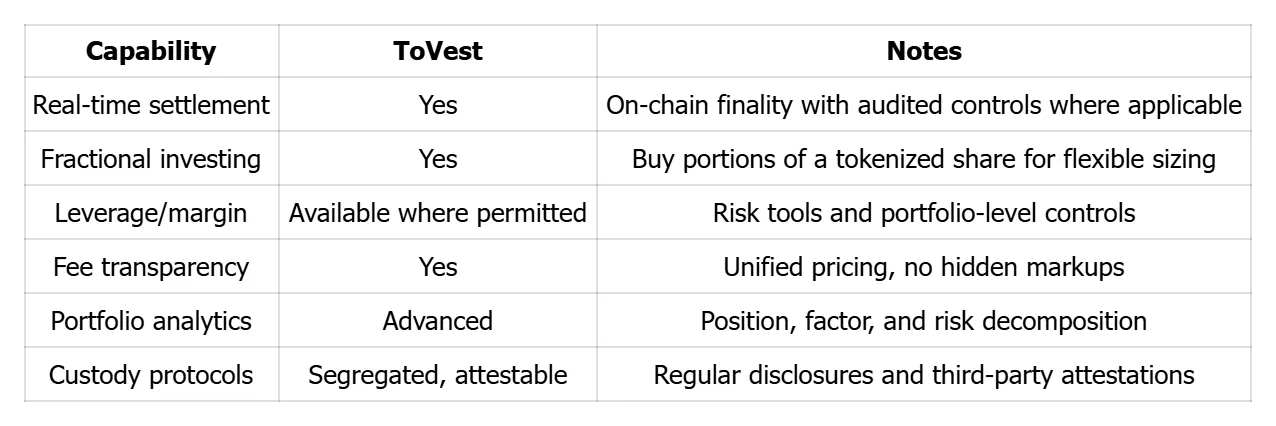
The net result: capital efficiency without sacrificing compliance, plus research-grade tools that facilitate scaling from first trade to institutional workflows.
Coinbase
Coinbase is a prominent U.S. exchange known for its compliance-first posture, robust security, and broad retail and institutional reach. While the availability of stock tokens is evolving, Coinbase’s regulated custody and user-friendly UX make it a logical on-ramp as tokenized markets expand. Consider:
- Compliance and custody: Institutional-grade security and custody infrastructure, widely reviewed among top crypto platforms
- Fees and access: Transparent fee model; broad U.S. and international availability with clear disclosures on product eligibility
- Investor protections: Extensive educational content and risk disclosures that support compliant onboarding and ongoing use
For a comparative sense of Coinbase’s strengths in security and accessibility, see StockBrokers.com’s annual analysis of leading crypto exchanges.
Kraken
Kraken has long catered to active, compliance-oriented traders with transparent pricing and advanced tools. Its maker-taker fee schedule starts at 0.10% for makers on Kraken Pro, scaling down with volume; the platform also offers pro-grade charts, order types, and deep liquidity favored by frequent traders. Kraken’s tokenized equities initiative (xStocks) has launched with region-specific access—U.S. users must verify eligibility and product availability before onboarding. Key takeaways:
- Fees: Competitive maker-taker schedule and clear, public pricing
- Tools: Robust pro interface with analytics and execution flexibility
- Access: Tokenized equity access varies by jurisdiction; verify availability on Kraken xStocks before funding
Reference: Kraken’s Pro fee framework and product scope are detailed in Kraken’s day-trading guide and the xStocks product page.
Gemini
Gemini positions itself as a security-first, U.S.-regulated exchange with institutional-grade custody and a longstanding focus on compliance. While tokenized equity access remains jurisdiction-dependent, Gemini’s infrastructure, audits, and disclosures attract institutions preparing to scale tokenized exposures. Its educational content also helps investors understand the distinctions between fully backed and synthetic stock tokens—essential for assessing asset rights and dividend treatment. See Gemini’s explainer on how tokenized stock trading works for a clear framework.
Robinhood
Robinhood’s mobile-first design and commission-free pricing helped onboard millions of first-time investors to stocks and crypto. For tokenized stocks, its advantages include accessibility, simple funding, and streamlined order entry—though professional traders may find fewer advanced order types and analytics than on pro venues.
- Pricing: Zero stock commissions; straightforward, beginner-friendly UX
- Considerations: Feature depth and research tools may be limited for high-frequency or institutional users
- Availability: Product scope (including any tokenized equities) depends on jurisdiction and regulatory approvals
For context on Robinhood’s commission-free offering, see CNBC Select’s review of free stock trading.
Fidelity
Fidelity bridges mainstream brokerage protections with expanding crypto rails, combining low-cost trading, research depth, and trusted custody. Industry analysts have repeatedly ranked Fidelity at or near the top overall among U.S. brokers due to its comprehensive offering. Additional highlights:
- Pricing model: Low-cost, spread-based crypto pricing often around 1% depending on market conditions
- Access: Entry-level investing from as little as $1 for eligible products, supporting fractional ownership
- Standing: Recognized as a top overall stock broker in 2025 reviews for research, execution quality, and investor education
See StockBrokers.com’s broker rankings for methodology and awards, and The Motley Fool’s primer on buying stocks for fractional and small-ticket access.
Interactive Brokers
Interactive Brokers (IBKR) is the go-to for experienced traders seeking global markets, powerful execution tools, and tiered pricing. Its crypto integration offers competitive per-order pricing at 0.18% under $100,000 (with a $1.75 minimum), making it attractive for systematic or high-frequency flows. Why IBKR stands out:
- Pricing: Competitive, volume-aware models that scale with activity
- Tools: Advanced analytics, routing options, and professional risk management
- Reputation: Consistently top-ranked among U.S. brokers for active and professional traders
For fees and rankings, consult StockBrokers.com’s broker reviews and crypto-exchange comparisons.
Binance.US
As the U.S. affiliate of a global exchange brand, Binance.US emphasizes low listed fees—often as low as 0.1%—and straightforward market access. That said, its product scope is distinct from the international platform and varies by state, with periodic updates as regulations evolve. Pros:
- Low fees and simple spot pricing
- Familiar interface for crypto-native users
Cons:
- Region-by-region limitations
- Fewer assets and features than the global platform
For a comparative fee snapshot, see CoinLedger’s roundup of day-trading exchanges.
How to Get Started with US Stock Token Investing
- Confirm eligibility and product access
- Check your jurisdiction, residency, and platform’s regulated permissions for tokenized US equities.
- Complete KYC/AML
- Provide identity verification and any required documentation for compliance.
- Fund your account
- Choose fiat (bank transfer, card, wire) or crypto deposits where permitted. Review fees, processing times, and limits.
- Select your market and instruments
- Verify whether the stock tokens are fully backed or synthetic. Review custody, dividend handling, and corporate action policies.
- Place your first trade
- Start with a small order. Consider limit orders to control slippage and review maker/taker fees where applicable.
- Manage risk and monitor
- Use position sizing, alerts, and portfolio analytics. Revisit disclosures as products evolve.
Fractional investing means buying less than one full tokenized share, enabling diversified portfolios even with small initial balances.
Using Cryptocurrency to Purchase US Stock Tokens
Common path:
- Deposit crypto to a compliant exchange that supports your region and stock token access.
- Convert to a required stablecoin or fiat rail.
- Purchase the desired stock token, confirming its structure (backed vs. synthetic) and any regional restrictions.
Availability varies widely. Some platforms permit direct crypto-to-token trades, others require conversion steps, and a few only accept fiat. As an example of wallet-based access, the Phantom team documents how tokenized stocks can be routed within its ecosystem—legal status and protections depend on the underlying issuer and venue, so scrutinize disclosures closely.
Crypto-to-stock-token flow (illustrative, region-dependent):
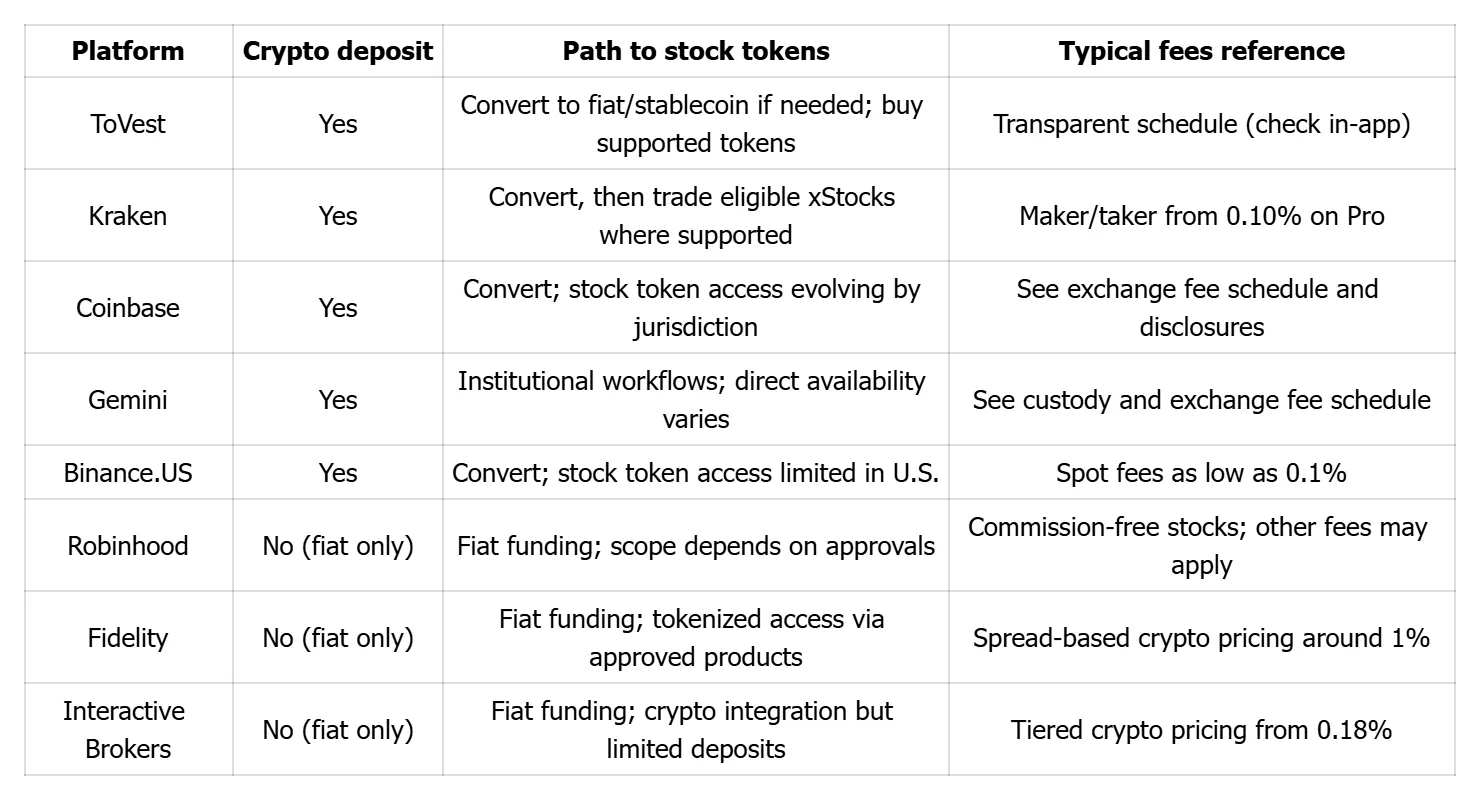
Always confirm current product lists, fees, and supported rails before moving funds.
Key Factors to Consider When Choosing a Stock Token Trading Platform
- Regulatory standing: Verify registrations, state-level permissions, and disclosures.
- Fee model: Maker/taker schedules, spreads, instant-buy markups, funding/withdrawal fees.
- Liquidity and execution: Depth, slippage, market hours, and routing quality.
- Custody and safety: Qualified custodians, segregation, audits, and attestations.
- Product scope: Universe of US stock tokens, corporate action handling, and dividend policies.
- Tools and UX: Research, analytics, mobile/desktop parity, and API access.
A maker/taker fee model charges different rates for adding vs. removing liquidity; makers often pay lower fees (or receive rebates), while takers pay higher fees—important for frequent traders, as outlined in Kraken’s pricing documentation.
Legal and Regulatory Considerations for US Stock Token Trading
In the U.S., tokenized equities intersect with securities and commodities laws, Bank Secrecy Act obligations, and state-by-state licensing. Platforms offering stock tokens must implement KYC/AML, maintain appropriate registrations, and clearly disclose whether tokens are backed by shares or synthetically reference prices. Analysts emphasize that tokenized stocks offer new access channels but carry unique risks tied to custody, market structure, and regulation.
Practical steps:
- Confirm the platform’s registrations and state permissions.
- Read product disclosures on backing, custody, and corporate action handling.
- Monitor regulator guidance and platform updates; token availability can change quickly.
For balanced perspectives on opportunity and risk, see Bankrate’s cautionary review and CNBC’s analysis of tokenized stock growth and associated trade-offs.
Frequently Asked Questions
Can I trade US stock tokens outside regular market hours?
Many venues support 24/7 trading, but liquidity and price discovery can vary; check each platform’s market hours and order book depth.
Are stock tokens backed 1:1 by the actual shares?
Sometimes—others are synthetic or derivative-based; review each platform’s disclosures to understand rights, dividends, and redemption.
What fees should I watch for when trading stock tokens?
Consider maker/taker fees, spreads, instant-buy markups, and funding or withdrawal costs since these affect your overall execution price.
Do I receive dividends when owning stock tokens?
Only if the token structure and platform policies support dividend pass-through; confirm eligibility and timing in the issuer’s documentation.
How do I know if a platform is legally authorized to offer stock tokens?
Look for clear registrations and licenses (federal and state) and review official disclosures on investor protections and custody arrangements.
References & Links
All sources are cited inline above.