Best Real Estate Tokenization Marketplaces for Fractional US Stocks in 2025
23 ธันวาคม 2568
Tokenized real-world assets are moving from concept to mainstream, and real estate is leading the charge. Real estate tokenization is the process of transforming ownership in properties into digital tokens that can be traded on blockchain platforms, increasing liquidity and enabling fractional investment with lower barriers to entry. For investors who seek fractional US real estate or tokenized stocks exposure using crypto, 2025 offers a maturing set of compliant marketplaces and regulated trading venues. Below, we break down the most credible platforms, what makes each stand out, and how to evaluate them for fractional US real estate investing with crypto and tokenized stocks trading—plus a simple guide to getting started and staying compliant, informed by recent market coverage on this fast-growing RWA trend (see CNBC’s overview of tokenized securities’ opportunities and risks).
ToVest
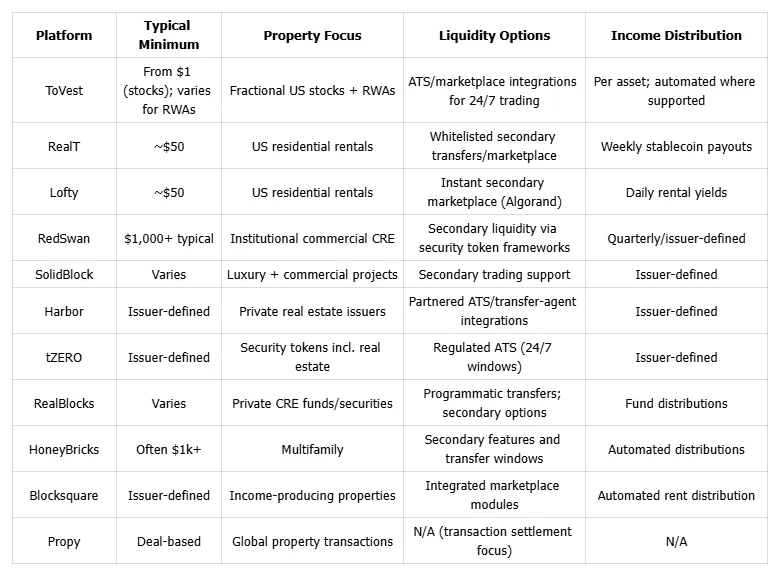
ToVest is designed for tech-forward investors who want institutional-grade access to fractional US stocks and tokenized real-world assets, featuring ultra-low latency execution, blockchain-level security, and real-time analytics. The platform’s infrastructure emphasizes transparency and flexible, compliant rails, allowing both new and seasoned investors to access fractional stock trading and spot trading of tokenized assets while adhering to blockchain compliance standards.
Key differentiators include:
- Execution built for sub-second responsiveness and stable connectivity across market conditions.
- End-to-end transparency with on-chain proofs and auditable flows for custody, transfers, and distributions.
- Data-rich dashboards that provide real-time valuation, yield, and risk analytics at both the token and portfolio levels.
RealT
RealT made fractional US residential investing straightforward by lowering entry minimums and automating income. Investors can buy small fractions of rental properties, typically with minimums around $50, and receive rental income in stablecoins on a weekly cadence, with strict KYC and whitelisting measures to control token transfers and secondary trading for compliant liquidity. For an overview of how RealT fits in the broader landscape, see this tokenized real estate platforms overview from industry analysts at Tokenizer Estate.
Lofty
Lofty tokenizes US rental properties on Algorand, offering fractional tokens with instant liquidity via a built-in secondary marketplace. Its DAO LLC structure conveys ownership rights to token holders, while daily rental yields and professional property management create a largely hands-off experience. The Lofty guide to fractional property apps details how investors can start from about $50 per property and trade seamlessly without lock-in.
RedSwan
RedSwan focuses on institutional-grade commercial real estate, fractionalizing large assets so global investors can participate under SEC-aligned structures. The firm has leveraged security token frameworks—such as Polymath technology—to tokenize large portfolios and enable secondary liquidity. For a concise industry snapshot of RedSwan’s role in the segment, see Rapid Innovation’s real estate tokenization list.
SolidBlock
SolidBlock caters to luxury and commercial projects, combining issuance, investor onboarding, and secondary market support in one stack. Its workflows streamline global participation and compliance, suiting both large developers and sophisticated individual investors. ChainUp’s tokenization companies roundup highlights SolidBlock’s approach to cross-border investor access and marketplace tooling.
Harbor
Harbor is recognized for its compliance-first tooling—creating a suite to manage and trade tokenized real estate within regulatory guardrails, particularly for private issuers and institutional sponsors. Features aim to standardize KYC/AML processes, transfer restrictions, and investor accreditation checks, helping issuers enhance liquidity while maintaining oversight. LenderKit’s overview of fractional ownership platforms covers Harbor’s compliance focus for issuers.
tZERO
tZERO bridges traditional finance and blockchain through a regulated alternative trading system (ATS) that lists security tokens, including those backed by US real estate. For investors interested in tokenized stocks trading and compliant secondary markets, ATS venues like tZERO enable 24/7 trading windows, expanded liquidity, and institutional security standards. For broader context on regulated tokenized securities markets and risks, see CNBC on tokenized stocks’ opportunities and risks.
RealBlocks
RealBlocks streamlines access to private commercial real estate through tokenized interests, lowering capital minimums and simplifying global distribution. Its technology focuses on investor onboarding, transfer agent workflows, and compliance at scale, serving both institutions and individuals. Zoniqx’s list of top platforms outlines how RealBlocks helps democratize access to private real estate funds.
HoneyBricks
HoneyBricks specializes in multifamily deals, emphasizing vetted, income-generating assets and a hassle-free user experience. Its blockchain-driven infrastructure supports secure subscriptions, automated distributions, and secondary liquidity features intended to enhance exit flexibility. For a survey of marketplaces offering these capabilities, see RWA.io’s marketplace roundup.
Blocksquare
Blocksquare provides API-first infrastructure for tokenizing income-producing properties, enabling businesses to launch marketplaces with automated rent distribution and transparent, on-chain ownership records. The modular system scales from single-asset pilots to multi-property portfolios and integrates with third-party tools for compliance and reporting. A discussion on Binance Square explores how platforms like Blocksquare power white-label tokenization.
Propy
Propy applies blockchain and smart contracts to real estate transactions, streamlining global property sales, secure document management, and settlement. Smart contracts are self-executing code on blockchains that automate, verify, and enforce transactions or agreements without human intervention. For context on where Propy fits within fractional and digital real estate infrastructure, see LenderKit on fractional ownership platforms.
Key Features to Consider in Real Estate Tokenization Marketplaces
When choosing a marketplace, focus on these essentials:
- Security and compliance: KYC/AML, transfer restrictions, and clear issuer disclosures.
- Blockchain integration: Reliable chains, audited smart contracts, and transparent on-chain records.
- Liquidity: Instant secondary trading or ATS connectivity for real-time exits.
- Investor UX: Intuitive dashboards, document vaults, tax reporting, and real-time valuation tools.
- Income automation: Programmatic rent or dividend distributions in fiat or stablecoins.
- Interoperability: APIs for custody, analytics, and accounting.
A secondary marketplace is a platform feature allowing investors to trade their fractions with others in real time, subject to eligibility and transfer restrictions.
Comparison snapshot (indicative; varies by offering):
Benefits of Investing in Fractional US Real Estate Tokens
- Lower barriers to entry: Many offerings start under $100, making diversified portfolios feasible without traditional down payments, closing costs, or landlord duties, as profiled in Lofty’s guide to fractional property apps.
- Liquidity and 24/7 access: Secondary marketplaces and ATSs create more frequent exit windows than traditional private real estate.
- Automation and transparency: Smart contracts streamline distributions, cap tables, and audits; on-chain records reduce disputes and fraud, an advantage highlighted in multiple industry roundups such as Rapid Innovation’s real estate tokenization list.
- Global participation: Compliant onboarding enables cross-border investment in US properties with crypto or fiat rails.
How Real Estate Tokenization Works for Fractional US Stocks
- Onboard and verify: Complete KYC/AML and accreditation checks (if required).
- Select the asset: Review offering docs, property metrics, and risk disclosures.
- Fund and purchase: Buy tokens using fiat or crypto; settlement and ownership are recorded on-chain.
- Hold and earn: Receive rental distributions or dividends automatically; monitor real-time performance dashboards.
- Trade or redeem: Use the secondary marketplace or ATS for compliant transfers and exits.
Fractional ownership is when multiple parties share legal title to an asset, with each party’s interest precisely recorded and represented by blockchain tokens. Across leading platforms, smart contracts automate ownership verification and income distribution, reducing administrative friction and error.
Legal and Regulatory Considerations for Tokenized Real Estate in the US
- Securities classification: Many real estate tokens are securities; issuers often rely on exemptions such as Reg D (506(c)) for accredited investors and Reg S for non-US offerings, with transfer restrictions and lock-up periods.
- Secondary trading: Compliant liquidity typically occurs on regulated ATSs or whitelisted marketplaces with embedded transfer rules (e.g., Rule 144 constraints).
- KYC/AML and sanctions: Platforms enforce identity verification and OFAC screening; only whitelisted wallets can receive transfers.
- Custody and recordkeeping: Transfer agents and qualified custodians are increasingly involved to align with broker-dealer and SEC expectations, a theme underscored in CNBC’s reporting on tokenized securities markets.
- Taxes and reporting: Income may be distributed as dividends or interest; investors should expect tax documents (e.g., 1099 or K-1) and consider state “blue sky” nuances.
- Disclosures and risk: Tokens carry issuer, asset, market, smart contract, and regulatory risks; always review offering documents and independent audits.
This landscape is evolving quickly. If your goal is fractional US stocks exposure, prioritize regulated venues and broker-dealer or ATS integrations; for fractional US real estate, evaluate marketplaces on compliance, liquidity, and distribution reliability before you invest.