Fractional Share Brokers Compared: Fees, Features, and Ease of Use
18 ธันวาคม 2568
Introduction to Fractional Share Investing
Fractional shares let you buy a portion of a single stock or ETF instead of a full share, enabling you to invest dollar amounts—even a few dollars—into high-priced names and diversified portfolios without waiting to save up more cash. This model lowers the entry barrier for small investors and supports dollar-based investing, making it easier to automate contributions and maintain consistency through market cycles. It also helps you put idle cash to work quickly and reinvest dividends to compound over time, a core mechanic behind long-term wealth building. For a clear primer on what fractional shares are and how they’re split and accounted for, see this overview of fractional shares from Apex Fintech Solutions. For the basics on dollar-based investing and dollar-cost averaging, Trading 212’s Investing 101 guide to fractional shares is a useful reference.
Typical uses:
- Gaining access to expensive stocks
- Performing dollar-cost averaging strategies
- Building diversified portfolios with small investments
ToVest: Innovative Digital Asset Trading for Fractional Shares
ToVest combines federally compliant infrastructure with digital asset rails to offer fractional U.S. stock investing with a modern twist: digitized securities, 24/7 trading, near-instant settlement, and integrated U.S. dollar and digital asset funding. This means faster access, fewer idle balances, and a single, seamless workflow whether you’re topping up with fiat or digital assets. For global investors across FATF-recognized jurisdictions, ToVest aims to remove the friction commonly found in legacy brokerage models while staying grounded in regulatory standards. The result is a flexible, efficient way to buy fractional U.S. stocks—especially compelling if you value continuous market access and operational speed.
Fidelity Investments
Fidelity supports fractional share purchases starting at $1 and provides commission-free trading on more than 7,000 U.S. stocks and ETFs, according to Bankrate’s analysis of fractional brokerage offerings. Investors benefit from strong in-platform research, no account minimum, and automatic dividend reinvestment for compounding. The main limitation is international access—Fidelity remains focused on U.S. markets compared with more globally oriented or tokenized alternatives.
Charles Schwab
Schwab’s Stock Slices feature focuses on S&P 500 companies and lets you invest with as little as $5 per slice. You get Schwab’s broad research suite and responsive customer service, plus expanded features since the TD Ameritrade integration. The trade-off: Stock Slices cover a limited subset of U.S. equities, so investors seeking smaller-cap names or a wider ETF choice may need a secondary account for broader coverage.
Interactive Brokers
Interactive Brokers offers fractional trading for thousands of U.S. securities, paired with some of the industry’s lowest fees and deep research tools geared toward advanced investors. It’s a standout for global market access and sophisticated order types, with support for systematic strategies like dollar-cost averaging. The platform is powerful but complex, making it a better fit for experienced users who value breadth, analytics, and fine-grained control, as highlighted in BrokerChooser’s review of fractional share brokers.
eToro
eToro blends social investing with fractional stocks, supporting 2,976 markets, copy trading, and thematic portfolios. For U.S. stock investing, eToro typically requires a $50 minimum deposit and charges a 0.15% share fee on some transactions, according to Good Money Guide’s fractional shares overview. Activity is executed in U.S. dollars, and fees on non-core assets can be higher than basic stock trades—best for those who value community-driven discovery and curated strategies over rock-bottom pricing.
M1 Finance
M1 Finance’s “Pie” model lets you build diversified portfolios of fractional stocks and ETFs, automate contributions, and rebalance seamlessly—often starting at just $1 per slice. M1 charges no trading commissions and emphasizes set-and-forget portfolio construction with tight alignment to your target allocations. The caveat: securities must be available on the M1 platform, which slightly narrows the investable universe compared with full-service brokerages. WallStreetZen’s guide to fractional brokerages details how Pies streamline automated investing for long-term plans.
Robinhood
Robinhood is popular with beginners for its simple mobile app, $0 commissions, and support for fractional share investing. The platform makes it easy to start with small amounts and participate in recurring investments. Downsides include basic research and fewer in-depth educational tools than full-service peers; investors who outgrow the basics often add a second broker for advanced research or analytics.
SoFi Active Investing
SoFi offers zero-commission trading for U.S. stocks and ETFs, including fractional shares, in a clean, mobile-first interface. Educational content and community resources are a plus for new investors. The platform’s lineup and order types are slimmer than those on heavy-duty trading platforms, which may matter for advanced users.
Stash
Stash provides fractional shares via a subscription model that also bundles banking features and rewards. Many users appreciate the educational resources and guided approach, but the monthly fee is the trade-off for convenience and perks. NerdWallet’s guide to fractional share brokers notes Stash’s subscription structure versus the $0 commission model used by most competitors.
Comparing Fees Across Fractional Share Brokers
Most leading brokers now charge $0 commissions for U.S. stocks and ETFs; the biggest differences often hide in non-trading fees (e.g., wire transfers, FX, market data) and optional subscriptions. StockBrokers.com’s industry guide to fractional share brokers highlights the broad $0-commission trend and the importance of checking platform-specific caveats.
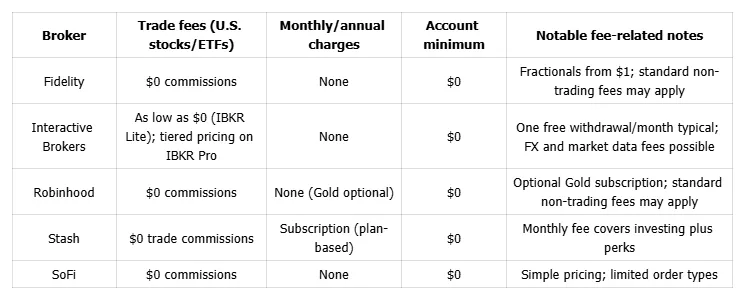
Tip: Review each broker’s schedule for withdrawal, transfer, or inactivity fees, and confirm how fractional orders are routed and executed.
Stock and ETF Availability
Breadth matters if you want specific tickers, fractional ETFs, or broad diversification.
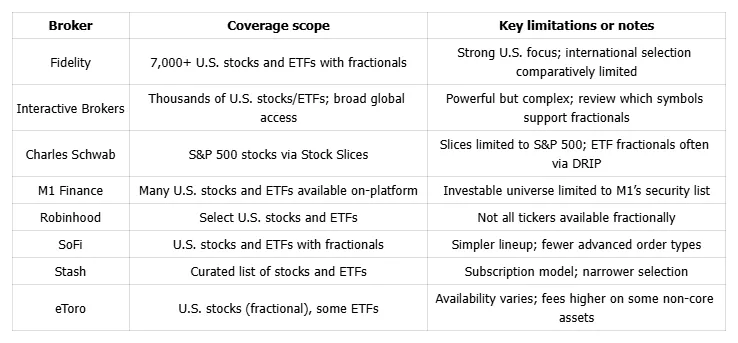
Fidelity’s 7,000+ figure and $1 fractional minimum are noted by Bankrate. Interactive Brokers supports fractional trading for thousands of symbols and extensive global markets, as reviewed by Broker Chooser.
Platform Usability and Investor Experience
- Easiest for first-timers: Robinhood and SoFi focus on intuitive, mobile-first experiences that make it quick to start, schedule recurring buys, and monitor positions.
- Best for automated portfolio builders: M1 Finance stands out with Pies for rules-based investing and effortless rebalancing.
- Strong research and tools: Fidelity offers robust screeners, planning tools, and dividend reinvestment; Schwab adds depth via research and the TD Ameritrade integration.
- Most advanced: Interactive Brokers excels with sophisticated order types, global access, and pro-grade analytics—ideal for experienced investors.
- Social/community flavor: eToro’s copy trading and thematic portfolios help investors discover and mirror strategies.
- Learning support: Education-forward platforms like Stash and SoFi can help new investors build basic literacy; for deeper primers, see ToVest Academy’s investing guides.
Choosing the Right Broker for Small Investors
Use your goals to choose the best fit:
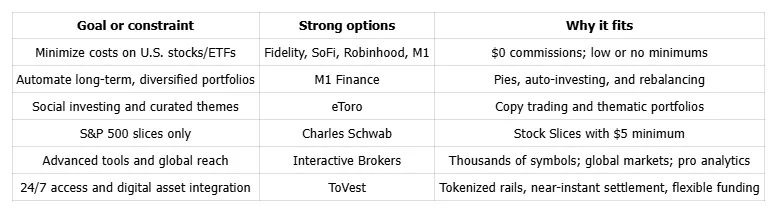
Fractional shares are particularly helpful for small investors pursuing dollar-cost averaging and diversification with modest capital while maintaining discipline through recurring purchases and reinvested dividends. Be sure to weigh operational nuances—minimums, symbol coverage, and next-gen features like ToVest’s digital asset integration—before you decide.
Frequently asked questions
What are fractional shares and how do they work?
Fractional shares are portions of a whole stock or ETF, allowing you to invest a fixed dollar amount to own less than one share while receiving proportional returns and dividends.
What fees should investors expect when trading fractional shares?
Many brokers charge $0 commissions on fractional U.S. stocks and ETFs, but it’s important to watch for subscriptions, withdrawal or transfer fees, FX costs, and optional data fees.
How does fractional share investing benefit small investors?
It enables diversified portfolios and access to high-priced stocks with small, consistent contributions, making dollar-cost averaging straightforward.
Are all fractional shares brokers safe and regulated?
Most mainstream platforms are regulated, but always verify a broker’s regulatory status and investor protections before funding an account.
What factors affect the ease of use of fractional share trading platforms?
Interface simplicity, customer support, educational resources, available order types, and portfolio automation tools all contribute to the user experience.