Tokenized US Stocks 2026: Best Platforms for Beginner Investors
5 มกราคม 2569
Tokenized U.S. stocks let you buy blockchain-based representations of equities in small fractions, trade beyond market hours, and settle instantly—all while tracking the price of the underlying shares. Put simply, yes: you can diversify your portfolio online by allocating small amounts across multiple blue chips and ETFs on regulated platforms. This guide highlights the best beginner-friendly platforms for 2026—ToVest, XT, Ondo Finance, MEXC, and Robinhood—what to look for (regulation, custody clarity, fees, UX), and a simple, safe way to place your first trade. For context on how tokenized stocks work and why they’re gaining traction, see CoinGecko’s explainer on tokenized stocks.

ToVest
ToVest is a blockchain-powered investment platform focused on regulated, fractional access to tokenized U.S. stocks and other real-world assets. It’s built for 24/7 trading with instant execution and real-time portfolio analytics, allowing beginners to track performance, holdings, and risk exposures at a glance. Fractional ownership means you can own part of a share via on-chain tokens, lowering minimums and making it easier to build a balanced basket across sectors.
What sets ToVest apart is its emphasis on compliance and transparency. The platform combines clear custody arrangements, industry-standard KYC/AML, and robust risk controls with competitive, straightforward fees. Global access, intuitive workflows, and education-first features help new investors feel comfortable quickly—backed by deep analytics and portfolio insights you can explore in the ToVest Academy guide.
XT
XT caters to crypto-savvy beginners who want seamless, wallet-native exposure to U.S. equities through tokenized assets. It supports 24/7 trading, low gas fees, and instant settlement on tokens pegged 1:1 to real shares—an approach the exchange outlines in XTs tokenized stocks overview. Pegged tokens are blockchain assets designed to mirror the value of an underlying security (e.g., one token equals one share), with custodial backing to maintain price parity.
Popular listings include AAPL, AMZN, and GOOGL, making it easy to diversify beyond crypto into top U.S. equities with low minimums and fast, familiar crypto funding. For users comfortable with self-custody and on-chain interactions, XT's deep integration with crypto wallets can make the initial steps notably straightforward.
Ondo Finance
Ondo Finance is positioning itself as a regulated, custodial gateway to a wide universe of tokenized U.S. stocks and ETFs. As covered in KuCoin's coverage of Ondo’s 2026 launch plans, the project is targeting one of the broadest spot markets (100+ assets), with a strong focus on compliance and transparent legal structuring for tokenized shares.
A key draw for beginners is Ondo’s custodial model, which prioritizes asset security and clarity on how underlying securities are held—paired with plans to expand across major chains (including Solana integration slated for 2026). For investors who value breadth of choice and regulatory rigor, Ondo’s roadmap is compelling.
MEXC
MEXC blends high liquidity with both spot and derivatives access to tokenized U.S. stocks, along with accessible trading tools for newcomers. As noted in MEXC's analysis of why crypto capital is flowing into U.S. equities, the exchange has leaned into real-world asset markets with deep order books and global retail on-ramps.
Perpetual futures are derivative contracts with no expiry that let traders speculate on price movements using margin; they can be powerful but risky. Spot markets, by contrast, provide direct exposure to tokenized assets with lower complexity. For beginners, starting with spot and fractional trades is a practical way to learn the market, with guardrails such as educational modules or demo environments to build confidence.
Robinhood
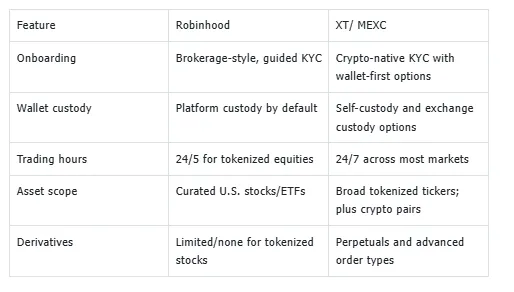
Robinhood offers a familiar path from traditional brokerage to on-chain assets, with 24/5 access to tokenized U.S. stocks and ETFs secured on Arbitrum, delivered through the same intuitive app that made it a household name among first-time investors, per the beginner’s 2026 tokenized assets guide. For users who prefer conventional finance interfaces, transparent fee disclosures, and robust onboarding, this can serve as an easy first stop.
How it compares with crypto-native exchanges:
Key Features to Consider in Tokenized Stock Platforms
- Regulatory standing and custody clarity: Favor platforms that publish licenses, name their custodians, and outline asset segregation. Custody clarity is transparent disclosure of where and how underlying securities are held, which directly affects investor protection and recourse.
- Market data freshness: Frequent price refresh (ideally seconds-level) helps minimize slippage and execution risk. Modern data pipelines routinely update in near real time, as reflected in research on seconds-level price intelligence.
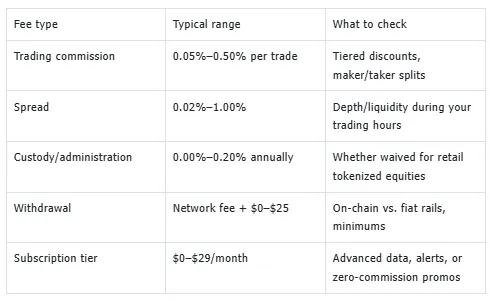
- Costs you’ll pay: Compare trading fees, spreads, custody/administration charges, and withdrawals. Small differences compound.
Illustrative fee comparison checklist (ranges are typical, not platform quotes):
Usability matters too. Interfaces with clean onboarding, plain-language disclosures, education, watchlists/alerts, and sandbox modes help beginners adapt quickly, a pattern echoed by best-in-class research tools.
A compact decision checklist:
- Verify regulatory and custody disclosures
- Review fee schedule and average spreads
- Confirm price-update frequency
- Test deposits/withdrawals (small amounts first)
- Favor strong UX with educational support
For market context and the maturing compliance landscape, see Wall Street moves on-chain and the Mint Ventures market status analysis.
How Beginners Can Buy Tokenized US Stocks
A simple five-step path (drawing on the beginner’s 2026 tokenized assets guide):
- Choose a platform and wallet
- Pick a regulated, transparent platform (e.g., ToVest, Ondo, Robinhood; or XT/MEXC if crypto-native suits you).
- Use an on-platform wallet for simplicity or install a simple wallet like MetaMask if self-custody is supported.
- Complete KYC and secure your account
- Submit identity verification and enable multi-factor authentication.
- Record recovery phrases securely if using a self-custody wallet.
- Fund your account
- Deposit fiat where supported, or transfer stablecoins like USDT for frictionless entry and quick settlement.
- Place your first trade
- Start with small, fractional amounts in a blue-chip tokenized stock or ETF.
- Use limit orders during your initial trades to control slippage.
- Review and iterate
- Track performance and risk in your portfolio dashboard.
- Build watchlists, set alerts, and use educational demos to refine your strategy—see ToVest Academy guide for step-by-step walkthroughs.
Diversifying Your Portfolio with Tokenized US Stocks
Portfolio diversification means spreading investments across assets and sectors so your returns aren’t dominated by a single risk. Tokenized stocks make this practical by letting you buy small fractions of many leading equities, often with minimums of $10–$50, and trade beyond market hours—improving accessibility for global investors, as highlighted in XT’s tokenized stocks overview.
Consider a simple sector mix:
- Technology: AAPL, MSFT, GOOGL
- Healthcare: UNH, JNJ, PFE
- Consumer: AMZN, PG, KO
- Financials/ETFs: JPM, VTI, SPY
Automated recurring buys can smooth volatility while you gradually assemble a diversified basket. Rebalance quarterly to maintain your target sector weights.
Risks and Regulatory Considerations for Tokenized Stocks
Key risks to understand:
- Custody and counterparty risk: You rely on the issuer and custodian to hold underlying shares securely.
- Price decoupling: Tokens can temporarily de-peg from the underlying stock during volatility or if redemption/liquidity is constrained.
- Regulatory change: Evolving rules can affect listings, access, or redemption terms.
- Liquidity risk: Thin markets can widen spreads and increase slippage, especially off-peak hours, a theme discussed in Real World Assets: Crypto Opportunities for 2026.
Regulatory frameworks like EU MiCA and U.S. securities law aim to protect investors, but due diligence is essential. Review platform legal status, named custody partners, audit attestations, and whether assets are segregated or insured. For context on compliant trading pathways, see how secondary trading works for tokenized securities under U.S. regulations.
Frequently asked questions
Can I diversify my portfolio by buying tokenized US stocks online?
Yes. Fractional, on-chain access enables you to spread small amounts across many U.S. stocks and ETFs, enhancing diversification with low minimums and extended trading hours.
What should beginners look for in a reliable tokenized stock platform?
Prioritize clear regulation, transparent custody of underlying shares, straightforward fees, frequent price updates, and a simple interface with strong educational support.
How do fees and pricing affect tokenized stock investing?
Trading commissions, spreads, custody, and withdrawal fees can compound over time; compare the full fee schedule before funding and favor tight spreads.
Are tokenized stocks legally recognized and secure?
Recognition is growing on regulated platforms with robust custody, but always confirm the provider’s legal status, audits, and asset protection measures.
How do I start trading tokenized US stocks with minimal risk?
Begin with small, fractional spot trades on reputable platforms, diversify across sectors, and utilize limit orders and educational tools as you learn.