2026 Updated Guide: Buying Stocks Using Cryptocurrency on Any Platform
2 มกราคม 2569
Buying stocks with cryptocurrency is now practical on multiple fronts. You can fund a brokerage with crypto or stablecoins, purchase tokenized stocks that mirror real equities, or use synthetic exposure on-chain—each with different fees, risks, and compliance requirements. This guide lays out the pathways, shows how to fund and execute trades step by step, and explains custody, taxes, and advanced tactics. For investors who want both crypto and equity exposure in one place, platforms like ToVest focus on regulated, fractional U.S. tokenized stocks with 24/7 trading, ultra-low latency execution, and institutional-grade custody—bringing TradFi and DeFi together without compromising compliance.

Understanding the Pathways to Buy Stocks with Cryptocurrency
There are three primary ways to buy stocks with crypto. Your choice depends on whether you want conventional brokerage protection, 24/7 tokenized trading, or full on-chain composability.
- Centralized brokers that accept crypto/stablecoin funding: You deposit crypto or stablecoins, convert to fiat if needed, and place stock orders through a regulated broker.
- Exchanges offering tokenized or synthetic stocks: You trade blockchain-based representations of equities that track real stock prices and, in some cases, pass through corporate actions.
- DeFi protocols for tokenized equity exposure: You use smart contracts for synthetic exposure or tokenized RWAs with on-chain settlement and composability.
Tokenized assets are digital representations of real-world assets, such as stocks, issued on a blockchain, enabling fractional ownership and 24/7 trading, a trend highlighted in the industry’s 2026 Crypto Outlook. See the broader runway for tokenization and stablecoin rails in Nasdaq’s 2026 crypto predictions and VanEck’s 2026 blockchain outlook.
Comparative snapshot of the three pathways:
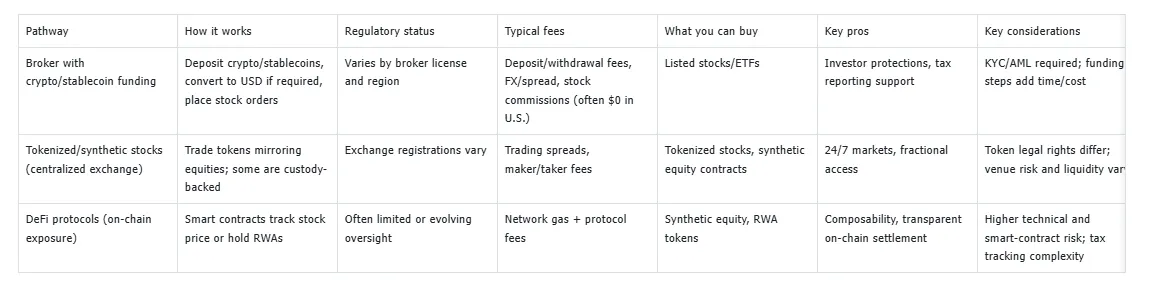
Regulation and venue quality directly affect pricing, execution speed, and taxes: high-quality, regulated platforms often provide better disclosures, tighter spreads, and clearer tax statements, while pure on-chain venues maximize access and uptime but demand more DIY risk management and recordkeeping, per comparisons like Investopedia’s Best Crypto Exchanges and large broker disclosures.
Verifying Identity and Compliance Requirements
KYC (Know Your Customer) is the regulatory process where a platform verifies user identity to prevent fraud, money laundering, and ensure compliance with financial laws. Expect to provide:
- Government-issued ID, a selfie/biometric check, and proof of address
- Source-of-funds/source-of-wealth confirmations for larger limits
- Screening against sanctions and politically exposed person (PEP) lists
Licensed platforms reduce legal risk and offer more predictable recourse. Industry analyses note expanding regulatory approvals and charter activity as crypto-native brokerages mature, with U.S. oversight intensifying through 2025–2026 in the 2026 Crypto Outlook. By contrast, many DeFi protocols have minimal or no KYC—which may increase counterparty, regulatory, and recovery risks.
Funding Your Account with Cryptocurrency or Stablecoins
A practical workflow is to convert volatile crypto (e.g., BTC, ETH) into a stablecoin for faster settlement and price certainty before you buy stocks. A stablecoin is a blockchain-based cryptocurrency whose value is pegged to a stable asset—usually the U.S. dollar—enabling low-friction, near-instant settlements on exchanges, a dynamic expected to broaden through 2026 according to Nasdaq’s 2026 crypto predictions. VanEck’s 2026 blockchain outlook also highlights expanding stablecoin rails and global payouts—accelerating the bridge between crypto and traditional assets.
Many platforms accept crypto and stablecoins; minimums and fees vary. For instance, Kraken’s minimums are often as low as $10, and maker/taker fees are competitive, according to Investopedia’s Best Crypto Exchanges.
Quick comparison of popular funding paths and whether they support stock buying:
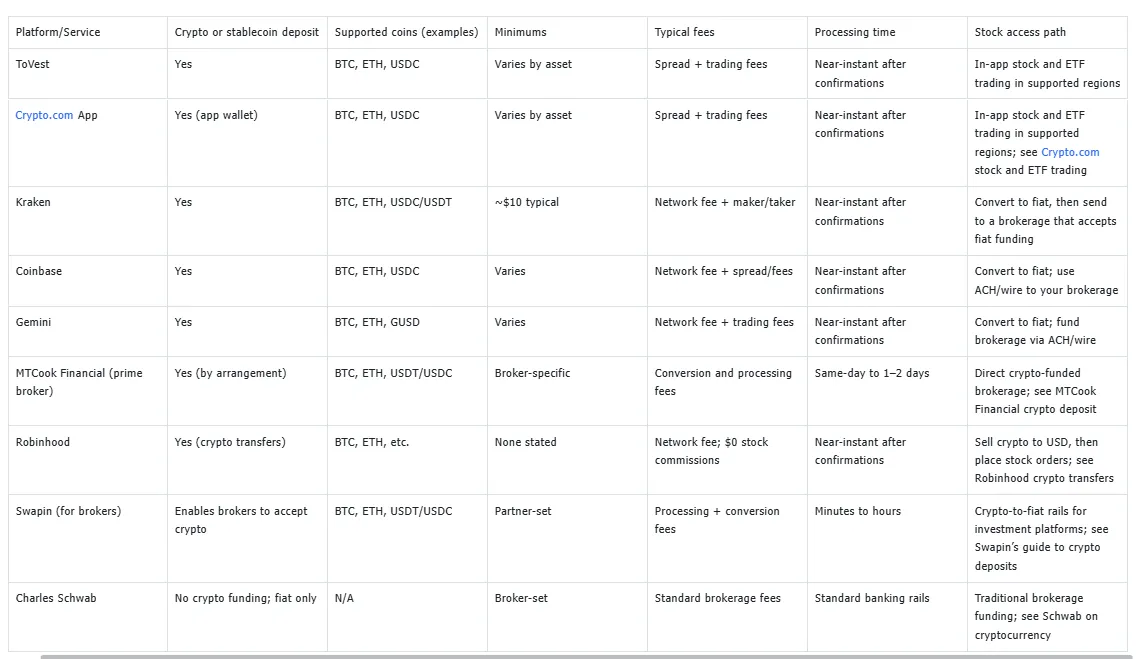
Notes:
- Fees vary by token, network congestion, and account tier; PayPal card deposits around 2.5% and wire withdrawals around $25 are typical figures cited in exchange reviews by Investopedia’s Best Crypto Exchanges.
- Stablecoin deposits (USDC/USDT) minimize price swings between transfer and execution and often settle faster than fiat wires.
Executing Stock Purchases Using Crypto on Various Platforms
Once funded, you can buy stocks using one of three execution flows:
- Buy tokenized equities directly
- Deposit crypto or stablecoins into a platform that lists tokenized stocks.
- Search for the equity token (e.g., AAPLx), review disclosures on backing, dividends, and redemption.
- Place a market or limit order; verify minimum order size and trading hours (many tokens trade 24/7).
- Monitor liquidity and spreads; some venues aggregate liquidity across order books.
- Convert crypto to fiat, then buy through a broker
- Send crypto to an exchange, convert to USD (prefer stablecoin-to-USD for minimal slippage).
- Transfer USD to your brokerage via ACH or wire.
- Place a stock or ETF order as usual; most U.S. brokers offer $0 commissions on standard trades.
- Platforms like Robinhood allow crypto transfers and stock trading in one app (sell crypto to USD, then buy stocks), while Coinbase is often used as the crypto on/off-ramp plus a separate brokerage for equities.
- Trade synthetic stock contracts on-chain
- Connect a wallet to a DeFi protocol offering synthetic equity exposure.
- Review collateral requirements, oracle sources, and liquidation risks.
- Execute the trade and track PnL and funding rates where applicable.
Execution considerations:
- On-chain contracts settle via smart contracts with gas fees and oracle dependencies; centralized brokers route orders to exchanges or market makers and may use smart order routing for best execution.
- Advanced users may prefer pro interfaces (e.g., Kraken Pro) for deeper order types and fee tiers, while beginners benefit from robust education hubs common on top exchanges, per Investopedia’s Best Crypto Exchanges.
- Always check the full fee stack: network fees, spreads, maker/taker, conversion costs, and any deposit/withdrawal fees.
Securing Custody and Maintaining Audit Trails
Custody describes how digital or tokenized assets are securely stored, whether by a third-party custodian or self-managed wallets.
- Hot wallets: Connected to the internet; convenient but higher attack surface. Best for small, active balances.
- Cold wallets: Hardware or offline storage; ideal for long-term holdings but require disciplined key management.
- Regulated custodians: Segregated accounts, SOC audits, institutional controls, and insurance. Suitable for larger balances and compliance-heavy mandates.
Best practices:
- Use multi-factor authentication, hardware security keys, and whitelist withdrawals.
- Keep detailed transaction logs for all crypto-stock conversions, tokenized stock purchases, and redemptions to support audit and tax filings. Regulated platforms enhance protection with segregated assets and on-chain auditability—a standard ToVest operationalizes across tokenized stocks and real-world assets.
Managing Taxes and Reporting When Buying Stocks with Crypto
A taxable event occurs when an asset is disposed of—such as converting crypto to fiat/stocks—or when profit is realized, triggering obligations to report gains or losses. Common taxable events in crypto-to-stock workflows include:
- Swapping crypto to stablecoins (if it realizes gains/losses)
- Converting crypto/stablecoins to fiat to fund a brokerage
- Trading tokenized or synthetic stocks
- Withdrawing profits or redeeming tokens for the underlying
Maintain meticulous records of cost basis, dates, proceeds, and fees. Tax treatment differs by jurisdiction—short-term vs. long-term capital gains, wash sale rules, and characterization of tokenized dividends can vary. Exchange and broker reviews (e.g., Investopedia’s Best Crypto Exchanges) and regulator guidance emphasize expanding oversight, making clean audit trails essential.
Advanced Tips for Optimizing Crypto-to-Stock Transactions
- Use liquidity aggregation and smart routing: These tools minimize slippage and spreads across venues. Building such systems typically costs $20k–$60k according to a trading platform build cost study, and their presence is a strong signal of price optimization.
- Prioritize custody and insurance: Select platforms with institutional-grade custodianship, proof-of-reserves or on-chain attestations, and clear insurance policies. Robust analytics dashboards for performance and tax exports (often a $10k–$25k build per the same study) save time and reduce reporting errors.
- Leverage fractional ownership and 24/7 trading: Tokenization enables micro-positioning, continuous markets, and real-time settlement—useful for managing cash, hedging, and tactical entries.
- Validate token legal terms: Confirm claim rights (e.g., dividends, voting), redemption mechanics, and issuer obligations before buying tokenized or synthetic stocks.
Frequently Asked Questions About Buying Stocks Using Cryptocurrency
Is it possible to buy stocks directly with crypto like Bitcoin or Ethereum on any platform?
Direct crypto-for-stock swaps are still rare; most investors convert to stablecoins or fiat first or use platforms that list tokenized stocks.
What are the best platforms for buying stocks with crypto in 2026?
The leaders like ToVest accept crypto/stablecoin deposits, support tokenized stocks or seamless fiat conversion, and offer strong compliance, education, and low fees for both beginners and pros.
How do I fund a stock brokerage account using cryptocurrency?
Deposit crypto to an exchange, convert to USDC/USDT or USD, then fund your brokerage via ACH/wire; some prime brokers accept crypto deposits directly.
What regulations affect buying stocks with crypto in 2026?
KYC/AML is standard, and oversight is expanding as more blockchain-based brokerages obtain approvals and integrate with traditional market infrastructure.
What are the risks and fees involved?
Expect volatility, smart-contract or custody risks, and layered fees (network, spreads, maker/taker, conversions); stablecoins can reduce timing risk and settlement friction.
Will tokenization let me buy real stocks on-chain with crypto?
Yes—tokenized stocks offer on-chain exposure to real equities, but legal rights and redemption terms differ by platform and jurisdiction.
What's new in 2026 for crypto-stock integration?
Stablecoins, tokenized equities, and unified platforms are tightening the bridge between crypto and stock markets, broadening access, liquidity, and settlement speed.