The Authoritative 2026 Guide to Tokenized Stock Regulations for Non‑US Residents
2 มกราคม 2569
Non‑US investors can now access U.S. equities through tokenized stocks—but only if they navigate the legal rules that ensure these assets are compliant and safe. This guide explains what tokenized stocks are, how cross‑border securities regulations work, and how to select the best tokenized stock platform for non‑US investors. We cover token standards, KYC/AML, custody, proof‑of‑reserves, jurisdiction and tax obligations, and a step‑by‑step evaluation framework you can use today. Throughout, we emphasize ToVest’s approach: institutional‑grade controls, real‑time trading, and diversified fractional access to both regulated tokenized equities and real estate.

Understanding Tokenized Stocks and Their Legal Framework
Tokenized stocks are blockchain-based representations of traditional shares, allowing for fractional ownership, real-time transfers, and global access. In practice, real‑world asset tokenization converts financial assets—like equities—into programmable tokens, improving liquidity, collateral utility, and investor reach across borders, as documented in industry surveys of RWA platforms and market infrastructure advances (see a 2026 industry roundup on RWA platforms). For an overview of how tokenization expands access while maintaining links to the underlying, see this summary of RWA tokenization platforms in 2026 from SecurityTokenizer.
Because tokenized stocks reference real securities, they are generally treated as securities in most jurisdictions and must comply with local securities laws at the time of offer and sale. U.S. regulators often look to the Howey test—an investment of money in a common enterprise with an expectation of profits derived from others’ efforts—to determine if something is a security; similar principles inform many non‑U.S. regimes, so exemptions and registration decisions are pivotal at issuance and distribution stages, as explained in Buzko Legal’s legal guide to RWA tokenization.
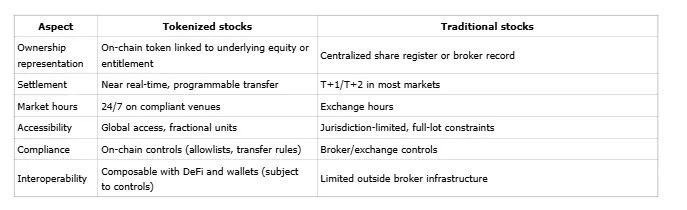
Comparison: tokenized shares vs. traditional stocks
Key Regulatory Considerations for Non-US Investors
If you invest from abroad, classification and compliance must be analyzed both where the token is issued and where you reside. Offshore routing or novel token mechanics do not automatically exempt you from local rules—U.S. guidance underscores that substance over form governs cross‑border offerings and intermediaries, a theme echoed in Global Legal Insights’ overview of U.S. blockchain and crypto regulations.
Determine whether the offering requires registration, qualifies for an exemption (e.g., Regulation S for certain offshore offerings), or uses a sandbox or pilot arrangement. Reg S can restrict who may buy and when tokens can be resold, and typically compels platforms to enforce transfer restrictions and investor eligibility, as outlined in Buzko Legal’s RWA legal guide.
Typical regulatory steps for non‑US investors:
- Confirm securities classification and offering status in the issuing venue (registered, exempt, or sandboxed).
- Check if a valid exemption applies (e.g., securities exemptions like Regulation S) and what resale limitations attach.
- Verify the platform’s broker‑dealer or exchange/ATS permissions and market surveillance rules in its operating jurisdictions.
- Assess custody arrangements and whether qualified, third‑party custodians hold the underlying assets.
- Review cross-border compliance requirements, including investor accreditation, marketing restrictions, and ongoing disclosures.
Keywords to watch in disclosures: tokenized securities regulations, securities exemptions, cross‑border compliance.
Token Standards and On-Chain Compliance Controls
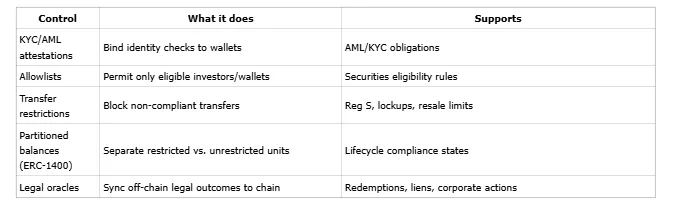
ERC‑3643 and ERC‑1400 are token standards designed for security tokens, enabling compliance with transfer restrictions, investor allowlists, and real‑world asset backing. ERC‑3643 (formerly T‑REX) extends ERC‑20 with identity‑aware transfer rules and lifecycle events; ERC‑1400 introduces partitioned balances and granular compliance states for regulated transfers. For a 2026 perspective on identity‑aware standards—including ERC‑7518, which ties verifiable digital identities and policy rules directly to tokens—see RWA.io’s 2026 guide to tokenized assets and identity‑linked controls, and Blockchain App Factory’s overview of ERC‑1400.
On-chain compliance controls common to regulated tokenized equities:
- KYC tokens or attestations that prove an investor’s verified status without exposing private data.
- Allowlists/deny‑lists controlling which wallets can receive or send tokens based on jurisdiction, accreditation, or holding period.
- Transfer restrictions that codify securities rules (e.g., Reg S distribution compliance periods, investor caps).
- Legal oracles that port off‑chain legal events (redemptions, liens, corporate actions) on‑chain for automated enforcement, as explored in Growth Turbine’s review of legal frameworks for RWA tokenization.
Controls overview
Compliance Best Practices: KYC, AML, Custody, and Audits
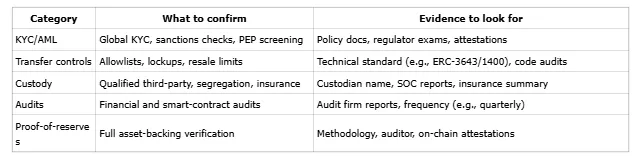
"KYC and AML processes verify investor identity and screen for illicit activity, forming the backbone of secure, regulated trading platforms.” Effective platforms pair this with sanctions screening, ongoing monitoring, and on-chain attestations that allow privacy‑preserving compliance. Automated rule engines enforce eligibility, while independent custodians hold underlying assets and segregate client property.
Independent third‑party audits and public proof‑of‑reserves increasingly validate that tokenized instruments are fully backed and that liabilities match assets—a best practice highlighted in industry legal and risk reviews such as Growth Turbine’s RWA frameworks analysis.
Compliance checklist
Jurisdictional Impact and Offshore Offering Exemptions
“Jurisdiction determines which laws apply to tokenized stock offerings, influencing investor eligibility and required compliance measures.” Offshore exemptions like Regulation S can open access for non‑U.S. persons, but issuers may impose transfer limits and resale seasoning to remain within the exemption’s boundaries, per Buzko Legal’s analysis. Even with exemptions, exchange/ATS rules and broker‑dealer obligations still apply, and the operating venue’s legal location drives supervision and reporting, as described in the Global Legal Insights overview of U.S. rules.
Decision process (practical flow)
- Identify issuer jurisdiction and venue (exchange/ATS or alternative platform).
- Classify the token (security vs. non‑security) under issuer and home‑country law.
- Determine offering path: registration, sandbox, or exemption (e.g., Reg S).
- If exemption: map investor eligibility, lockups, and resale restrictions.
- Map intermediaries: broker‑dealer, ATS/exchange, custodian, and their licenses.
- Validate on‑chain controls that enforce the legal model (allowlists, transfer rules).
- Confirm disclosures, ongoing reporting, and audit cadence.
Taxation, Reporting, and Withholding Obligations for Global Investors
“Taxation of tokenized stocks depends primarily on the nature of the underlying asset—not just the digital wrapper itself.” Investors should evaluate whether returns are capital gains, dividends, or interest in their home country, and whether withholding applies. U.S. tax reporting may affect non‑U.S. participants if a transaction is considered U.S.‑linked—new reporting rules, including IRS Form 1099‑DA for digital asset transactions, are slated for phased application in 2025–2026 and may affect certain brokers and custodians, per Camuso CPA’s 1099‑DA guide. Cross‑border frameworks and bilateral treaties can change effective rates and reporting burdens; coordinate with a qualified advisor.
Tax due‑diligence checklist
- Map the underlying asset and income type (dividends vs. capital gains).
- Identify residence‑based reporting (self‑assessment, foreign asset disclosures).
- Determine any U.S. or source‑country withholding and treaty relief.
- Track cost basis, acquisition dates, and holding periods.
- Collect documentation: platform statements, audit/proof‑of‑reserves, W‑8/W‑9 forms if applicable.
How to Evaluate and Choose a Tokenized Stock Platform as a Non-US Investor
The best tokenized stock platform for non‑US investors balances legal rights, security, compliance, user experience, and liquidity. Look for regulated tokenized equities backed by verifiable custody, strong on‑chain controls, and transparent fee and audit practices. For deeper context on scoring platforms and avoiding common pitfalls, see our step‑by‑step buyer’s guide to regulated tokenized assets on ToVest Academy, and our market trends briefing on liquidity and trading behavior in tokenized markets.
Core decision criteria
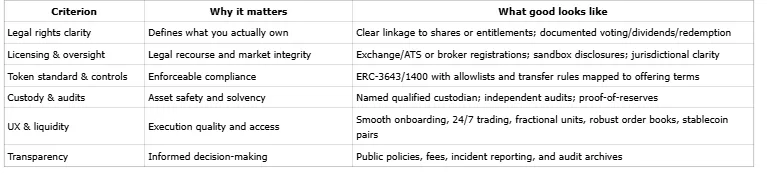
ToVest’s differentiator: a single, compliant interface for global access to regulated tokenized equities and institutional‑grade real estate, with real‑time trading, fractional ownership, and comprehensive controls that global investors can rely on.
Verifying Legal Rights and Underlying Equity
Underlying equity rights are the formal legal entitlements—such as voting, dividends, or redemption—attached to a tokenized stock. Confirm what the token represents (beneficial ownership, participation rights, or depositary receipts) and how tokens map to the share register. Review offering documents, whitepapers, and any legal opinions the platform publishes.
Assessing Platform Regulatory Compliance and Licensing
Check for current regulatory disclosures: exchange/ATS licenses, broker‑dealer registrations, or formal regulatory sandbox participation where applicable. Fully regulated or sandboxed platforms typically provide clearer legal recourse, incident reporting, and supervisory visibility, as discussed in RWA.io’s overview of regulatory frameworks for tokenized securities. Build a simple checklist to compare licensing status across platforms and jurisdictions.
Evaluating Token Standards and Transfer Controls
Prefer platforms implementing robust security token standards like ERC‑3643 or ERC‑1400 to assure enforceable transfer controls and lifecycle compliance. Verify that transfer restrictions, on‑chain allowlists, and wallet‑bound KYC checks are active to prevent unqualified ownership and honor resale restrictions.
Reviewing Security, Custody, and Proof-of-Reserves Measures
Choose platforms that name their custody providers, describe asset segregation and insurance, and publish regular independent proof‑of‑reserves. Proof‑of‑reserves is an independent third‑party audit confirming that tokenized assets are fully backed by the underlying securities or assets. Look for public audit reports, attestations, and recovery procedures for contingency scenarios.
Considering User Experience, Liquidity, and Trading Features
Evaluate onboarding simplicity, instant execution, 24/7 access, and clean reporting tools for taxes and portfolio tracking. Examine liquidity signals such as trading volume, order book depth, stablecoin pairs (USDC/USDT), and fractional investing—factors highlighted by institutional research on how tokenization is reshaping market access and settlement dynamics, including State Street Global Advisors’ perspective on asset tokenization.
Quick feature checklist
- Account creation and KYC in minutes
- Clear fee schedule and instant settlements
- Fractional trading and recurring orders
- Deep order books and stablecoin pairs
- Exportable statements and tax reports
- Mobile and API access
Emerging Trends and Future Outlook for Tokenized Stocks in 2026 and Beyond
Expect deeper integration of on‑chain identity and policy—standards like ERC‑7518 aim to bind verified identities and real‑time compliance rules directly to tokens, while legal oracles bring corporate actions and redemptions on‑chain for automation. Regulators continue to expand sandboxes and publish cross‑border standards to harmonize oversight and enable safer global access, as summarized in RWA.io’s regulatory frameworks review. Combined with more frequent proof‑of‑reserves, audit transparency, and identity‑aware token standards, investor protection and market integrity should continue to improve without sacrificing 24/7 access or fractional ownership.
Frequently Asked Questions
What makes tokenized stocks legally compliant for non-US residents?
Tokenized stocks are compliant when offerings are registered or rely on valid exemptions, and platforms enforce KYC/AML and transfer restrictions that align with applicable securities laws in all relevant jurisdictions.
How do on-chain transfer controls protect investors?
They restrict purchases and sales to eligible, verified investors and wallets, reducing illicit activity and ensuring tokens are transferred only in compliance with securities rules.
What tax considerations should non-US residents keep in mind?
Tax treatment depends on the underlying asset and local laws; assess capital gains versus income treatment, potential withholding, and any relevant reporting (such as digital asset forms) that may apply to cross‑border transactions.
How can investors verify the legitimacy and backing of tokenized stocks?
Look for independent proof‑of‑reserves, named custodians with audits, and official disclosures that link tokens directly to underlying shares or entitlements.
What features are most important when selecting a tokenized stock platform?
Strong regulatory compliance, secure custody, transparent audits, intuitive onboarding, deep liquidity, fractional access, and clear, reasonable fees."}