International ETFs vs Direct Stock Purchases: Which Is Safer in 2025
30 ธันวาคม 2568
Global stock investing lets you tap growth beyond your home market, but the safest path in 2025 depends on how you balance diversification, costs, liquidity, and control. For most investors, international exchange-traded funds (ETFs) offer a safer baseline because they spread risk across many companies and countries, feature low ongoing fees, and are typically more tax-efficient and liquid. Direct stock purchases—especially via company-run plans—can be compelling for high-conviction bets, but they concentrate risk and trade less flexibly. This guide explains both routes, compares their key risks, and shows how platforms like ToVest provide a modern, secure way to gain cross-border stock access through tokenized international stocks and 24/7 trading.
Overview of Global Stock Investing Options
At its core, global stock investing means owning companies outside your home country—either through baskets of stocks (international ETFs) or by buying individual foreign equities. International diversification can help smooth portfolio returns by spreading exposure across regions and sectors rather than relying on a single economy.
Two primary routes dominate:
- International ETFs package dozens to thousands of non‑domestic stocks into a single trade, delivering broad cross-border stock access and simpler portfolio management.
- Direct stock purchases (including direct stock purchase plans, or DSPPs) target individual foreign companies and can suit investors with strong, specific views—but concentrate risk in a single name.
ToVest complements these traditional paths by offering tokenized real-world assets—fractionalized exposure to international markets with crypto funding, 24/7 trading, and transparent on-chain settlement—providing flexible, secure access to global markets for more investors.
Understanding International ETFs
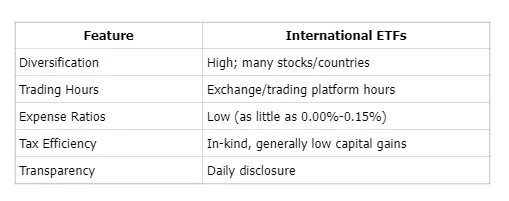
“An international ETF is a publicly traded fund that holds stocks from multiple countries, allowing investors to access global markets through a single investment.” This structure provides instant diversification across regions like Europe, the Pacific, and emerging markets, typically with daily price transparency and intraday trading on exchanges, making it a widely used tool for efficient global stock exposure (International ETF definition, Investopedia).
Broad-market international ETFs are designed to hold many securities across developed and emerging economies, reducing single-company risk while tracking regional or global benchmarks. Ongoing expenses tend to be low, and the ETF vehicle’s creation/redemption process further supports efficiency and liquidity.
For ToVest users, ETF-like, tokenized baskets can add flexibility beyond traditional exchange hours—enabling small, fractional trades and round-the-clock access aligned with your schedule.
Suggested Table:
Understanding Direct Stock Purchases
A direct stock purchase plan (DSPP) lets investors buy shares directly from a company—often without a broker—and may offer fractional purchases and automated contributions (DSPP definition, Investopedia). Some investors choose DSPPs for potential fee savings, disciplined accumulation, and dividend reinvestment.
However, DSPPs concentrate your exposure in a single company, raising idiosyncratic risk compared with diversified funds. They’re typically administered by transfer agents and can carry setup, purchase, dividend, or selling fees; they also lack the intraday liquidity and order flexibility of listed stocks or ETFs (DSPP overview and fees, Corporate Finance Institute). In 2025, DSPPs remain niche—appropriate for long-term conviction positions, but generally riskier for safety-focused global investors.
Key points:
- Direct, broker-free access
- Potential for fractional shares and DRIPs
- Higher concentration risk
- Limited diversification and trading flexibility
Risk Comparison: Diversification and Volatility
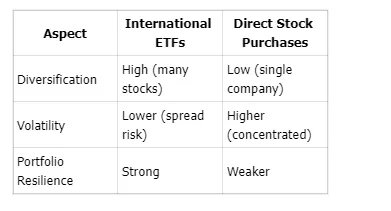
International ETFs spread risk across many companies, sectors, and regions, while DSPPs concentrate all exposure in a single stock. For most retail investors, diversified funds are considered inherently safer because they reduce the impact of company-specific shocks (NerdWallet on foreign stock investing basics).
Volatility snapshot:
Cost, Fees, and Tax Efficiency
Cost often tilts the balance toward ETFs and away from single-stock plans—especially after taxes.
- International ETFs:
- Expense ratios: often very low (as little as 0.00%–0.15%) based on global fund ranges.
- Tax efficiency: the in-kind creation/redemption mechanism helps minimize capital gains distributions; Morningstar projects only about 6% of U.S. ETFs will make significant capital gains distributions in 2025.
- Trading costs: normal brokerage commissions/spreads.
- Direct Stock Purchases (DSPPs):
- Commissions: may reduce or eliminate broker commissions; possible purchase discounts.
- Fees: potential setup, transaction, dividend reinvestment, and selling fees.
- Taxes: sales and dividends are taxed at the investor level; without the ETF’s in-kind buffer, realized gains come directly from your own selling activity.
Bottom line: ETFs generally offer lower all-in costs for diversified global stock exposure and greater tax efficiency for many investors.
Liquidity and Trading Flexibility
International ETFs trade throughout the day on major exchanges with continuous price discovery and commonly narrow bid-ask spreads, making them easier to enter and exit—an advantage during volatile markets (ETF mechanics, Investopedia). DSPPs, by contrast, route through transfer agents and often process transactions in batches, limiting intraday liquidity and reducing flexibility to rebalance or react quickly (CFI DSPP overview above).
For investors who value fast rebalances, stop/limit orders, or tactical tilts, ETF liquidity is a key safety feature. Tokenized access via ToVest can further enhance flexibility with 24/7 trading and fractional orders beyond traditional market hours.
Performance Trends and Market Opportunities
International leadership can shift quickly. In early 2025, analysts highlighted improving relative performance abroad amid a softer U.S. dollar and sector rotation, a backdrop supportive of non‑U.S. markets (Schwab’s international outlook). Recent examples also underscore both opportunity and volatility: the Global X MSCI Greece ETF (GREK) and iShares MSCI South Korea ETF (EWY) posted 1‑year returns of 74.27% and 68.97%, respectively—big moves that broad ETFs can capture while still diversifying single‑company risk (NerdWallet’s international ETF snapshot).
While DSPPs can participate in such country or sector surges if you pick the right company, they also magnify downside if that single business stumbles.
How to Start Global Stock Investing from Your Country
- Choose your access method: broad international ETF, individual foreign stock/DSPP, or tokenized international stocks.
- Open an account with a platform that supports global stock investing—either a cross‑border brokerage or a digital platform like ToVest for tokenized, fractional access.
- Fund your account: consider local currency, FX conversion costs, or crypto-based funding (available on ToVest).
- Select assets: align exposure with your goals—broad ETFs for core diversification; targeted funds or single stocks for focused bets.
- Monitor and rebalance: review currency exposure, regional weights, fees, and tax considerations; rebalance periodically.
Quick tips:
- Compare regulatory protections, account minimums, FX spreads, and product menus across providers.
- Start with a diversified ETF core; add targeted exposures only if you accept higher risk.
- Use fractional positions to build gradually and maintain allocation discipline.
Choosing the Right Approach for Your Investment Goals
For most safety-first investors, international ETFs provide a cost-effective, diversified foundation with strong liquidity and tax efficiency (NerdWallet overview). DSPPs suit investors with high conviction in specific companies and a tolerance for greater concentration and administrative complexity.
Consider:
- Time horizon: longer horizons can tolerate more volatility; shorter horizons favor diversified, liquid ETFs.
- Liquidity needs: if you may need to rebalance or raise cash quickly, ETFs (or tokenized equivalents) are more flexible.
- Portfolio size/diversification targets: smaller portfolios benefit from broad ETFs; larger, active portfolios might layer in DSPPs.
- Engagement level: passive investors often prefer ETFs; active stock pickers may accept DSPP risks.
ToVest offers a hybrid path—global reach, fractional ownership, 24/7 liquidity, and transparent, tokenized access—that can complement traditional ETFs and reduce the frictions of cross-border investing.
Frequently Asked Questions
Are international ETFs safer than buying individual foreign stocks?
International ETFs are generally safer for most investors because they diversify across many global stocks, reducing single-company risk.
How do taxes affect international ETFs compared to direct stock purchases?
ETFs are typically more tax-efficient thanks to in-kind processes that limit capital gains distributions, while direct stock sales can trigger more taxable events.
What are the liquidity differences between ETFs and direct stock ownership?
ETFs trade throughout the day with market pricing, whereas DSPPs often process in batches via transfer agents, making them slower and less flexible.
Can I invest in international stocks through tokenized platforms like ToVest?
Yes. ToVest enables fractional, tokenized access to global stocks and ETFs with 24/7 trading and crypto-based funding.
What factors should I consider before investing internationally?
Assess diversification, fees, liquidity, taxes, your risk tolerance, and whether you want broad market exposure or single-company bets.