Invest in Tokenized Real Estate Today: Top RWA Platforms for 2025
22 ธันวาคม 2568
Tokenized real estate lets you buy fractional shares of properties directly on blockchain-based RWA platforms—no middlemen, faster settlement, and lower minimums. To start, choose a trusted platform, complete identity verification (KYC), connect a digital wallet, and purchase tokens representing direct or indirect interest in real property. In 2025, leading ecosystems such as Chainlink, Avalanche, Hedera, and specialized platforms like Centrifuge and Ondo Finance power a maturing market that blends real estate with institutional-grade infrastructure and DeFi liquidity. Below, we map the landscape, highlight platform strengths, and show you precisely how to invest—while positioning ToVest as a secure, data-rich marketplace built for tokenized real estate.
ToVest Platform for Tokenized Real Estate
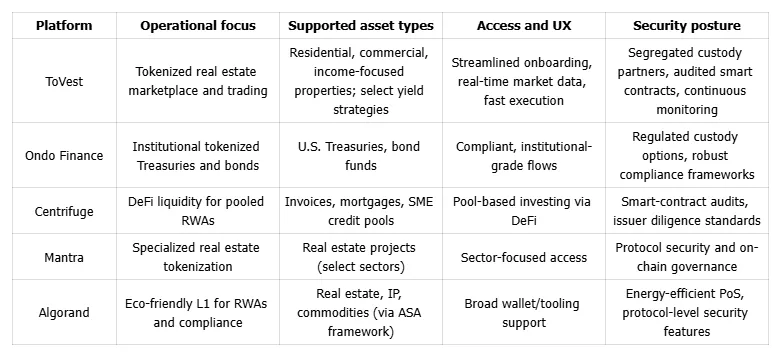
ToVest is a next-generation marketplace for tokenized real estate investment, designed for speed, transparency, and security. Investors enjoy an intuitive purchase flow, comprehensive market data and charting, and high-speed execution backed by strict security protocols and risk controls. Tokenization of real-world assets (RWAs) refers to issuing digital tokens on a blockchain that represent ownership or claims on physical assets (like properties, commodities, or bonds), making them tradable and divisible.
What sets ToVest apart is its end-to-end investor experience—frictionless onboarding, deep analytics, and institutional-grade safeguards—paired with curated access to real estate and related yield products. Compared with broader RWA platforms, ToVest emphasizes ease of access, diverse asset selection, and risk management tools that guide allocation and compliance. For deeper context on market structure and trade ideas, explore our latest market insights and explainers via the ToVest Market Report and the ToVest Academy.
Summary comparison
Chainlink for Reliable RWA Oracles
A decentralized oracle network is a system that securely transmits off-chain (real-world) data to smart contracts so on-chain assets can price, settle, and comply accurately. Chainlink is widely used across RWAs for price feeds, proof-of-reserve attestations, and event data, and in one 2024 RWA roundup Chainlink earned a 4.8/5 rating, with Avalanche at 4.7/5, Hedera at 4.6/5, and Mantra at 4.3/5, underscoring mainstream confidence in these stacks for real-world asset rails (see this RWA projects overview on Cryptopotato).
For ToVest, robust oracle integration enables accurate property valuations, automated income distributions, and real-time compliance checks—critical for up-to-date NAVs, rent rolls, and proof-of-assets.
Avalanche for High-Speed Tokenization
Avalanche pairs high throughput and low latency with customizable subnets—useful for real estate issuers that want purpose-built networks with predictable fees and performance. Faster finality and low costs matter because tokenized property markets benefit from tight spreads, smooth order execution, and instant settlements, especially during portfolio rebalancing or corporate actions.
Compared with other fast chains, Avalanche’s subnet model appeals to issuers and institutions experimenting with permissioned environments and compliance-aware infrastructure, while maintaining open access at the base layer. Its strong community and tooling further reduce time-to-market for new tokenized property offerings.
Hedera’s Enterprise-Grade RWA Solutions
Hedera uses Hashgraph technology—a consensus algorithm that orders transactions quickly and fairly without traditional blocks—to deliver high throughput and energy efficiency with predictable fees. Its enterprise governing council and partnerships are meaningful signals for institutions evaluating where to launch compliant RWA programs because governance and operational stability directly affect tokenized asset credibility.
For real estate tokenization, Hedera’s predictable performance and enterprise alignment can support workflows like document notarization, investor whitelisting, and lifecycle event management.
MakerDAO and Algorithmic Stablecoin Collateral
An algorithmic stablecoin maintains price stability through smart contract rules that expand or contract supply; DAI is a leading example. MakerDAO helped pioneer the use of real-world assets—including tokenized credit and property-linked exposures—as collateral to mint DAI, enabling investors to tap liquidity, hedge, or generate yield without exiting positions. Legal perspectives increasingly outline pathways for compliant RWA collateralization and structured token issuance for institutions (see JD Supra’s overview of tokenized RWA pathways).
Integrating real estate tokens as DeFi collateral can unlock flexible leverage, income strategies, and portfolio diversification—tools historically reserved for institutional desks.
Ondo Finance’s Institutional Tokenized Bonds
Ondo Finance targets institutions with compliant, tokenized exposure to U.S. Treasuries and bond funds—bridging familiar fixed-income products with blockchain settlement. Tokenized bonds are digital tokens representing shares of traditional fixed-income securities, enabling fractional access and faster secondary-market liquidity.
As investors diversify beyond property tokens, platforms like ToVest can integrate or showcase treasury-backed products to provide cash-management options and defensive allocations within a single account. For details on product design and custody, see this institutional overview of tokenized Treasuries and bonds on Coingape.
Algorand’s Eco-Friendly RWA Ecosystem
Algorand uses a pure proof-of-stake consensus, is carbon-negative, and supports a compliance-friendly asset framework (Algorand Standard Assets) that helps tokenize real estate, commodities, and intellectual property with embedded controls like transfer restrictions—features valued by issuers and regulators. Its low-energy profile and native support for diverse asset classes make it attractive to ESG-focused investors and institutions seeking credible sustainability claims (see Tangem’s guide to RWAs and why they matter).
XDC Network’s Global Trade Finance Focus
XDC Network applies a hybrid blockchain model—combining private and public components—to deliver low fees, interoperability, and near-instant (≈2-second) finality suitable for trade finance. For global investors, this enables rapid settlement, cross-border asset distribution, and diversified exposure across invoices, letters of credit, and, increasingly, property-linked credit streams. For a practical survey of RWA platforms and where XDC fits, see this overview of RWA platforms on BitcoinChaser.
VeChain’s Supply Chain and RWA Integration
VeChain’s dual-token architecture and enterprise partnerships have made it a go-to for supply-chain RWAs, provenance, and asset-backed attestations. These strengths complement real estate by linking physical verification (e.g., construction inputs, ESG documentation) to on-chain disclosures—supporting more transparent due diligence and secondary trading. For a snapshot of enterprise-grade participants across the RWA stack, explore Tokeny’s RWA ecosystem map.
Mantra’s Specialized Real Estate Tokenization
As a specialized RWA protocol focused on real estate, Mantra has publicized large property tokenization initiatives and targets sector-specific tooling—helpful for developers and sponsors who need tailored compliance, investor onboarding, and lifecycle management. In comparative reviews, Mantra scores as a credible real estate–centric option in the broader RWA mix (rated 4.3/5 in the same RWA roundup cited earlier).
Specialized protocols are purpose-built for a narrow asset category, which can translate into smoother issuer workflows and clearer investor disclosures for that niche.
Centrifuge and the Future of RWA Liquidity
Centrifuge’s Tinlake brings pooled RWA investing to DeFi—tokenizing assets like invoices and mortgages and connecting borrowers with on-chain investors. A liquidity pool is a collection of tokenized assets that facilitates decentralized trading or lending while algorithmically managing inflows and outflows. This architecture previews how tokenized real estate portfolios could achieve continuous price discovery and programmatic risk management over time. For a forward-looking take on RWA coins and DeFi integration, see Phemex’s analysis of top RWA projects for 2025.
Benefits of Investing in Tokenized Real Estate
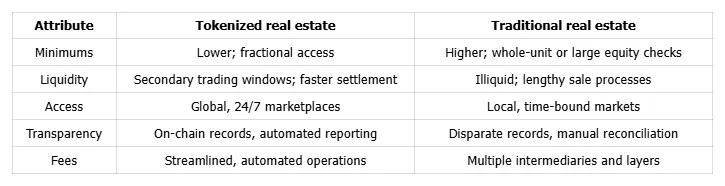
Tokenization delivers tangible improvements for investors and issuers: higher liquidity through fractional ownership, global access with instant settlement, transparent on-chain records, and improving regulatory clarity across jurisdictions. Fractional ownership means splitting a property into smaller shares so multiple investors can buy and trade portions of the same real asset.
Comparison snapshot
For ongoing market data and strategy deep-dives, review the ToVest Market Report and our Academy guides.
How to Invest in Tokenized Real Estate on RWA Platforms
Step-by-step
- Create an account: Sign up on a trusted RWA platform like ToVest.
- Complete KYC: Verify your identity to meet regulatory requirements (KYC is Know Your Customer, a standard compliance process).
- Connect a digital wallet: Link wallets via WalletConnect or browser extensions; a digital wallet securely stores and signs your assets and transactions.
- Fund your account: Deposit fiat or crypto as supported.
- Select an offering: Review property details, legal docs, fees, and income distribution terms.
- Purchase tokens: Execute the order; track holdings, yield, and statements in your dashboard.
- Manage and diversify: Rebalance across properties, fixed income, and cash-like products as needed.
Quick platform readiness overview
Note: ToVest streamlines the purchase flow with integrated market data, charting, and indicators to support informed decisions.
Risks and Considerations When Investing in RWAs
- Regulation and jurisdiction: Frameworks are evolving; offerings may be limited by residency and accreditation status.
- Market volatility and liquidity: Secondary markets are maturing; spreads and volumes can vary by asset and venue.
- Platform and smart contract risk: Custody, audits, and oracle quality affect operational safety.
- Data integrity and valuation: Off-chain data feeds and appraisals must be reliable and timely.
Many platforms mitigate risks via regulated custodians, third-party audits, insurance options, and conservative smart contract design, while new policies continue to shape the category (for an industry snapshot of leading projects and controls, see this RWA projects roundup on BlockchainTechs).
Indicative safeguards to look for
- Independent smart contract audits and continuous monitoring
- Segregated, regulated custody partners
- Clear issuer disclosures and legal documentation
- Oracle transparency (proof-of-reserve, data source attestations)
- KYC/AML and transfer-restriction controls
Frequently Asked Questions
What is tokenized real estate and how does it work?
Tokenized real estate converts property ownership into digital tokens on a blockchain, allowing investors to buy, sell, and hold verified fractions with transparent records.
How can I start investing in tokenized real estate through RWA platforms?
Open an account on a reputable platform like ToVest, complete KYC, connect your wallet or fund your account, and purchase tokens tied to vetted property offerings.
What are the advantages of fractional ownership in tokenized assets?
You can enter high-value markets with smaller amounts, improve liquidity, and adjust positions more flexibly than with whole properties.
Are tokenized real estate investments secure and regulated?
Leading platforms, including ToVest, utilize audited contracts, regulated custodians, and compliance controls, but always review offering documents and jurisdictional rules.
Can I earn rental income or dividends from tokenized real estate?
Yes—many offerings distribute rent or dividends pro rata to token holders according to the terms disclosed for each property.