7 Essential Factors to Pick a Tokenized Stock Platform in 2026
5 มกราคม 2569
Choosing the best tokenized stock platform as a non-US investor comes down to one thing: balancing access with risk control. Tokenized stock platforms are digital marketplaces that let you buy, sell, and hold blockchain-based tokens representing shares of real companies, with built-in compliance and near-real-time settlement. As tokenized assets scale globally—analysts project trillions of dollars in tokenized value by 2028—the range of platform models is widening from retail-first apps to regulated, institution-grade venues. This guide distills seven essential factors that matter most in 2026 so you can avoid hidden pitfalls, compare options objectively, and secure liquid, compliant exposure to U.S. equities and other real-world assets.

Strategic Overview
A tokenized stock platform combines regulated market access with blockchain technology to issue, trade, and settle tokens that mirror the economics of underlying securities. Some platforms prioritize retail simplicity and broad asset menus; others focus on institutional mandates with granular controls and auditability. The growth curve is steep: a leading RWA market outlook expects tokenized value to reach the trillions by 2028, underscoring why selection rigor now determines long-term outcomes for both retail and institutional investors.
Clear definitions and discipline matter. As CNBC notes, tokenized stocks unlock new opportunities but carry unique risks—especially around regulatory posture, liquidity, and custody—so your platform’s safeguards must be as strong as its product catalog. Below are the seven decision factors that separate today’s best tokenized stock trading platforms from the rest.
ToVest: A Leading Blockchain-Powered Tokenized Stock Platform
ToVest is designed for non-US investors seeking secure, transparent exposure to U.S. stocks and other real-world assets through tokenization. The platform pairs 24/7 trading and fractional ownership with real-time analytics and institutional-grade security, providing individuals and institutions with a high-performance infrastructure. Integrated KYC/AML workflows, multi-asset coverage (including equities and real estate), and ultra-low-latency execution are at the core of our design. Importantly, ToVest’s compliance-first architecture is crafted to maintain rigorous controls while removing traditional cross-border frictions for global investors. For an overview of the platform’s approach and capabilities, see ToVest’s platform overview.
Regulatory and Compliance Stack
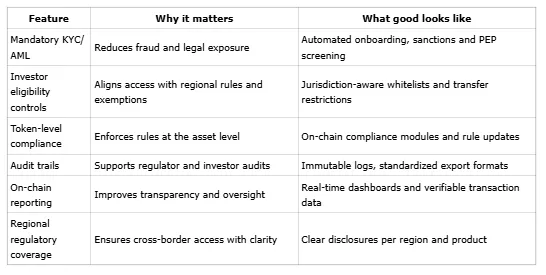
The regulatory and compliance stack comprises the system of policies, automated checks, and protocols—such as KYC/AML, investor eligibility controls, and token-level transfer restrictions—that ensure users and transactions meet legal standards. Non-US investors should prioritize platforms that require identity verification at onboarding, enforce trading rules in real-time, and support cross-border eligibility frameworks. This reduces legal risk, supports institutional participation, and sustains market integrity.
- Why it matters: Educational resources emphasize that the structure of tokenized stocks varies, and understanding compliance and custodial models is critical to managing risk and rights.
- What to look for: Compliance-first architectures used by specialists integrate identity, rule enforcement, and audit trails from issuance to secondary trading, aligning investor protections with regulatory mandates.
Top compliance features to compare
Liquidity and Secondary Market Access
Secondary market access is the ability to trade tokens peer-to-peer or via exchanges after initial issuance, enabling ongoing liquidity and exit options. Thin liquidity leads to wide spreads and higher exit friction, so prioritize platforms with integrated secondary markets, active trading venues, or partnerships with DEXs/AMMs that sustain order flow.
Common liquidity solutions:
- Regulated internal exchanges with continuous matching
- Connections to external brokerages or DEXs/AMMs
- Market-maker or exchange partnerships that fuel volume
Nasdaq’s coverage of tokenized shares highlights how major trading platforms are building listings and liquidity pathways, while media and research continue to flag liquidity as a central investor concern. With regulated secondary marketplace support, ToVest is designed to reduce exit friction for global investors by keeping more trades on-venue and executable at transparent prices.
Cost and Fee Transparency
Cost and fee transparency involves complete, itemized disclosure of every charge you’ll incur—setup, servicing, custody, per-transaction, corporate actions, and exit fees. Hidden or bundled fees can quietly erode returns. In 2026 benchmarking, clear fee structures account for roughly a quarter of platform due diligence scoring, making transparency a prime selection criterion.
What to compare side by side
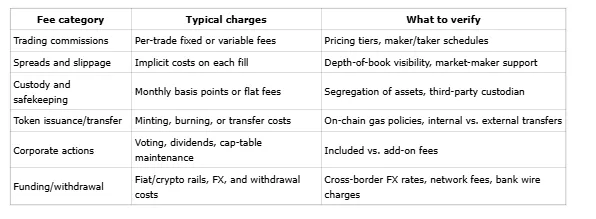
Also, check whether demo accounts or cost simulators are available so you can model total cost of ownership across realistic trading patterns.
Scalability and Performance
Scalability refers to the ability to handle growing users, transactions, and asset variety without degrading speed or reliability. Performance means predictable execution and fast settlement—critical for institutions, active traders, and any investor relying on timely exits. Market benchmarks in 2026 expect platforms to support $50M+ in assets, ship upgrades without downtime, and settle transactions in under a minute on modern networks. Scalability and performance typically comprise about 20% of platform evaluation weights in 2026, reflecting their impact on risk and user experience.
Quick scalability checklist:
- Can the platform process high order flows without degraded spreads?
- Are settlement times reliably short and observable on-chain?
- Is downtime minimal during upgrades or peak demand?
- Does the system support horizontal scaling across assets and venues?
- Are incident response and status transparency documented?
Asset Coverage and Fractional Ownership
Asset coverage is the range of tokenized securities available on one platform—U.S. and global equities, real estate, private funds, and fixed income. Fractional ownership allows you to buy smaller slices of high-priced stocks or assets, lowering minimums and improving diversification across a broader market set. Educational primers note that fractionalization and 24/7 market access are key benefits of tokenized stocks—provided you understand how tokens map to the underlying asset and custody model.
Common supported assets:
- U.S. and global equities
- Tokenized real estate and REIT-like structures
- Fixed income and private credit
- Alternatives such as private funds and commodities
Confirm the asset classes you need are supported and that fractional sizes are flexible enough for your strategy.
Security, Custody, and Auditability
Security encompasses the end-to-end measures that protect keys, user data, and transaction integrity. Custody refers to how tokenized assets are held—often with regulated third parties—and whether those holdings are segregated. Auditability is your ability (and a regulator’s ability) to verify holdings, flows, and controls.
Minimums to expect:
- Multi-layer authentication and hardware key support
- Segregated accounts and institutional-grade custody
- Regular smart contract and infrastructure audits
- Incident response playbooks and continuous monitoring
A practical approach blends on-chain transparency with independent third-party audits. Market roundups of tokenized stock platforms increasingly assess security stack, custody provider quality, and audit history as part of core diligence. Media coverage also cautions investors to verify how platforms manage counterparty risk and asset backing structures.
Ecosystem Integrations and User Experience
Ecosystem integration is how well a platform connects to wallets, exchanges, custodians, and issuer tools like cap-table management and corporate actions. In 2026 scoring models, ecosystem reach and integrations contribute roughly 15% to overall platform ratings, reflecting their impact on liquidity, compliance, and operations.
What to evaluate:
- Supported wallets: browser wallets, hardware devices, or a secure native app
- Issuer tools: reporting, tax documents, corporate actions, and governance
- Onboarding quality: clear ID verification, eligibility checks, and user flows
- Venue reach: single-venue liquidity vs. multi-channel access across partners
Platforms that minimize onboarding friction while maximizing venue reach help non-US investors move confidently from account creation to compliant, executable trades.
Frequently Asked Questions
What regulatory compliance should non-US investors prioritize?
Choose platforms that enforce robust KYC/AML, apply jurisdiction-aware investor eligibility and transfer restrictions, and provide clear disclosures on how tokenized assets comply with local and U.S. securities and market rules.
How secure is custody and key management on tokenized stock platforms?
Leading platforms like ToVest utilize institutional-grade custodians with asset segregation, strict operational controls, and periodic independent audits, minimizing counterparty and key management risks.
What role does fractional ownership play in tokenized stocks?
Fractional ownership allows you to buy small slices of high-priced stocks, reducing minimums and enabling more diversified portfolios without sacrificing liquidity.
How does settlement speed compare to traditional stock trading?
On-chain settlement is typically near-instant to under a minute, compared to T+1 in most traditional U.S. equity markets, helping reduce counterparty risk and improve capital efficiency.
How can I evaluate platform scalability and institutional adoption?
Look for consistent high-volume throughput, reliable sub-minute settlement, minimal downtime, and visible institutional partnerships or mandates that signal durability and compliance maturity.