The Complete 2025 Guide to Stablecoin Yield Farming for Investors
16 ธันวาคม 2568
Introduction to Stablecoin Yield Farming
Stablecoin yield farming involves using stable digital currencies like USDC or USDT in decentralized finance (DeFi) protocols to earn interest or rewards, typically with lower price risk than other cryptocurrencies. By supplying liquidity or lending stablecoins, you can earn from trading fees, protocol incentives, and interest. The appeal is clear in 2025: passive income with reduced volatility, strong capital efficiency, and broad accessibility. Industry trackers report that the market has grown from under $1 billion to over $24 billion since early 2024, driven by real economic activity and tokenized yield opportunities, especially in treasuries and private credit. This guide illustrates how to start, where to earn, and which strategies and platforms offer the best balance of yield and security, with ToVest’s focus on data-driven, real-world asset integrations and disciplined risk management.
Preparing to Invest with Stablecoins
A clear plan minimizes risk and enhances your chances of consistent returns:
- Define goals and risk tolerance: income target, time horizon, acceptable drawdowns, and liquidity needs.
- Understand mechanics: how lending pools, liquidity pools, and reward tokens work; how APY/APR, fees, and token incentives influence net yield.
- Pick starter assets: begin with widely adopted stablecoins like USDC, USDT, or DAI before moving to newer or yield-bearing options with additional complexities.
- Choose platforms: shortlist audited, well-established protocols with deep liquidity, favoring those with strong security track records and transparent disclosures.
- Maintain operational hygiene: use a reputable wallet, enable 2FA, keep seed phrases offline, and maintain meticulous records for tax and compliance.
Onboarding flow:
- Research strategies and platforms
- Select a protocol and stablecoin
- Fund your wallet (bridge if needed)
- Connect to the protocol and deposit
- Monitor APY, fees, and rewards; adjust as needed
For tax documentation and transaction tracking, specialized tools and guidance can help you stay compliant year-round.
Choosing the Best Stablecoins for Yield Farming
A stablecoin is a cryptocurrency designed to maintain a fixed value, often pegged to the US dollar, enabling stable trading and yield opportunities. The most widely used options are USDC (Circle-issued, with regular attestations), USDT (the market’s liquidity leader), and DAI (overcollateralized by crypto and increasingly real-world assets). Adoption, transparency, collateral, and regulatory posture all influence suitability.
- USDC: strong compliance posture and transparency; widespread integration across DeFi and exchanges.
- USDT: the deepest liquidity and broadest exchange support; prevalent in cross-border crypto markets.
- DAI: decentralized governance with diversified collateral; competitive yields via DeFi-native mechanisms.
Recent yield snapshots vary by venue and structure. For example, USDC lending and savings yields cluster in the low-to-mid single digits in many venues, while yield-bearing stablecoins like USDS distribute approximately 5% automatically at the token level, and opportunistic USDT strategies can vary widely depending on incentives. The six largest stablecoins account for the vast majority of market value, underscoring the importance of liquidity and platform reach for execution and exits.
Stablecoin comparison (illustrative ranges, always verify live rates):
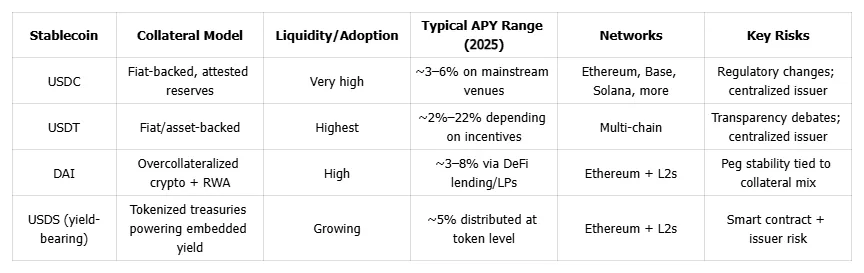
Sources: market adoption and concentration analysis from The Motley Fool on dominant stablecoins; APY ranges from platform roundups and yield-bearing stablecoin primers.
Top Platforms for Stablecoin Yield Farming in 2025
A handful of DeFi leaders anchor stablecoin yield generation:
- Uniswap: a decentralized exchange (DEX) where you can provide liquidity to earn trading fees; concentrated liquidity enhances capital efficiency on stablecoin pairs.
- Curve Finance: specialized for stable swaps, commonly delivering 5–15% on specific pools with low price volatility due to tight-peg assets.
- Aave: a blue-chip lending market with variable APYs, robust risk controls, and deep stablecoin liquidity.
- Yearn Finance: a yield aggregator that automates strategy selection and compounding to maximize net returns.
- PancakeSwap: a leading BNB Chain DEX with incentives; select pools can show elevated returns depending on emissions and market conditions.
Emerging real-world asset (RWA) platforms tokenize treasury bills, private credit, and invoices, offering 4%–18% APYs depending on duration, seniority, and credit risk. A DEX is a non-custodial exchange utilizing smart contracts to match trades, while a yield aggregator automates allocation and compounding across multiple strategies.
Quick comparison (illustrative):
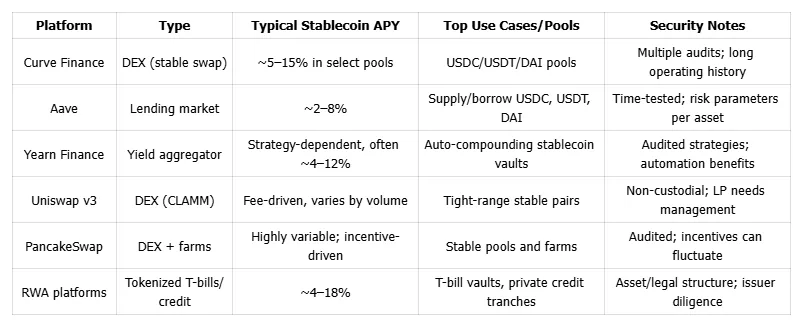
Always confirm audits, insurance options, and historical performance. Daily return roundups and tooling can help you identify live opportunities and risk flags.
Strategies to Maximize Stablecoin Yield
Start simply and diversify. Once comfortable, add layers of complexity:
- Core allocation: spread deposits across two to three lower-volatility pools (e.g., Curve stable pools and Aave lending).
- Laddering and tranches: split capital across short-, mid-, and longer-duration vaults or between senior/mezz tranches in RWA pools to balance yield and liquidity.
- Protocol rotation: rebalance when incentives shift; move into higher net APY after fees and gas, not just headline rates.
- Auto-compounding: use Yearn-style vaults or Pendle-like structures that automatically harvest and reinvest to boost effective APY.
- Cross-chain selectively: pursue additional yield on L2s or alternative L1s where fees are lower, but weigh bridge and operational risks.
Illustrative strategy map:
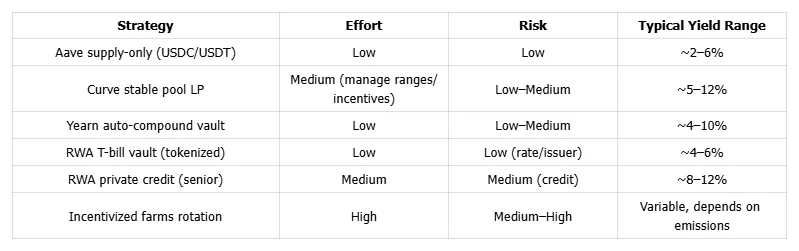
Automation and advanced contract designs are central to “Yield Farming 2.0,” which emphasizes auto-compounding, protocol-owned liquidity, and risk-tuned architectures.
Managing Risks in Stablecoin Yield Farming
Understand the key risks and how to mitigate them:
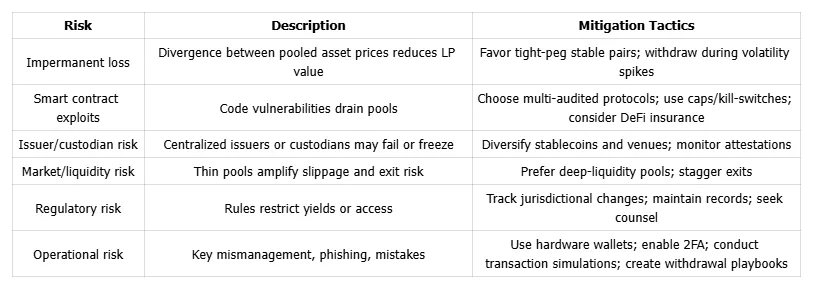
- Impermanent loss: temporary loss compared to holding arises when pooled assets diverge in price; it’s limited in tight-peg stable pools but not eliminated.
- Smart contract risk: bugs or exploits in protocol code can lead to losses; utilize audited, battle-tested protocols and consider insurance.
- Platform/security risk: custody, oracle, or governance failures can impair assets or yields; diversify across issuers and protocols.
Risk checklist:
The Role of Real-World Asset Tokenization in Yield Farming
Real-world asset (RWA) tokenization allows for creating digital tokens that represent off-chain assets like treasury bills, private credit, or real estate. These platforms route on-chain capital into off-chain yield, offering roughly 4%–18% APY depending on asset class, duration, and tranche seniority. Analysts estimate the tokenized RWA market surpassed $40 billion in 2025, reflecting the convergence of programmable finance and stablecoin rails for settlement and yield distribution. Common use cases include depositing stablecoins into tokenized government bond vaults, lending into RWA credit pools, or purchasing tokenized notes that remit on-chain coupons. Platforms comprise exchange-style venues, DeFi protocols, and fintechs focused on institutional on-ramps—an area where ToVest’s expertise in low-latency execution and asset diligence is directly applicable.
Monitoring and Reinvesting Your Stablecoin Yields
Consistent monitoring is vital for improving net results:
- Track yields and risk: dashboards like DefiLlama and Dune Analytics provide live APYs, fees, and volumes; RWA.xyz tracks tokenized asset yields and issuers.
- Measure net performance: concentrate on APY after fees, gas, and any lockups; compare against your hurdle rate (e.g., T-bills).
- Automate compounding: aggregator vaults can reinvest rewards; alternatively, set a schedule to harvest and redeploy to the highest risk-adjusted yields.
Practical loop:
- Screen opportunities (APY, liquidity, audits)
- Allocate using position sizing rules
- Monitor utilization, incentive changes, and peg health
- Harvest/compound on a schedule or via auto-vaults
- Rebalance across protocols or into safer tranches when conditions change
Regulatory Landscape Impacting Stablecoin Yield Farming
Regulation shapes both access and returns. In the EU, MiCA establishes a framework for stablecoins (e-money tokens and asset-referenced tokens) and, in practice, limits remuneration models for some issuers, affecting how and where yields can be offered to depositors. In the U.S., various proposals aim to clarify stablecoin issuance, reserve requirements, and distribution models; combined with state-level regulations and bank oversight, this creates jurisdictional differences in yield availability and disclosures. Practical compliance steps include verifying a platform’s licensing status, maintaining complete transaction records, and seeking legal guidance for cross-border participation. Monitoring evolving rules helps protect capital and preserve access to the best opportunities.
Emerging Trends and Innovations in Stablecoin Yield Farming
- Yield Farming 2.0: automation-first designs, protocol-owned liquidity, and smart risk controls reduce manual overhead while enhancing capital efficiency.
- Yield-bearing stablecoins: tokens like USDS embed treasury yields directly into the asset, with approximately 5% distributed automatically and growing mainstream adoption, with some banks predicting significant market share within the next year.
- RWA-centric allocation: tokenized treasuries and private credit are emerging as core building blocks for stable, scalable returns.
- Delta-neutral and cross-chain vaults: strategies hedge market risk while directing funds to lower-fee networks to enhance net APY.
Conclusion: Navigating Stablecoin Yield Farming with Confidence
Stablecoin yield farming can yield attractive, lower-volatility income if approached with discipline: diversify across high-quality protocols, verify audits and issuers, monitor net yields, and size positions prudently. Blend DeFi-native pools with tokenized T-bills or senior credit tranches to align returns with your risk tolerance and liquidity needs. Keep learning, track regulations, and utilize professional research and tools—including ToVest’s market insights and academy resources—to stay informed as the opportunity set evolves.
Frequently Asked Questions
What is stablecoin yield farming and how does it generate returns?
Stablecoin yield farming involves depositing stablecoins into DeFi platforms or liquidity pools to earn rewards from trading fees, incentives, or interest, typically with low price risk due to stablecoin pegs.
Which platforms offer the best stablecoin yields with optimal security?
ToVest’s recommended platforms like Curve Finance, Yearn Finance, and Aave provide competitive yields, deep liquidity, audits, and proven track records that many investors trust.
What are the typical risks I should consider before yield farming?
Smart contract vulnerabilities, platform or issuer failures, and regulatory shifts are key risks; stablecoin pools reduce impermanent loss, but due diligence and diversification remain crucial.
How much capital is needed to start stablecoin yield farming effectively?
You can start with $50–$500 on many protocols, scaling as you learn and as fees and liquidity justify larger positions.
How can investors track and optimize their stablecoin yield farming performance?
Utilize tools like DefiLlama and Dune dashboards to monitor live yields and fees, then compound rewards or rotate into higher risk-adjusted APYs on a set schedule.
Resources for further learning:
- ToVest Research Reports
- ToVest Academy