The Complete ToVest Guide to Fractional US Stock Investing and Minimum Deposits
15 ธันวาคม 2568
Fractional US stock investing makes it possible to buy a small slice of companies you know—without needing the cash for a full share. If you’re asking how to find the best fractional US stock investing app and what the minimum investment is, here’s the short answer: many leading brokers let you start with $1–$5, and the “best” app balances low minimums, strong execution, broad stock coverage, clear fees, and robust security. This guide explains what fractional shares are, how they work, the benefits, the risks, and how to get started on ToVest—where you can trade US stocks and tokenized real‑world assets with ultra‑low latency and institutional‑grade security.
What Are Fractional Shares in US Stock Investing?
“Fractional shares let investors buy portions of a stock instead of full shares, making high-priced stocks accessible.” As a practical example, if a stock trades at $500 and you invest $50, you own 0.10 shares—10% of a single share—so your gains, losses, and dividends scale with that fraction. Many brokers enable dollar-based orders that translate to exact share fractions, helping small amounts of money work consistently across your portfolio, even in high-priced names like Tesla or Amazon. Guides from sources such as Bankrate and NerdWallet emphasize that this approach lowers the barrier to US stock investing for millions of retail investors by allowing fractional ownership of otherwise pricey shares.
Behind the scenes, brokers typically hold whole shares in custody and reflect proportional claims in your account ledger, rather than delivering a standalone, transferable certificate for the fraction itself, as explained in the SEC’s investor bulletin on fractional shares.
Benefits of Investing in Fractional US Stocks
Fractional shares help you invest on your own terms—by dollar amount, at your cadence, in the companies and ETFs you care about.
- Accessibility: Own high-value stocks with small sums, often starting at just a few dollars, according to broker roundups like Bankrate’s overview of fractional-share platforms.
- Diversification: Spread incremental purchases across multiple assets to reduce single-stock concentration risk over time.
- Flexibility: Set dollar-based orders to automate consistent investing, even when share prices move.
- Dividend participation: Receive dividends proportional to your fractional holdings; many brokers support automatic reinvestment, so compounding can keep working without manual intervention (see Fidelity’s fractional shares program for details).
- Economic equivalence: Fractional shares move in step with the underlying stock’s price and pay dividends pro rata, similar to whole shares, though operational details can vary by broker (the SEC bulletin outlines key distinctions).
How Fractional US Stock Investing Works
“Fractional shares represent a portion of a whole stock, allowing proportional ownership and trading based on dollar amounts.” Here’s the typical flow in a US stock trading app:
- Select a stock or ETF eligible for fractional trading.
- Enter a dollar amount (e.g., $25).
- The broker calculates the exact share fraction (e.g., $25 ÷ price) and displays the estimated fraction before execution.
- Your account reflects the fractional position; cash balances and portfolio values update in real-time.
Operationally, brokers pool orders behind the scenes and maintain custody of whole shares while crediting fractional interests to individual accounts, per the SEC’s guidance. Note that order handling can differ by platform: some execute fractional share orders in real-time, others batch them at set times, and certain order types (like fractional limit orders) may be restricted—an important nuance to check in your chosen US stock trading app.
How to Choose the Best App for Fractional US Stock Investing
The right fractional US stock investing app should make it easy, safe, and cost-effective to invest by the dollar. Focus on:
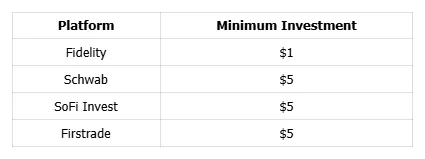
- Minimum investment: Many leading brokers start at $1 (e.g., Fidelity), while others begin at $5 (e.g., Schwab’s Stock Slices). See Bankrate’s roundup for a broad view.
- Coverage: Look for thousands of eligible US stocks and ETFs; platform guides like StockBrokers.com compare breadth and functionality across brokers.
- Costs and execution: Confirm commission structure, spreads, order types, and whether fractional trades are real-time or batched; the SEC notes these differences may affect outcomes.
- Tools and data: Quality research, screeners, charts, and alerts help you invest with confidence.
- Security: Prioritize strong account protections (e.g., 2FA, encryption) and clear disclosures on custody and protections.
Feature snapshot (selected platforms):
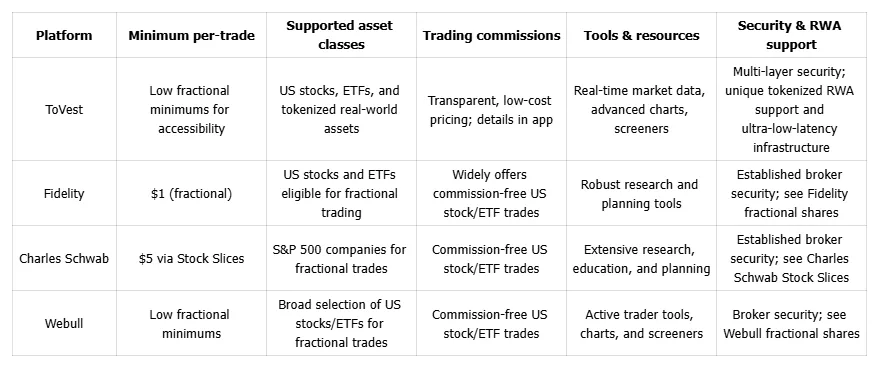
"A comparative table analyzing key features of major investment platforms (ToVest, Fidelity, Charles Schwab, Webull). It details minimum trade requirements, supported asset classes (including fractional stocks and RWA), commissions, and security features."
Sources: Fidelity fractional shares, Charles Schwab Stock Slices, Webull fractional shares, StockBrokers.com’s fractional-shares guide, and NerdWallet’s fractional-share broker guide.
What Is the Minimum Investment Needed for Fractional US Stocks?
Platforms like Fidelity and Robinhood enable fractional share investing with as little as $1, while others like Charles Schwab start at $5, according to Bankrate’s roundup of fractional-share brokers. Typical minimums you’ll see:
A detailed comparative table outlining major investment platforms (ToVest, Fidelity, Charles Schwab, Webull) based on Minimum per-trade requirements, Supported asset classes (including Tokenized RWA), Trading commissions, Tools, and Security & RWA support.
At ToVest, our platform is designed for accessibility with low-dollar entry points for eligible fractional US stocks, reflecting our mission to democratize investing while maintaining high performance and security. Always check in-app for the current minimum deposit for fractional shares and any per-order requirements.
Steps to Start Investing in Fractional US Stocks with ToVest
Getting started takes minutes:
- Create and verify your ToVest account.
- Fund your account via supported payment methods; low-to-zero funding minimums help you start small.
- Browse eligible US stocks and ETFs for fractional trading using ToVest’s screener and real-time market data.
- Enter your desired dollar amount; preview the share fraction and estimated cost.
- Confirm and execute your fractional share order.
- Track positions and performance in ToVest’s real-time portfolio dashboard and set alerts or auto-invest plans as needed.
Along the way, you’ll benefit from ultra‑low‑latency execution, deep market data, and ToVest’s multi-layer security controls. For deeper learning, explore ToVest Academy and our getting-started guides.
Considerations and Risks of Fractional US Stock Investing
Even small investments deserve a clear view of risks:
- Broker dependency: Fractions are credited in your account while the broker holds whole shares in custody; your ability to transfer or exercise full voting rights may be limited, as the SEC’s investor bulletin notes.
- Asset availability: Not every stock or ETF is eligible for fractional trading on every platform; coverage varies and may change.
- Order handling and execution: Some platforms batch fractional share orders or limit order types, which can affect execution quality and timing.
- Regulatory and operational differences: Protections and practices can vary by jurisdiction and broker; review disclosures and fee schedules carefully.
- Liquidity and events: Corporate actions (e.g., mergers, splits) and low-liquidity names can add operational complexity for fractions.
Understanding how fractional shares work, the minimum investment for US stocks, and the practical trade-offs across apps will help you start small, diversify smartly, and stay focused on long-term goals. For a streamlined experience plus access to tokenized real‑world assets, open a ToVest account and begin building your portfolio by the dollar.
References: Bankrate’s roundup of fractional-share brokers; Fidelity fractional shares; Charles Schwab Stock Slices; NerdWallet’s fractional-share broker guide; StockBrokers.com fractional-shares guide; Webull fractional shares; and the SEC investor bulletin on fractional shares.